Voyager 1 Reaches One Light-Day
NASA's Voyager 1 has become the first human-made object to travel one light-day from Earth, so far away that its radio signal now takes 24 hours to reach home. The spacecraft has stopped sending back science data, and engineers are still working on the fault.
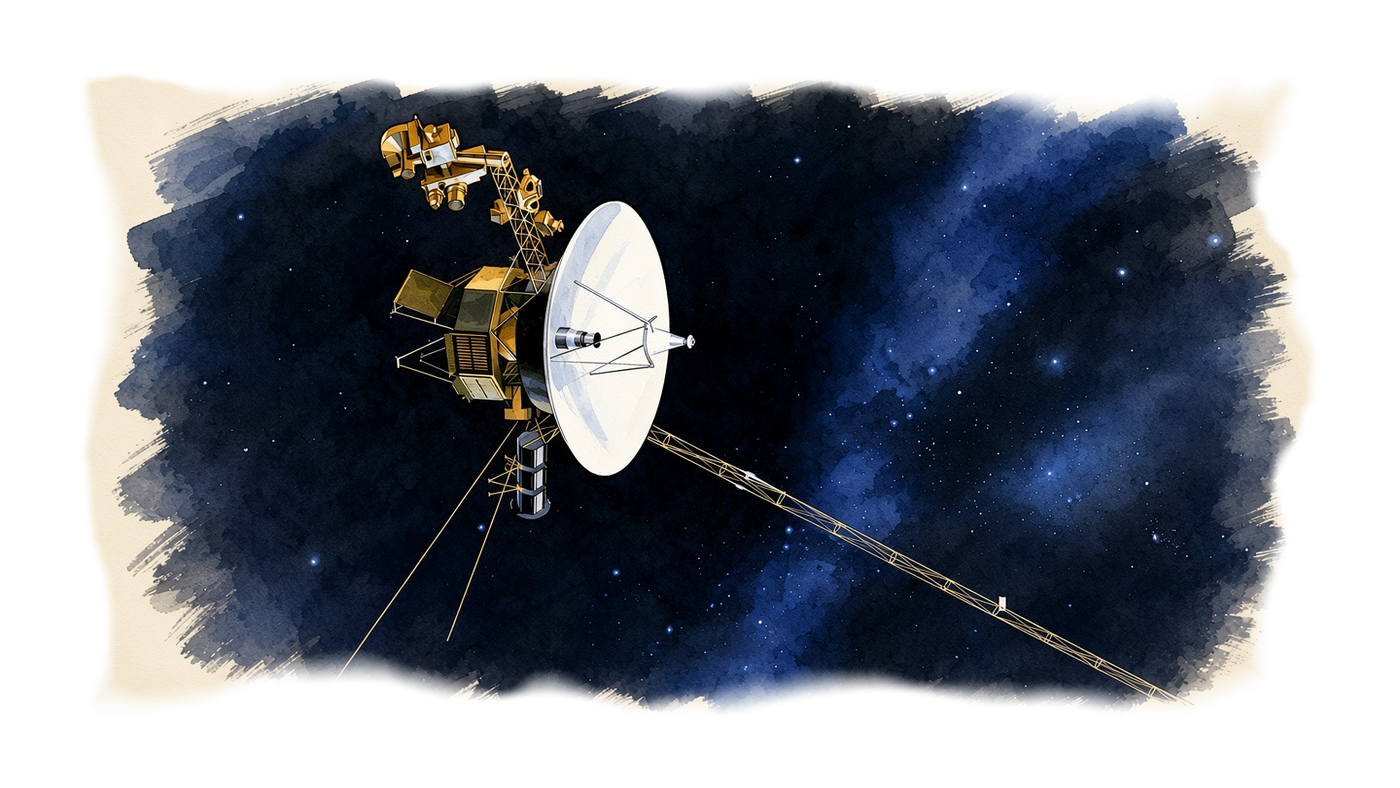
Illustration: NASA artist's concept of a Voyager spacecraft in flight.Illustration by Agentic Newsgathering, based on a NASA/JPL artist's concept (public domain).
NASA's Voyager 1 spacecraft has become the first human-made object to reach one light-day from Earth. A light-day is the distance light travels in 24 hours, about 16.1 billion miles. The probe crossed that line at 5:16 a.m. ET on November 18, after more than 49 years in flight. Because its radio signal now needs a full day to arrive, the team at NASA's Jet Propulsion Laboratory in Pasadena, California, received the signal sent at that moment 24 hours later. Voyager 1 launched in 1977, flew past Jupiter and Saturn, and in 2012 became the first spacecraft to leave the heliosphere, the bubble of particles and magnetic fields the Sun blows around itself, and enter interstellar space. The milestone came with a problem. Voyager 1 has sent no science or engineering data since November 14. Engineers confirmed the distance using its carrier signal, a basic radio tone that shows the probe is still powered and pointed at Earth, along with trajectory calculations. Suzanne Dodd, the Voyager project manager, said the team has seen this kind of problem before. "I'm confident that it won't be too long, and it will send us data back," she told Space.com. Sending a command and hearing back now takes two days.
Measured in light
Scientists measure the vast distances of space by how long light takes to cross them. Light moves at about 186,000 miles a second. A ray of sunlight passing Earth takes about 1.3 seconds to reach the Moon and about four hours to reach Neptune, and it needs another 20 hours to reach Voyager 1. A light-year, by comparison, is 5.88 trillion miles.
Voyager 1 travels at about 38,000 miles an hour on a fixed path and has no way to change its speed, so the fault on board could not change when it reached the mark, NASA said. Its twin, Voyager 2, took a different path, crossed into interstellar space in 2018 and is expected to reach its own light-day in 2035.
A celebration in Pasadena
Voyager team members gathered at the Jet Propulsion Laboratory to mark the milestone. Space.com reported that it was the mission's first such event there since 1989, when Voyager 2 flew past Neptune, and that most of the team had stayed up all night to confirm the signal.
"I remember in 1977 I was standing at the Cape watching Voyager launch, and I never thought I would be here today, 49 years later, to celebrate Voyager's one light-day," Linda Spilker, the Voyager project scientist, said at the event, according to Space.com.
The two probes launched in 1977 to take advantage of a rare alignment of the outer planets. Voyager 2 went on to study Uranus and Neptune. Both still measure changes in the Sun's magnetic field across vast distances. "One big surprise is the extent to which our Sun continues to affect interstellar space, all the way out to Voyager 1," Spilker said in NASA's announcement. "Where does the Sun's influence end and pristine interstellar space begin? Perhaps Voyager may endure long enough to answer that question."
Silence since November 14
The mission team learned on November 14 that Voyager 1 had stopped sending science and engineering data, after a NASA antenna in Canberra, Australia, locked on to the spacecraft and received a carrier signal but no data. The carrier signal shows that the computer that keeps the probe pointed at Earth, its antenna and its transmitter are all working. NASA says the missing data suggests a problem with the onboard computer that collects readings from the spacecraft's instruments and formats them to send home.
Voyager 1 had a similar problem that began in November 2023, when ground controllers received a carrier signal but no data, and engineers solved it in June 2024. NASA says the team is drawing on that experience now. NASA also said the team is checking whether the fault is connected to a brief gap in October, when the mission lost all contact with the probe for about 48 hours before the probe resumed communication on its own.
"It takes two days to diagnose anything with the spacecraft, so we can't do anything fast, and the data rates are very low," Dodd said at a NASA news conference. "We are in a realm where we're going to see more anomalies with Voyager, just due to the distance and the age." NASA says diagnosing the cause may take weeks or longer.
"We listen to Voyager 1 every day and send commands to the spacecraft weekly. It just takes a little longer to communicate than it used to," Dodd said. NASA talks to both probes through its Deep Space Network, large antennas at three sites around the world.
Power running down
Each Voyager runs on three radioisotope thermoelectric generators, nuclear batteries that turn heat from decaying plutonium into electricity, and each probe loses about 4 watts of power a year. Earlier this year engineers switched off three devices on Voyager 1 and replaced them with three lower-power alternatives, a move NASA says carried risk, to keep the science instruments running at least through the probes' 50th launch anniversaries next summer. If the current fault is fixed, Voyager 1 will keep sending readings from its two working science instruments, a magnetometer that measures magnetic fields and a plasma wave instrument that measures charged particles between the stars.
Both probes carry a Golden Record, a gold-plated copper phonograph disc of images and sounds from Earth, meant as a message to anyone who might one day find it.