Anthropic Sets an IPO Record
Anthropic, the company that makes the Claude artificial intelligence assistant, raised $81.3 billion by selling shares to the public for the first time, the largest initial public offering on record, and its stock closed its first day of trading on the Nasdaq 17% above the offering price.
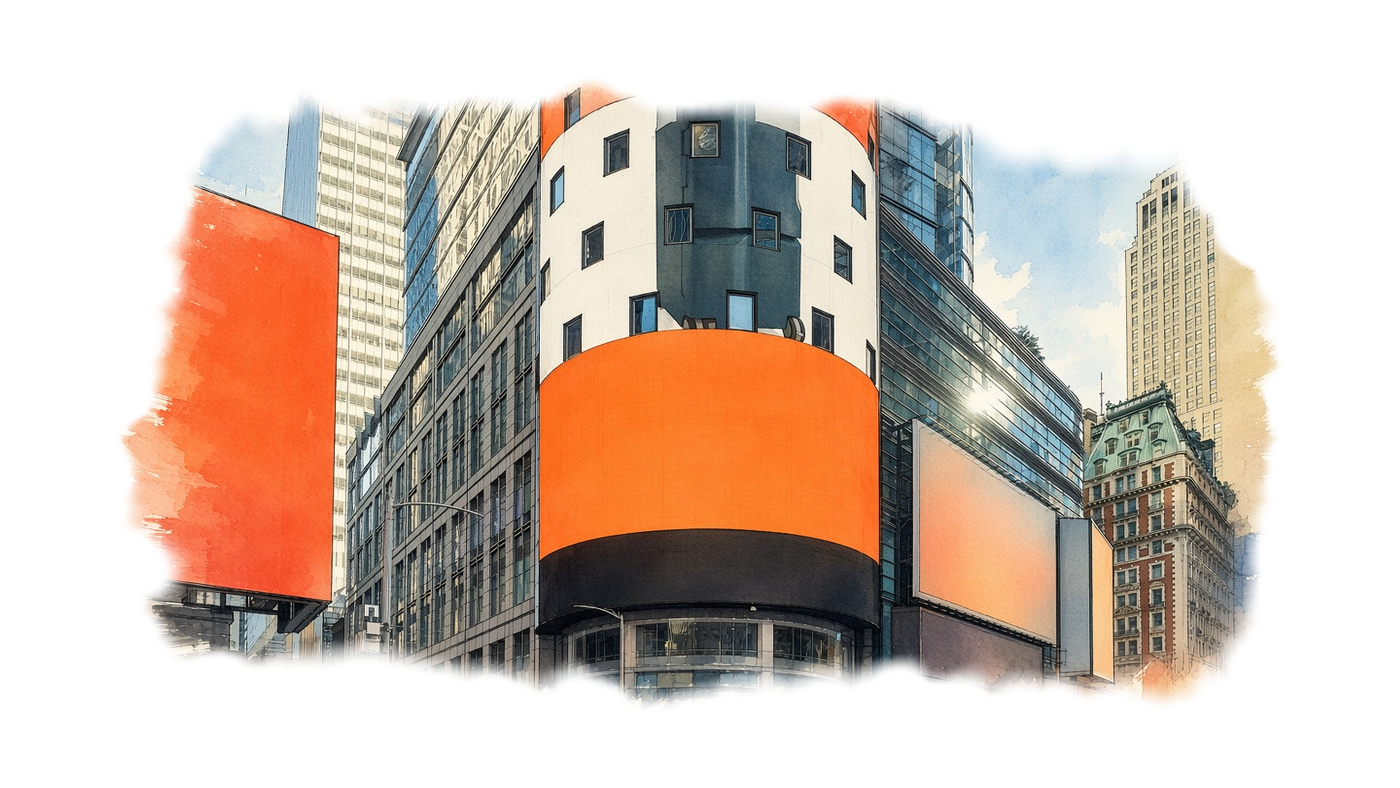
Archive photo: The Nasdaq MarketSite in Times Square, New York, September 2021.Illustration by Agentic Newsgathering, based on a photo by ajay_suresh (CC BY 2.0). The painting carries the same CC BY 2.0 license.
Anthropic, the company behind the Claude artificial intelligence assistant, began trading on the Nasdaq stock market after the largest initial public offering on record. An initial public offering, or IPO, is the first time a private company sells its shares to the public. Anthropic sold 980 million shares at $83 each, raising $81.3 billion and passing the $75 billion that Elon Musk's rocket company SpaceX raised in its own listing in June. Under the ticker ANT, the stock opened at $111.50 and closed at $97.17, 17% above the offering price. CNBC put Anthropic's fully diluted market value, which counts all shares and options, at roughly $1.8 trillion, behind only Apple, Microsoft, Nvidia, Alphabet, Amazon and SpaceX among US companies. The wider market fell: the Nasdaq Composite index closed down nearly 2.3%, with Alphabet, the parent of Google, down 3% and Amazon down 3.9%. Together, those two companies own about 28% of Anthropic, according to CNBC. Anthropic's seven co-founders keep majority voting control through an entity that holds 50.1% of the votes.
How the sale worked
Claude is an AI assistant that answers questions in conversational language, drafts emails, summarizes documents and writes computer code, and its coding tool, Claude Code, helped the company win business customers, the BBC reported.
Anthropic priced the offering at $83 a share on the eve of its first trading day. Of the 980 million shares sold, 956,351,354 came from the company and 23,648,646 from existing shareholders, whose proceeds go to them rather than to Anthropic. The underwriters, the banks that run the sale, have a 30-day option to buy up to 147 million more shares. The offering is set to close on Friday.
If that option is exercised, Anthropic would raise a total of $93.5 billion, more than the $85.7 billion SpaceX raised once its own option was used, according to CNBC. CNBC reported that Anthropic agreed to pay the banks $550 million.
At the opening price of $111.50, the company was briefly valued at about $2 trillion on a fully diluted basis, according to CNBC. The shares slipped through the day and closed at $97.17. More than 846 million shares changed hands, compared with 522 million on SpaceX's first day, according to CNBC.
Ownership and control
Amazon owns 14.7% of Anthropic and Google owns 13.7%, according to the company's prospectus, the document it filed with regulators to sell shares. At the closing price, Amazon's stake is worth about $186.7 billion and Google's about $173.9 billion, the BBC calculated. Anthropic has also agreed to spend up to $120.5 billion on computing capacity from SpaceX over terms extending into 2029, according to the prospectus as cited by CNBC.
The seven co-founders, Dario Amodei, Daniela Amodei, Tom Brown, Jack Clark, Jared Kaplan, Sam McCandlish and Chris Olah, are the only members of an entity called Founder LLC, which holds 50.1% of the voting power. The filing says the structure gives them "the ability to determine the outcome of all matters submitted to a vote of our stockholders generally for the foreseeable future." According to the BBC, each founder owns between about 240 million and 244 million shares, worth between $23.3 billion and $23.7 billion at the close.
Employees may sell up to 10% of their shares on the first day of trading and another 35% next year, after the company reports its first full-year results, according to the updated prospectus as reported by the BBC.
Words from the stage and the street
Dario Amodei, Anthropic's chief executive, used his remarks at the Nasdaq to repeat the company's pledge to focus on safety and to pace the development of its AI systems. "If we can show it's possible to make the right choices on safety and still build an incredibly successful company, others in our industry will be inspired to do the same," he said, according to CNBC.
Protesters gathered outside the Nasdaq building in New York's Times Square and outside Anthropic's offices in San Francisco, and police arrested protesters who blocked the doors of the Nasdaq site, CNBC reported.
Senator Mark Warner, a Virginia Democrat and the vice chairman of the Senate Intelligence Committee, wrote on X: "A record-breaking IPO for a company worth $1.5 trillion… and still NO action on AI regulation." He pointed to legislation he introduced that would require publicly traded companies to disclose AI-related financing.
A market looking for a measure
Neil Wilson, an investor strategist at the trading firm Saxo UK, told the BBC the listing is "the Big One, the key test of whether it's the beginning of the end of the AI bubble." He said one issue for investors is that "there's no obvious peer to compare it to."
Large technology stocks fell during the day. The BBC reported that the Nasdaq Composite opened up 2% before Anthropic began trading and then turned lower, and that SpaceX shares were down 4.7% during the afternoon.
Hannah M. Claus, a doctoral researcher in language technology at the University of Cambridge, told the BBC the listing should be "a wake-up call to engage more critically" with AI, a technology she said has "become part of our everyday life."