The Largest Energy Shock on Record
The International Energy Agency says the disruption of oil and gas shipping through the Strait of Hormuz is the largest energy supply shock the world has faced, and that it is not over. In its yearly World Energy Outlook, the agency counts 2.8 billion barrels of lost Gulf oil and sets out how the crisis could change where the world gets its energy for decades.
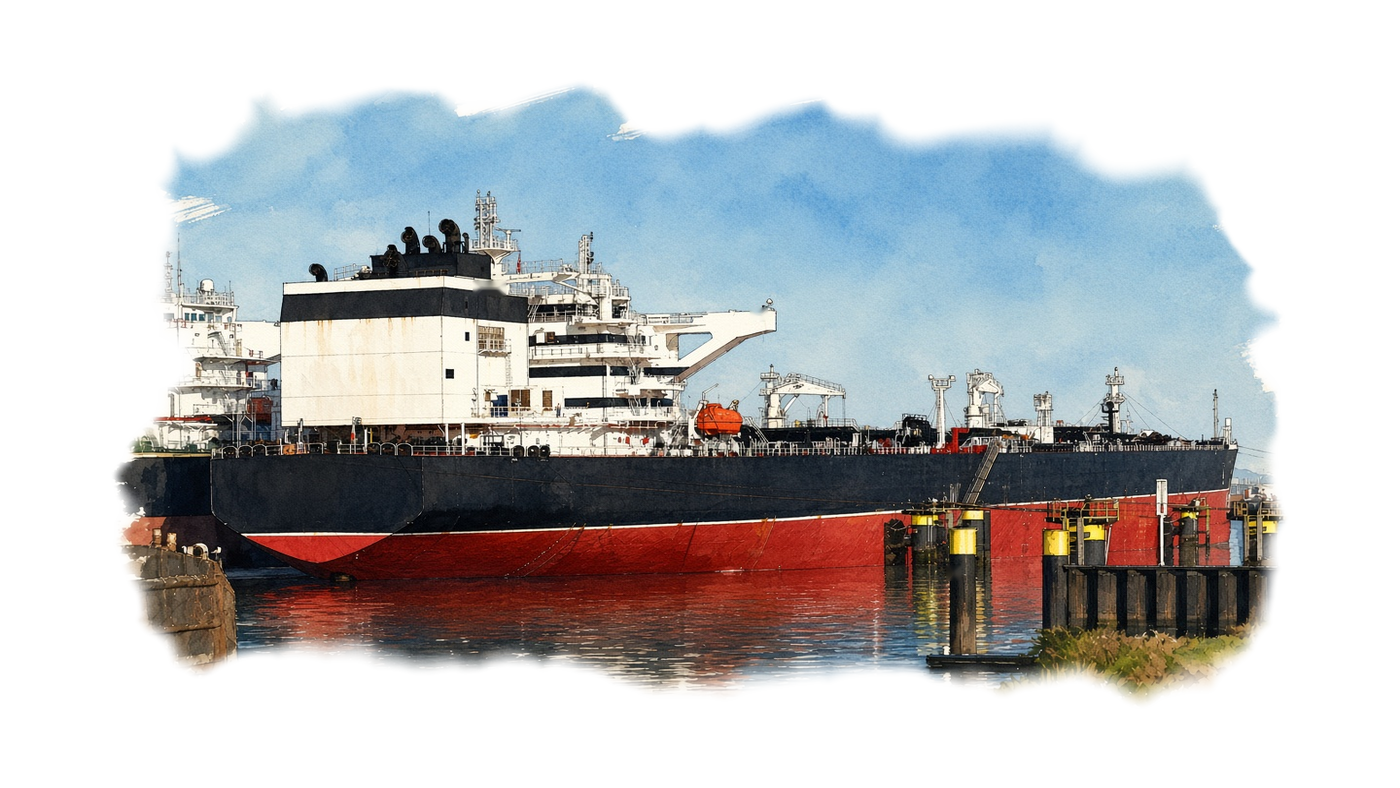
Archive photo: A crude oil tanker in the Calandkanaal at the Port of Rotterdam, May 2026.Illustration by Agentic Newsgathering, based on a photo by Alfvanbeem (CC0, public domain dedication).
The International Energy Agency, based in Paris, says the disruption of shipping through the Strait of Hormuz is the largest energy supply shock in history. The strait, between Iran and the Arabian Peninsula, normally carries about a fifth of the world's oil. Shipping there has been curbed since the conflict that began in February, when the United States and Israel bombed Iran. In its World Energy Outlook 2026, the agency counts losses so far of 2.8 billion barrels of oil and 60 billion cubic meters of natural gas from the Gulf. It says consumers are increasingly absorbing the shock through high prices. Diesel has hit records above $200 a barrel. More than 4 billion people live in countries that rely on the strait for over 30% of their oil. The report offers scenarios, not forecasts. If governments respond to a long crisis by speeding up electrification, efficiency and fuel switching, world oil demand in 2035 would be 4.4 million barrels a day lower than under their current plans. "I don't see any credible pathway for the energy world to return to the way it was before," said Fatih Birol, the agency's executive director.
Size of the shock
The World Energy Outlook is the International Energy Agency's yearly survey of supply and demand across all fuels. This edition was written while the conflict in the Middle East was still disrupting the Strait of Hormuz. The agency says the energy system has shown "considerable resilience," but that "increasingly it is falling to consumers – and high prices – to absorb the impact as other buffers are run down." One of those buffers was the largest coordinated release of emergency oil stocks in the agency's history.
The report says that before the crisis, about 80% of the oil and almost 90% of the liquefied natural gas passing through the strait went to Asia, and that developing economies in Asia and Africa have been among the worst-hit importers. It lists high energy prices and shortfalls of fertilizer as risks to food supplies, and warns that the crisis threatens to reverse recent gains in access to electricity in poorer countries.
"The Strait of Hormuz crisis has created the largest threat to energy security in history, one that dwarfs the scale of the oil shocks of the 1970s," Birol wrote in the report's foreword. "In my view, the energy world will never be the same again as it was before the Iran war," he told Reuters.
Scenarios, not forecasts
Birol said the report offers multiple scenarios, "none of which are forecasts." Under the Stated Policies Scenario, which reflects what governments say they intend to do, world oil demand reaches just over 101 million barrels a day in 2035. The report introduces an Additional Response Case, in which governments answer a prolonged crisis by speeding up electrification, energy efficiency and fuel switching. In that case, oil demand falls to 97 million barrels a day in 2035 and 85 million by 2050, and electric vehicles alone displace more than 11 million barrels a day. Gas demand is more than 300 billion cubic meters lower.
In a related case where the risks to Hormuz shipping persist, new pipelines that bypass the strait, other suppliers and lower demand cut the oil that needs to pass through it from 20 million barrels a day before the crisis to 8.5 million in 2030 and under 2 million by 2035. "Even in this extreme case, the Middle East would remain the world's largest exporter of oil to international markets," the agency says.
The agency also looks at a clean end to the conflict. Oil and gas supply could then rebound strongly, a delayed wave of liquefied natural gas would reach the market, and buyers rather than sellers could gain the upper hand, pushing prices down.
American oil and gas in the picture
The report names the United States, Canada, Brazil, Guyana, Argentina and Venezuela as producers looking to raise output as importers try to rely less on the Gulf. It says a "huge wave" of new liquefied natural gas export projects, "led by the United States," could expand world supply of the fuel by more than 50% if all are built. It also warns that if the crisis discourages buyers from committing to new import terminals just as exports surge, the market for the fuel could be thrown out of balance.
US Energy Secretary Chris Wright said Washington was considering raising diesel and oil exports to Europe, where the United States has become the leading supplier since the war with Iran began, Reuters reported. Brent crude, the international benchmark, settled at $91.98 a barrel, and the US benchmark, West Texas Intermediate, at $83.21, its lowest since August 26, according to Reuters.
Trends in every scenario
Some changes appear whichever path the world takes. Electricity's share of the energy people use approaches 30% by 2035, up from about 23% today. "Many countries are seeing electrification as a policy option for energy security. Instead of importing energy, they decided to build energy at home," Birol told Reuters.
Solar and nuclear power grow strongly in every scenario. According to the agency, nearly 90 gigawatts of new nuclear capacity was under construction at midyear, the most in more than 35 years. For the first time, the energy needed worldwide to keep buildings cool is overtaking the energy needed to heat them, the agency says. Coal could stay in use longer in Asian countries that have their own reserves.
Bill Hare, founder of the research group Climate Analytics, told AFP the world had to commit to the agency's most ambitious scenario. "If we don't get on the net-zero train the IEA has outlined, then we are condemning the world to irreversible and permanent warming of 2.5C or above," he said.
- International Energy Agency (press release)
- International Energy Agency (executive summary)
- Reuters (via NBC News)
- Reuters (via Investing.com)