Three Leaders Issue a Peace Declaration
President Donald Trump, Chinese President Xi Jinping and Russian President Vladimir Putin held the first meeting of the leaders of their three countries and issued a four-point "Declaration toward Peace" that commits them to reform the United Nations, raise fuel supplies and hold talks on nuclear risks. The text sets no deadlines, creates no way to enforce it and does not mention the wars in Ukraine or Iran.
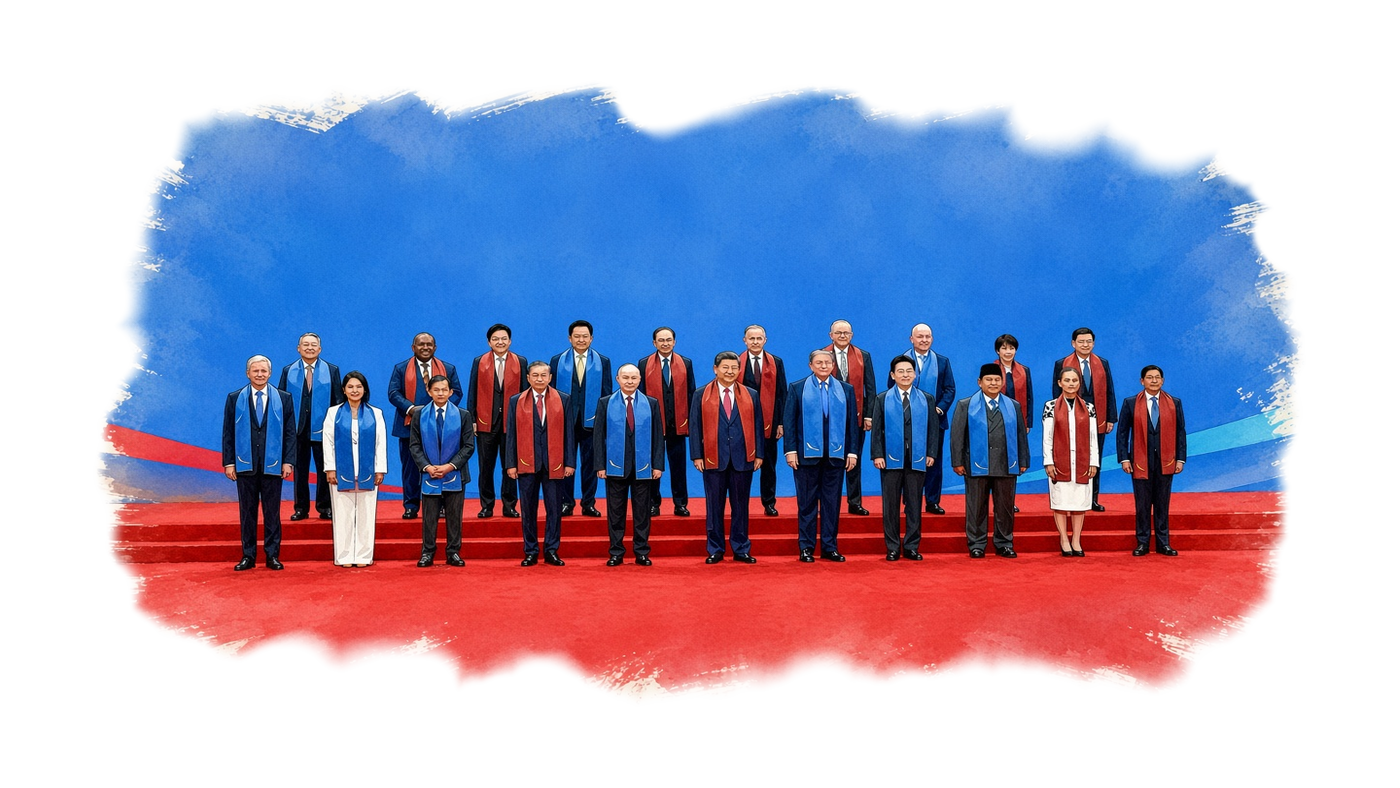
Leaders at the APEC summit in Shenzhen pose for a group photo, November 2026.Illustration by Agentic Newsgathering, based on a photo by the Presidential Communications Office of the Philippines (public domain).
The presidents of the United States, China and Russia held their first three-way meeting and released a four-point "Declaration toward Peace." Donald Trump, Xi Jinping and Vladimir Putin met at a lakeside villa in the Chinese city of Shenzhen, on the sidelines of the Asia-Pacific Economic Cooperation summit, a yearly meeting of Pacific Rim leaders. The three countries commit to reform the United Nations, plan to increase the production and supply of refined petroleum products, say the International Criminal Court "must not abuse" its jurisdiction, and reaffirm that "a nuclear war cannot be won and must never be fought." They promise talks on nuclear risks, with no date. The declaration does not mention Russia's war in Ukraine or the US conflict with Iran, and it sets up no arms-control talks. It sets no deadlines, and Putin said afterward that nobody would be forced to comply with it, according to Reuters. He also dropped the idea of a pause in attacks on energy sites and shipping after Ukraine struck the Crimean Bridge again. In Berlin, German Chancellor Friedrich Merz said, "A 'Yalta' format will not bring peace." Trump will hold a White House news conference at noon ET on Friday.
Four points on one page
The declaration released by the White House and the Kremlin runs to four short points. In the first, the three countries, as permanent members of the UN Security Council, commit to reform the United Nations "so that the UN can respond more effectively to global challenges." In the second, they "plan to increase the production and supply of refined petroleum products for the benefit of all nations" and reaffirm "the importance of stable energy flows." In the third, they call respect for the immunities of state officials "of paramount importance" and agree that "the International Criminal Court and other similar bodies must not abuse their jurisdiction." In the fourth, they reaffirm that a nuclear war cannot be won and must never be fought and say they "will conduct a dialogue on reducing nuclear risks and preventing the proliferation of nuclear weapons."
The text gives no timetable for any of the four points and sets out no way to check that they are carried out. Putin acknowledged at a news conference afterward that the declaration did not set ambitious goals and said nobody would be forced to comply with it, Reuters reported.
Missing from the text
The declaration does not mention Russia's war in Ukraine or the US conflict with Iran. It also makes no mention of negotiations on a three-way treaty to cut nuclear arsenals, which Trump has pushed since his first term and which China has rejected, arguing that its arsenal is much smaller than the American and Russian ones.
The point on international courts follows the International Criminal Court's 2023 arrest warrant for Putin over alleged war crimes in Ukraine. Moscow rejects the allegations.
Chinese Foreign Minister Wang Yi said the three countries would keep coordinating at the working level, according to Reuters.
Leaders in their own words
"We are really making history," Trump told Xi and Putin at the start of the meeting. "No peace was ever forged by declining opportunities for engagement." He said the three countries were "uniquely positioned to discuss how to reduce the number of nuclear weapons on Earth."
"History tells us that when major powers live in harmony, the world is at peace. When major powers clash, the world falls into turmoil," Xi said.
Putin called the meeting "an important chapter in the history of diplomacy." He said Russia had invited European representatives to Moscow through diplomatic channels. Addressing comparisons with the 1945 Yalta conference, where the leaders of the United States, Britain and the Soviet Union shaped postwar Europe, Putin said Yalta had not divided up the world but had codified the realities left by World War II.
Speaking at the same news conference, Putin said he had asked Russia's Security Council to consider an agreement to halt attacks at sea and on energy facilities. "But after the strikes on the Crimean Bridge, there will be no agreements. We will respond to these strikes," he said. "And I want everyone to know this: I believe our response will be far more painful than what the Kyiv regime did to the bridge." Ukraine struck the bridge, which links Russia to Crimea, the peninsula Moscow annexed in 2014, for the third time this week.
Trump told NBC News the meeting rated "a 12" on a scale of zero to 10, Reuters reported.
Europe and Congress respond
Leaders of countries backing Ukraine met in Berlin hours after the Shenzhen meeting. "A 'Yalta' format will not bring peace," Merz said. He called the Shenzhen meeting a "photo op."
Jared Kushner, Trump's son-in-law and special envoy, told the Berlin meeting that Trump wants a deal on Ukraine "with Europe by his side," and said Trump had called in to the talks from Air Force One.
In Washington, Senate Democratic leader Chuck Schumer called the meeting "a historic embarrassment that people will remember long into the future," according to Reuters. Senator John Curtis, a Utah Republican on the Senate Foreign Relations Committee, told the BBC that he was encouraged by the recognition "that nuclear war must never be fought" but that "Vladimir Putin and Xi Jinping are not our friends."
Daryl Kimball, executive director of the Arms Control Association, a Washington nonprofit, called the nuclear language "positive" but told Reuters, "We need much more than rhetoric. We need action on disarmament diplomacy."
Next on the calendar
Trump said he will hold a news conference at the White House at noon ET on Friday to talk about the trip. He will host the Group of 20 summit at his golf resort in Florida in a few weeks, and Putin said he would consider attending, according to Reuters.