Vulcan Rocket Fails, Losing 40 Amazon Satellites
A United Launch Alliance Vulcan rocket suffered an anomaly 10 minutes after lifting off from Cape Canaveral and lost all 40 Amazon Leo internet satellites aboard, the company's first total mission failure.
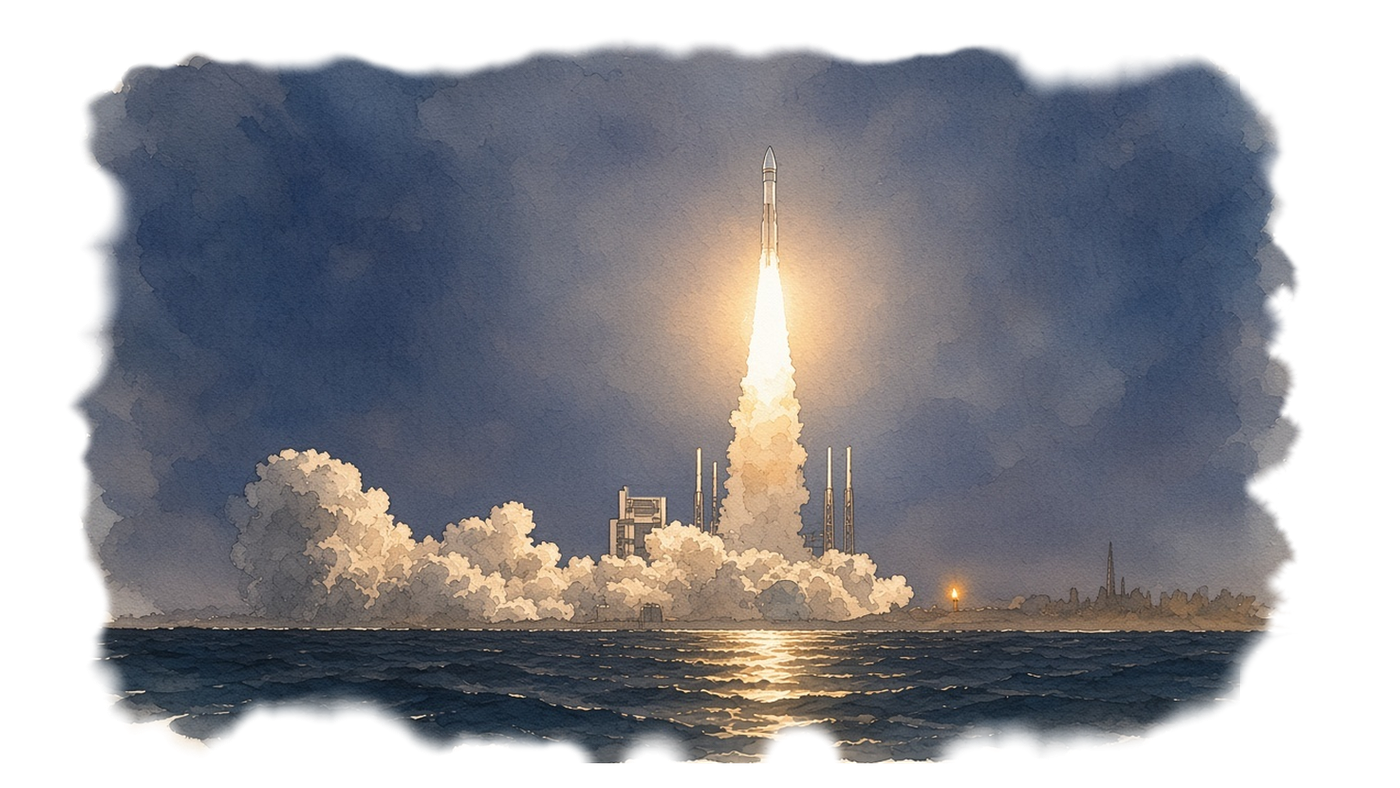
A United Launch Alliance Vulcan rocket lifts off from Space Launch Complex 41 at Cape Canaveral on the USSF-87 mission in February 2026.Illustration by The Good Times, based on a U.S. Space Force photo by Gwendolyn Kurzen (public domain).
A United Launch Alliance Vulcan rocket suffered an anomaly 10 minutes after lifting off from Space Launch Complex 41 at Cape Canaveral Space Force Station and failed to deliver 40 Amazon Leo internet satellites to orbit. Reuters, Ars Technica and Spaceflight Now called it the first total mission failure for ULA, the Boeing and Lockheed Martin joint venture formed in 2006. The rocket lifted off at 12:40 p.m. Eastern on November 15. It was Vulcan's fifth flight and its first in nine months, after booster nozzle problems on two earlier missions. ULA has not identified a cause. Ars Technica, citing multiple sources, said the anomaly was in the booster stage. Spaceflight Now and CBS News said something went wrong during the Centaur upper-stage burn, after the first stage appeared to fire longer than planned. Amazon said there is risk with any launch, "especially true for inaugural missions." Before the flight, Amazon had launched 396 Leo satellites across 14 missions since April 2025, about 12 percent of a planned constellation of more than 3,200. In premarket trading at 8:22 a.m. Eastern on November 16, SpaceX shares were little changed from the November 13 close of $139.11, and Amazon shares were down less than 1 percent.
A failure 10 minutes up
The Vulcan lifted off from Space Launch Complex 41 at Cape Canaveral carrying 40 satellites for Amazon's Leo broadband network, a planned rival to SpaceX's Starlink. About 50 minutes after liftoff, ULA said, "Based on data received by our Launch Director, we confirm that the Vulcan vehicle launched from Space Launch Complex 41 suffered an anomaly 10 minutes into the flight and failed to deliver the Amazon mission to orbit." The company said it did not yet have specific data to understand what had occurred, and that it would work with its customer and other organizations to find the cause, take corrective action and return to flight as quickly as possible.
Liftoff was at 12:40 p.m. Eastern on November 15. Reuters, Ars Technica and Spaceflight Now all described the loss as ULA's first total mission failure since the company was formed in 2006, when Boeing's Delta program and Lockheed Martin's Atlas program were combined.
ULA has not named a cause, and early accounts of where the flight went wrong do not agree. Ars Technica, citing multiple sources, said the anomaly was in the booster stage, not the Centaur V upper stage or the solid rocket boosters, and that it was not immediately clear whether the two methane-fueled BE-4 main engines, built by Jeff Bezos's Blue Origin, or another part of the booster was involved. The BE-4 engines were supposed to shut down just short of the five-minute mark but kept firing for at least 30 more seconds, Ars reported. A telemetry-driven animation on ULA's broadcast then showed the vehicle starting to spin, and the spin continued through separation of the Centaur, according to Ars. Spaceflight Now and CBS News, in reports by William Harwood, said the first stage appeared to burn longer than planned and that, according to a ULA update, something went wrong during the Centaur burn. Reuters wrote that the failure appeared to occur after the first stage had separated from the upper stage carrying the satellites.
The nine-month gap
The flight was only the fifth for Vulcan, which first flew in January 2024. Aviation Week said it followed a nine-month stand-down to address problems with the vehicle's solid rocket boosters. On two earlier flights, in October 2024 and February 2026, a booster nozzle burned through and fell away; the rocket still delivered its payloads, Space.com and Aviation Week reported, but the U.S. Space Force paused national security launches on Vulcan until the problem was addressed. ULA chief executive Mark Peller told Aviation Week before the flight that the company had identified three credible causes and taken steps to mitigate them. The solid boosters appeared to perform normally on November 15, according to Spaceflight Now, CBS and Space.com. Reuters reported that the hiatus was also extended by investigations into the BE-4 engines after a May launch-pad explosion of Blue Origin's New Glenn, which uses a version of the same engine, was traced to a BE-4 valve. Peller said Blue Origin had installed a retrofit kit on the engines flown on this mission.
The launch was the first of 38 Vulcan flights Amazon has booked with ULA, after eight earlier Leo flights on ULA's Atlas V. NASA Administrator Jared Isaacman, posting on X, thanked ULA for informing the public and its partners and said NASA was available to help. "Artemis, Moon Base, and the nation need ULA," he wrote.
Amazon's count, and its statement
Amazon's own mission list records 14 successful Leo deployment flights from April 28, 2025, through July 2, 2026, carrying a combined 396 satellites. Amazon's updates page describes the total as "nearly 400 satellites to date across 14 missions since that initial launch." Aviation Week wrote that about 12 percent of the constellation had been deployed over those 14 launches. The planned first-generation network will have more than 3,200 spacecraft; Reuters put the figure needed for global coverage at 3,236.
Amazon, which calls the mission LV-01, said in a statement also posted by its Leo account on X, "There is risk with any launch, and that's especially true for inaugural missions like LV-01. ULA has been a trusted partner for Amazon, and we believe they'll learn from this mission and deliver on their long-term plans for Vulcan."
How the shares moved
Space Exploration Technologies Corp. Class A shares, ticker SPCX, closed at $139.11 on November 13, the last regular session before the launch, according to Nasdaq and Yahoo Finance. In premarket trading on November 16, Nasdaq had the shares at $138.87 at 8:22 a.m. Eastern, down 24 cents, or 0.17 percent; Yahoo Finance showed $138.88 at 8:21 a.m. Amazon.com shares closed at $266.66 on November 13. At 8:22 a.m., Nasdaq had them at $265.00, down $1.66, or 0.62 percent; Yahoo Finance showed $264.66 at 8:21 a.m., down 0.75 percent. Amazon's market capitalization was about $2.88 trillion at the November 13 close, on 10.81 billion shares outstanding, according to Yahoo Finance and CompaniesMarketCap.
SpaceX went public on June 12, pricing the shares at $135, CNBC reported. On July 16, SpaceX aborted a Starship test flight after an engine ignition failure. The shares fell 5.43 percent the next day, CNBC reported. Yahoo Finance's daily record shows a July 17 close of $123.99, down from $131.11 and below the $135 IPO price.
What analysts say drives the SpaceX price
Morgan Stanley initiated coverage of SpaceX in July with an Overweight rating and a $300 price target, and with what lead analyst Adam Jonas called an intentionally wide range: a $75 bear case and a $600 bull case. "Our $600 bull case assumes faster execution across Starship, orbital compute, and Terafab, with AI more than 60% of valuation. Our $75 bear case assumes Starship slips to 2029 and AI monetization and deployment speed miss expectations, leaving Space and Connectivity at roughly 90% of valuation," Jonas wrote, as quoted by Yahoo Finance. In a summary of the same note, Saxo's Neil Wilson reported Morgan Stanley's line that "Starship is the main unlock for SpaceX's long-term economics across Space, Connectivity, and AI," and that the bank's base-case sum of parts assigned $8 of the $300 target to space, $152 to enterprise AI, $128 to connectivity and $12 to X and Grok. Yahoo Finance reported that the firm pointed to recent "neocloud rental deals" with Anthropic and Google.
In April, writing about Amazon's planned purchase of Globalstar to support Leo, CNBC noted that Morgan Stanley had called the deal's size small relative to Amazon's capital spending, and that "for a company projected to do roughly $800 billion in revenue this year, it takes a lot to move the needle."
See all (23)Show fewer
- Aviation Week
- CBS News
- The Verge
- GeekWire
- SpaceNews
- New York Post
- Amazon Leo mission updates
- ULA on X
- Amazon Leo on X
- Nasdaq (SPCX)
- Nasdaq (AMZN)
- Yahoo Finance (SPCX)
- Yahoo Finance (AMZN)
- Yahoo Finance (AMZN key statistics)
- CompaniesMarketCap (Amazon)
- CNBC (July 17 Starship abort and SPCX)
- Yahoo Finance / AOL (Morgan Stanley on SpaceX)
- Saxo (Morgan Stanley on SpaceX)
- CNBC (April, Amazon Leo and Globalstar)