Router Flood Grounded US Flights
The Federal Aviation Administration says a flood of network traffic from two remote sites, one where a contractor was installing a new router, knocked its legacy equipment off balance and forced the nationwide ground stop.
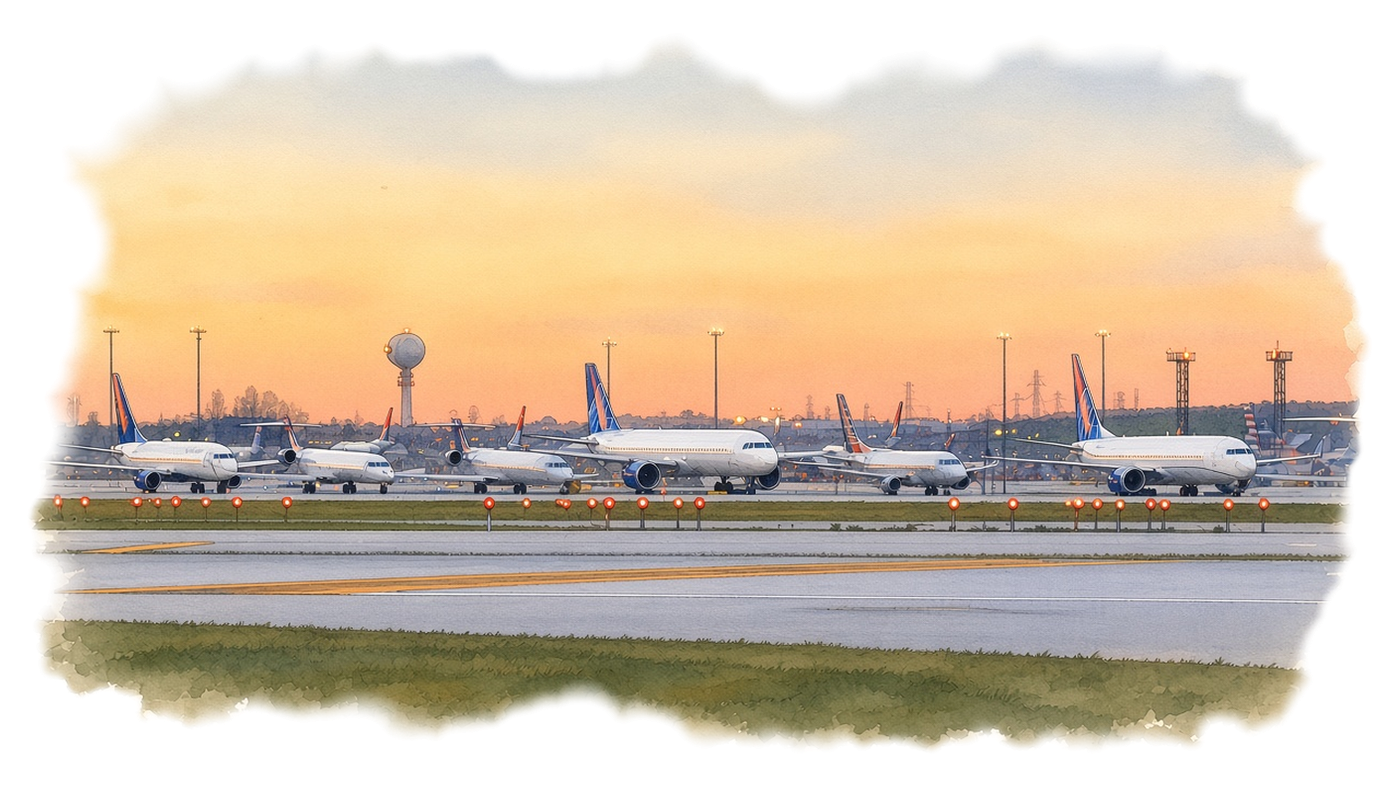
Airliners lined up on a taxiway at Chicago O'Hare International Airport during the nationwide ground stop, November 2026.Illustration by The Good Times, based on a photo by Spelg33 / Wikimedia Commons (CC0 1.0)
The Federal Aviation Administration says the ground stop that halted every US flight began with a flood of data on its telecommunications network, about 1,000 connection attempts every four to five seconds, that made its older equipment unstable. The agency traced the traffic to a radar site in Amarillo, Texas, and a radio communications site in El Dorado, Arkansas, where its network contractor, L3Harris, had been installing a new router. L3Harris blocked both sites and the network settled. As a precaution, the FAA switched off the same broadcasting function on about 60 similar routers. The agency says it has no indication of a cyberattack, and that the root cause is still under investigation. Instability hit 17 of the 22 centers that guide planes between airports. About 3,500 aircraft in the air landed safely. Operators canceled 12,462 flights that Friday, the FAA said, though not all of those cancellations were caused by the stop. Transportation Secretary Sean Duffy said the government wants the root cause before making broad fixes, and the FAA says it will rethink doing this kind of work in the middle of the day.
What the FAA found
The trouble began around 3:30 p.m. Eastern, according to a question-and-answer page the FAA posted. Data began flooding the FAA Telecommunications Infrastructure network, which carries radio and radar signals between facilities, at a rate of about 1,000 connection attempts every four to five seconds. The agency says its legacy equipment, an older time-division system still in service, became unstable under that load, disrupting aircraft communications and radar feeds. ABC News reported that the nationwide ground stop was declared at 3:54 p.m.
The initial investigation points to two locations: a radar site in Amarillo, Texas, and a radio communications site in El Dorado, Arkansas. L3Harris, the FAA's network service provider, had been working at El Dorado, including deploying a new router. When the data inconsistencies appeared, L3Harris blocked both locations and the network stabilized. The broadcasting function was then disabled on all of the new routers, about 60 of them, as a precaution, the FAA said. Transportation Secretary Sean Duffy said Sunday on ABC's "This Week" that broadcasting is now disabled on 69 routers. Rebecca Guy, the FAA's technology chief, said at a Saturday press conference, "We disabled both of those right away and were able to stabilize our network," The Wall Street Journal reported.
The FAA says that, based on all available evidence, there is no sign of a cyberattack or an outside actor. It also says the newer equipment bought with recent modernization money did not fail, and that the outage came from the legacy system. The agency says the disruption was not caused by SMART, an artificial intelligence tool it has been expanding. The FAA and L3Harris are still investigating the root cause.
How far it spread
Instability appeared at 17 of the FAA's 22 Air Route Traffic Control Centers and spread into several approach control facilities near airports. The FAA says some radio frequencies and radar feeds kept working throughout, so controllers could still talk to and track aircraft. About 3,500 planes that were in the air landed safely, and medical, law enforcement and military flights continued. Flights resumed at 8:15 p.m. after the agency lifted the stop.
Operators canceled 12,462 flights that day, including 9,082 by major airlines, by the FAA's count. The agency said not all of those cancellations were caused by the ground stop. Reuters, citing the flight-tracking service FlightAware, put Friday's cancellations at about 9,200 and said that by 9:35 p.m. Eastern on Saturday airlines had canceled more than 6,400 more US flights and delayed more than 8,000. FAA Administrator Bryan Bedford said Saturday that schedules would not return to normal until late Sunday. On NBC's "Meet the Press," Duffy said Sunday he expected normal operations by the end of the day or early Monday morning.
The investigation
Duffy, on the Sunday shows, said the El Dorado work was a replacement of an old copper line that was going to be shut down. "When we turned that router on, we saw that in Amarillo, Texas, a system [L3Harris] had replaced about three weeks earlier, that started to flood our system as well," he said, in remarks released by the Transportation Department. He said both routers were at an L3Harris laboratory in Florida with FAA staff on site, and that the FBI has offered assistance. "Was this a cyber attack from a foreign nation? We have no indication that that was at play here. We think it was the installation or the router that was the bad actor, but we're open if we see something else."
At a press conference on Saturday, Duffy said officials were trying to determine "whether we had incompetence, meaning was it user error or installer error from L3Harris, or did they install a faulty router?" Bedford said investigators had seen "zero evidence of anything nefarious, and zero evidence of anything AI-related." L3Harris said in a statement, reported by ABC News and The Wall Street Journal, that it was supporting the FAA's investigation and "takes the nationwide ground stop and its impact on travelers, airlines and air traffic operations seriously."
What changes now
Maintenance at major air traffic control facilities usually happens at night, when traffic is lighter. The FAA says the El Dorado job was a routine replacement at a remote site, the kind done for decades without trouble, and that, based on what happened Friday, it will reevaluate when such work is scheduled. Duffy told ABC that once the routers could no longer broadcast, "the issue is resolved."
Duffy has used the Sunday interviews to repeat a request for more money from Congress to replace the telecommunications network. He said Congress last year provided $12.5 billion for air traffic control upgrades, a sum he called a down payment, already spoken for radars, radios and other systems and not available to build a new network. He said AT&T, Verizon and Lumen were ready to build and that a new system could be ready by the end of 2028 or early 2029. On "Meet the Press," he blamed previous administrations for "30 years of a lack of investment." Representatives Rick Larsen of Washington and André Carson of Indiana, the ranking Democrats on the House transportation committee and its aviation subcommittee, said in a statement reported by ABC News that the department had obligated $4.3 billion of that sum and spent $1 billion, and asked why more money was needed.