Greece Uses Starlink on Trains
Greece is using Starlink to send live train positions, speeds and headings to a government control center, including through mountain stretches with no mobile coverage, and to warn staff automatically if two trains appear to be on a collision course.
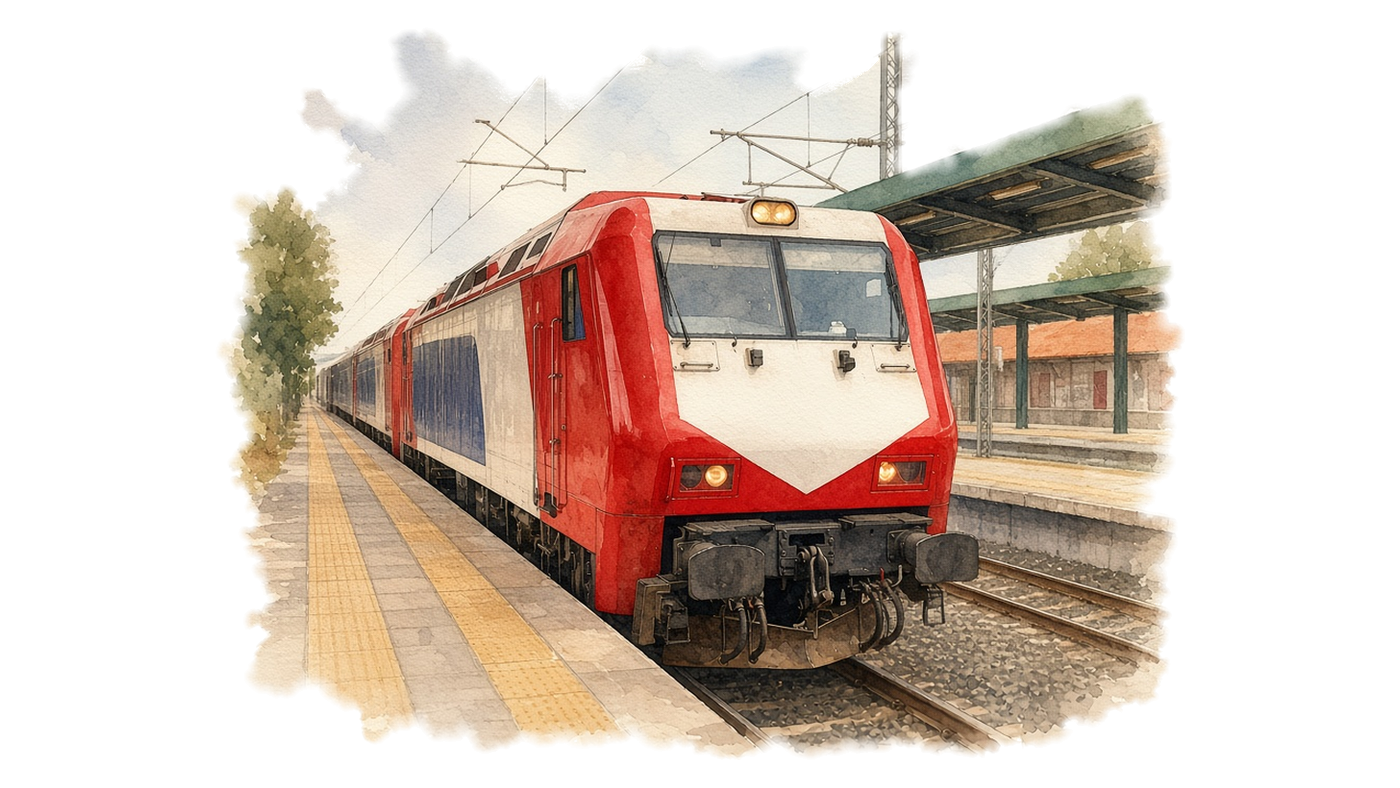
A Hellenic Train passenger train led by a red-and-white diesel locomotive at Katerini station on the Athens–Thessaloniki line, April 2026.Illustration by The Good Times, based on a photo by Greek trainspotter / Wikimedia Commons (CC0)
Greece is using Starlink to carry live position, speed and direction data from trains to a 24-hour operations center, including through mountainous stretches where there is no mobile coverage. The official how-it-works page for the government platform railway.gov.gr names Starlink as the satellite link that sends that data to the center. Monitoring equipment has been installed on 134 locomotives. The trains are located with GNSS-HEPOS, the high-precision positioning network run by the Hellenic Cadastre; officials say that combination can pinpoint a train to as little as five centimeters, and positions are updated every second. If the platform detects two trains on a dangerous path, it automatically alerts staff at the Acharnes Railway Center, who then radio the drivers to stop. The warning is automatic; the intervention is not. railway.gov.gr is an extra awareness layer and does not apply the brakes by itself. Prime Minister Kyriakos Mitsotakis said on November 10 that the European Train Control System had already been installed on the main line and on trains and was in the certification phase. The public platform opened on February 25, first on the Athens-Thessaloniki line. Equipment and installation were paid for by a 2,489,409-euro donation from the Union of Greek Shipowners, through its social-contribution arm, SYN-ENOSIS.
How the data moves
Starlink is the communications link, not the positioning system. Onboard GNSS-HEPOS receivers collect each train's coordinates, speed and heading, and the data is transmitted over Starlink to the central system, the official railway.gov.gr page says. Updates are sent every second, and the page describes coverage as nationwide and the service as running around the clock. Stelios Sakaretsios, the secretary-general for transport, told a presentation in Piraeus last week that large parts of the network, among the mountains, have no mobile coverage, and that low-Earth-orbit Starlink satellites were used so the data would reach the control center without a break. A high-precision GNSS receiver and a Starlink antenna have been fitted on 134 locomotives that run on the network, he said.
Officials say GNSS-HEPOS can locate a train to as little as five centimeters, after survey runs that digitally mapped about 1,650 kilometers of track. The Ministry of Infrastructure and Transport, when the public platform opened, said the system also uses Europe's Galileo satellites and can tell parallel tracks apart, unlike conventional GPS, whose error can reach about 15 meters. The ministry said the data arrives with a delay of less than 1.2 seconds.
The 24-hour operations center sits at the Acharnes Railway Center, known as SKA. Hellenic Railways, or OSE, presented the platform with the ministry. If two trains appear to be on a collision course, the system automatically alerts staff there. Operators then contact the drivers and coordinate a stop, and the drivers have to confirm they have received the order. Every step, including the response time and the official responsible, is recorded. Speed-limit violations also open an automatic case for review. The platform also analyzes recorded official radio traffic with help from artificial intelligence, the prime minister's office said, to check that operating protocols are being followed. Officials at the November 10 presentation said more than 120,000 conversations had already been analyzed, with any flagged exchange reviewed by a person before action is taken.
Elon Musk posted "Starlink saves lives" about the system on November 15.
An extra layer, not ETCS
The government describes railway.gov.gr as an additional safety layer, complementary to signaling, remote traffic control and the other systems already on the network. It does not replace those systems and does not apply the brakes by itself. Mitsotakis, speaking at the old Piraeus railway depot on November 10, said ETCS had already been installed on the line and on the trains and was in the certification phase, and that funding had been secured for telecommand systems across the core network. The prime minister's office said the platform allows continuous monitoring of traffic, the detection of departures from operating rules and automatic notification of a possible collision risk.
The public site was opened on February 25, initially for passenger trains on the Athens-Thessaloniki line, with a plan to equip all trains on the network by the end of April. A more limited version had been running as a pilot on selected routes since July 2025. Citizens can use the site to see an equipped train's location, its next station and its estimated arrival time.
A passenger train and a freight train collided near Tempi on February 28, 2023, killing 57 people.
Who paid for the equipment
The Union of Greek Shipowners signed a donation agreement with the Greek state in December 2025 for 2,489,409 euros, covering the purchase and installation of the geolocation equipment for the fleet and bypassing a public tender. The prime minister's office said the work was supported by SYN-ENOSIS, the union's social-contribution company, and by 26 members of the union's board. Business Daily and Ethnos reported that the donors also prepaid the first year of the satellite internet subscription.
- railway.gov.gr (how it works)
- Greek Prime Minister's Office
- Ministry of Infrastructure and Transport
- Kathimerini
See all (23)Show fewer
- eKathimerini (November 10)
- eKathimerini (February 25 launch)
- eKathimerini (shipowners' donation)
- eKathimerini (Tempi)
- To Vima (February 25 launch)
- To Vima (November 10)
- ERT
- Naftemporiki (donation)
- Naftemporiki (November 10)
- Euronews
- Business Daily
- Ethnos
- Sidirodromika Nea
- NewsIT
- Zougla
- Human Rights Watch (Tempi)
- ProtoThema
- CNN.gr
- Elon Musk on X