Yemeni Forces Pull Back From the Bab el-Mandeb
Saudi-backed Yemeni forces withdrew from positions overlooking the Bab el-Mandeb strait, a pullback that, Reuters reported, leaves the Iran-aligned Houthis in control of the coast beside one of the world's busiest shipping lanes.
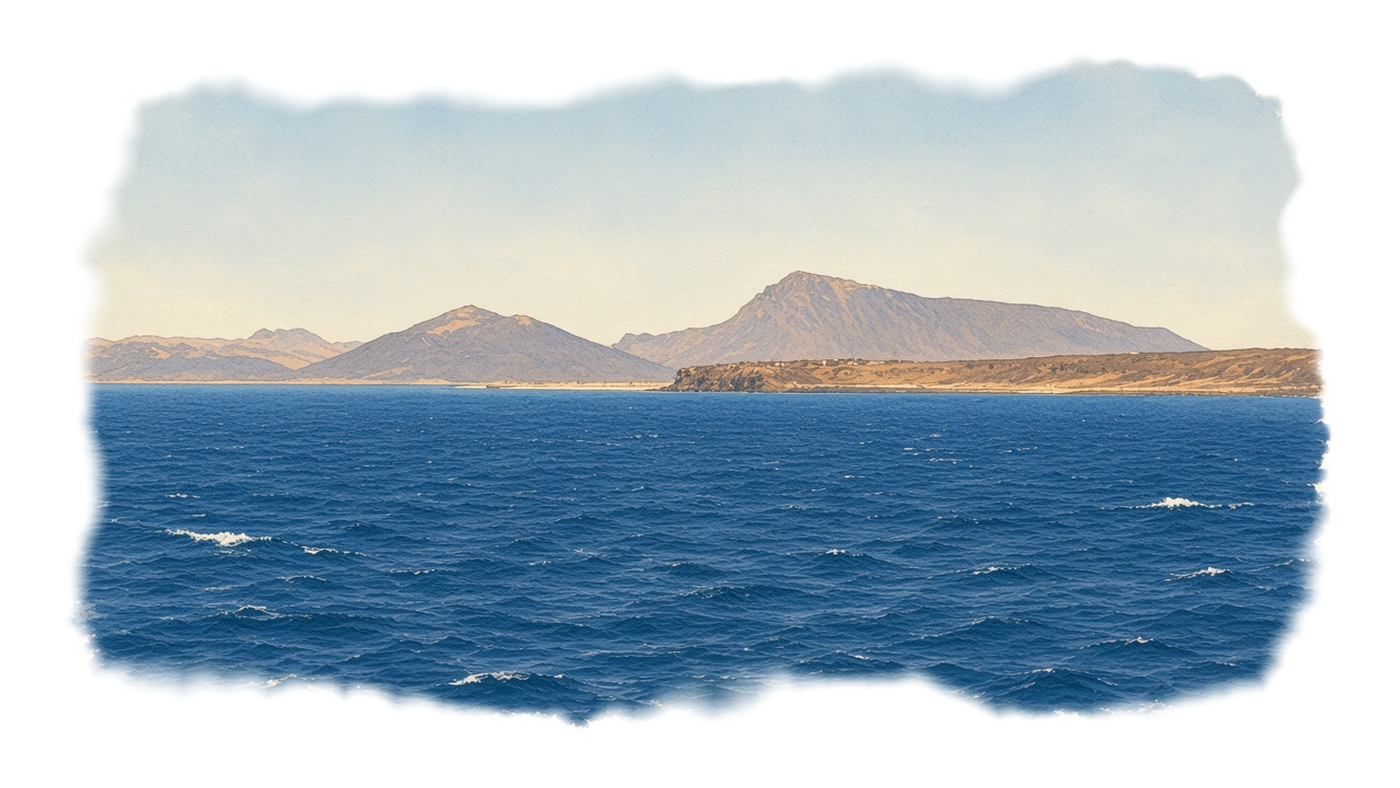
Perim Island and the mountains of the Sheikh Said peninsula on Yemen's coast at the Bab el-Mandeb strait, February 2007.Illustration by The Good Times, based on a photo by Michael Kleiner / Wikimedia Commons (public domain)
Yemeni forces fighting for the internationally recognized government announced that they were withdrawing from Dhubab Airport and the coast overlooking the Bab el-Mandeb strait, the narrow passage at the south end of the Red Sea. The Southern Armed Forces said they were redeploying to defend Aden, where the government is based, to strengthen other front lines and to help break the Houthi siege of Taiz. Reuters reported that the pullback leaves the Iran-aligned Houthis in control of the ground beside the strait; The National wrote that it could leave them in control. A media adviser to Yemen's presidency told Arab News the move should not be read as a withdrawal, and said the forces had repositioned about six to eight kilometers from the strait. Ships carrying goods from Asia to Europe through Egypt's Suez Canal pass through the waterway, and Iran is already disrupting traffic through the Strait of Hormuz. Government troops said they had recaptured Dhubab in October after a Houthi push in September. The Houthis have also struck Saudi ports, airports and oil sites, including the Red Sea export hub of Yanbu. Hours earlier, Iran said it had sent drones at a US radar in Bahrain; Bahrain said it shot them down, and no damage was reported.
The pullback
"The Southern Armed Forces announce the implementation of a redeployment operation for its forces from Dhubab Airport and the Bab el Mandeb area, west of Taiz Governorate," the group said in a statement. It said the step was "taken based on the priority of securing the capital, Aden, and the neighbouring governorates, as well as strengthening the front lines and addressing existing threats." The National, citing the statement, said the redeployment would also support efforts to break the Houthi siege of Taiz and would be carried out with the support of the Saudi-led coalition.
Reuters reported that the withdrawal leaves the Houthis in control of the area. The National was more cautious, writing that the move "could leave" the Iran-backed Houthis in control of territory overlooking the waterway. Xinhua, reporting from Aden, said the southern forces were withdrawing from positions near the strait "to reinforce defenses around the southern port city of Aden, as advancing Houthi fighters put mounting pressure on government-held territory."
A source in the Yemeni presidency told Asharq Al-Awsat, in an account published by Arab News, that the redeployment was a "calculated military move" aimed at protecting Aden, reinforcing fronts in Lahj and creating conditions to lift the siege of Taiz. Jaber Mohammed, a media adviser to the presidency, said it should not be interpreted as a withdrawal in the military sense, but as a redistribution of troops. He said the Southern Forces had repositioned in the Al-Suqyah area, about six to eight kilometers from the strait, "keeping them within the operational area of the front." The Southern Armed Forces, in a further statement reported by Arab News, said the move did not represent an abandonment of the fight against the Houthis.
Why the strait matters to shipping
The Bab el-Mandeb links the Red Sea to the Gulf of Aden and is one of the main routes for seaborne goods and commodities between Asia and Europe through the Suez Canal. Reuters said that, with Iran disrupting traffic through the Strait of Hormuz, Houthi leverage over the Bab el-Mandeb puts pressure on both main exits for Gulf oil. The BBC, in a separate report on attacks in the Gulf, said shipping through Hormuz has been restricted since a war between the United States and Iran began in February, and that the United States has kept a naval blockade in place.
Government forces launched a campaign in October to recapture coastal areas after the Houthis pushed south in September in a bid to take more of the Red Sea coast, Reuters and The National reported. Those accounts said the September offensive brought the Houthis within reach of the strait, and that government troops later said they had recaptured Dhubab. Al Jazeera, in a report with Reuters, said the counteroffensive recaptured key positions around the strait, notably Dhubab, but failed to push the Houthis out of the port city of Mocha and other areas near the coast.
The fighting broke a 2022 truce brokered by the United Nations. The Houthis, who hold the capital, Sanaa, and most of Yemen's populated north, have fired on Saudi Arabia, hitting ports, airports and facilities of the state oil company Saudi Aramco, including the Yanbu export terminal on the Red Sea. The Saudi-led coalition said on Sunday it intercepted two Houthi ballistic missiles aimed at Riyadh, Reuters and Al Jazeera reported.
Fighting has also intensified around Taiz. Reuters, The National and Al Jazeera reported that the city, which holds about half of the 300,000 people displaced across Yemen by the latest fighting, remains besieged, with aid unable to enter and civilians unable to leave. Majid Al-Nazili, a spokesman for the government forces, called on the international community to help return the Bab el-Mandeb and Yemen's west coast to government control, Al Jazeera reported, saying the strait was vital for maritime navigation and trade.
Drones over Bahrain
Before dawn on Sunday, Iran's Revolutionary Guards said they had launched six drones at a US air defense radar at the Al-Riffa helicopter base in Bahrain, in what they called retaliation for American strikes, the BBC and Xinhua reported. Bahrain's military said it intercepted the attacks "before they could achieve their objectives." Bahrain's Foreign Ministry said it held Iran fully responsible. It was the second Iranian attempt on Bahrain in three days. On Friday, the US military said it shot down two Iranian drones headed for the island, with no injuries or damage.