Russia Agrees to Arm Iran Helicopters
Leaked Russian defense documents show an order for 90 helicopter-mounted missile launchers for Iran; they do not show whether the launchers were delivered.
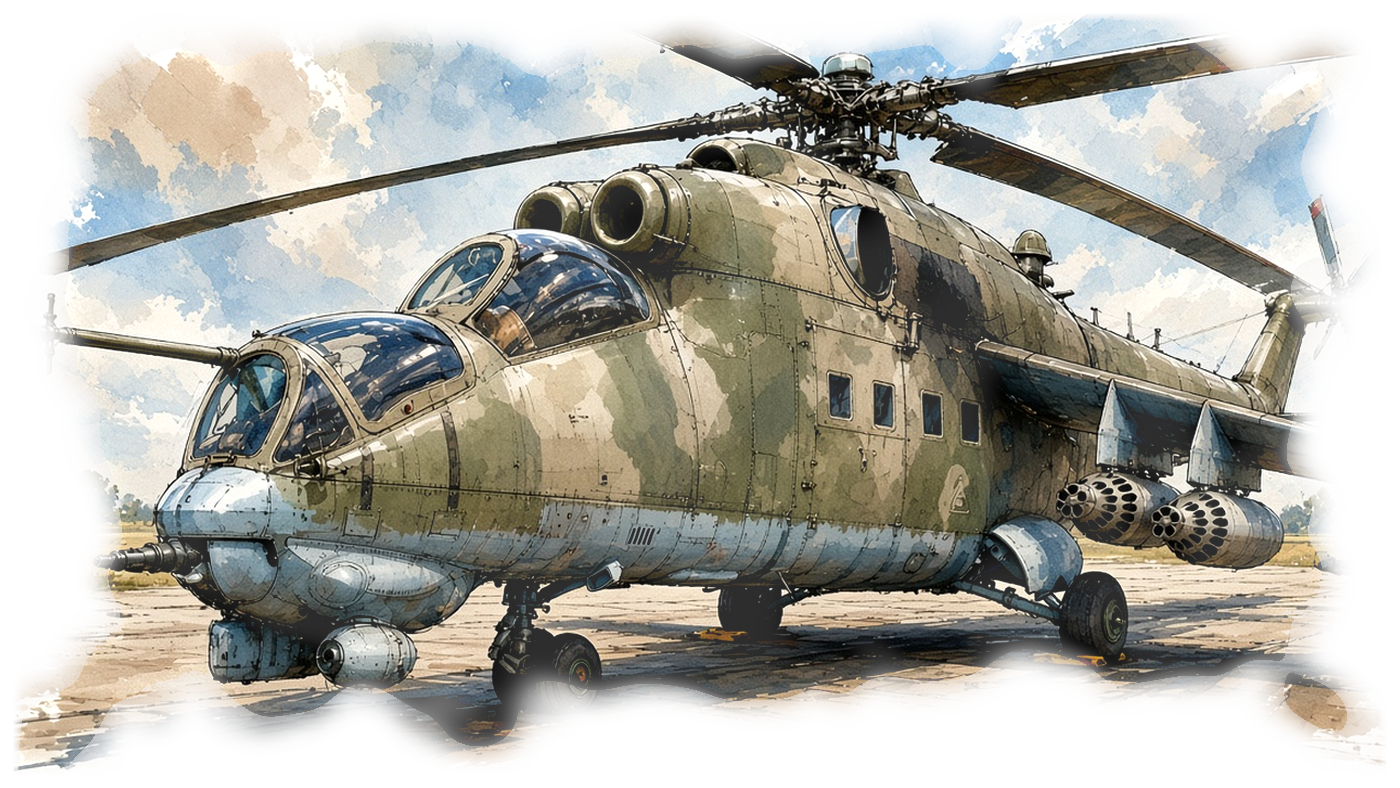
A Mil Mi-24 attack helicopter parked on the tarmac, October 2015.Illustration by Agentic Newsgathering, based on a photo by Eric Friedebach / Wikimedia Commons (CC BY 2.0)
Russia agreed to supply Iran with 90 helicopter-mounted launchers for precision-guided missiles that Russian forces have used extensively in Ukraine, according to leaked defense-industry documents obtained by Dallas Analytics, a Ukrainian private intelligence firm, and shared with the Guardian; Al-Monitor and Kyiv Post carried matching accounts citing the Financial Times. A Vympel production schedule lists an export order for 90 APU-L launchers under a contract coded "K-10," which separate internal paperwork identifies as Iran, with deliveries planned across a late-2024 to 2025 window. The launchers are built to fire LMUR missiles, also called Izdeliye 305, from attack helicopters such as the Mi-28. The documents do not establish whether the launchers were ultimately delivered. A separate Vympel schedule for Yak-130 jet trainers destined for Iran matched aircraft already reported as delivered. Moscow denies supplying military equipment for use in the current U.S.-Iran conflict. President Trump said last month that Russia was doing "very little, if anything" to help Tehran.
What the documents say
Dallas Analytics, a Ukrainian private intelligence firm, obtained the files and shared them with the Guardian. The FT's account, relayed by Al-Monitor and Kyiv Post, describes a 2024–2025 production plan attached to a May 2024 Vympel letter. It lists 90 APU-L launchers for customer "K-10." FT reporters tied that code to Iran through Rosoboronexport practice and other contracts, including Yak-130 trainers. The same paperwork, Al-Monitor reported, also lists China as a buyer of a larger batch of related launchers and several Russian customers.
APU-L launchers mount on Mi-28 attack helicopters and fire the LMUR, a light multipurpose guided missile able to hit moving targets at ranges reported around 14 kilometers. Russian forces have used the missile widely against Ukrainian targets since 2022.
What the documents do not say
They do not confirm delivery. The production schedule is an order plan, not a shipping receipt. The Guardian notes that a separate Yak-130 schedule lined up with publicly reported deliveries of those aircraft, which is circumstantial support for the paperwork's reliability, not proof that the 90 launchers arrived in Iran.
The wider Moscow-Tehran track
Military cooperation between Russia and Iran deepened after Russia's full-scale invasion of Ukraine, when Tehran supplied Shahed attack drones that Russia later built at home. The two countries signed a strategic partnership in 2025 that covers military-technical cooperation but stops short of a mutual defense pledge. Moscow has denied reports that it is supplying weapons for Iran's fight with the United States. European intelligence findings cited in the Guardian have pointed to Russian data and satellite imagery useful for targeting, and to preparations to supply explosive drones; those are separate from the launcher order.
Trump has repeatedly played down Russian help for Iran. Last month he wrote that Russia was doing "very little, if anything" to help Tehran and that he did not want to drive Moscow away from Ukraine talks. The leaked order, if carried out, would sit against that public assessment. Whether the launchers shipped, and whether any that did have been used, remains unconfirmed in the opened reporting.