Bank of England Raises Rates to 4%
Britain's central bank lifted its base rate for the first time in more than three years as Iran-war energy costs push inflation higher, and warned another hike is likely unless the Middle East conflict eases.
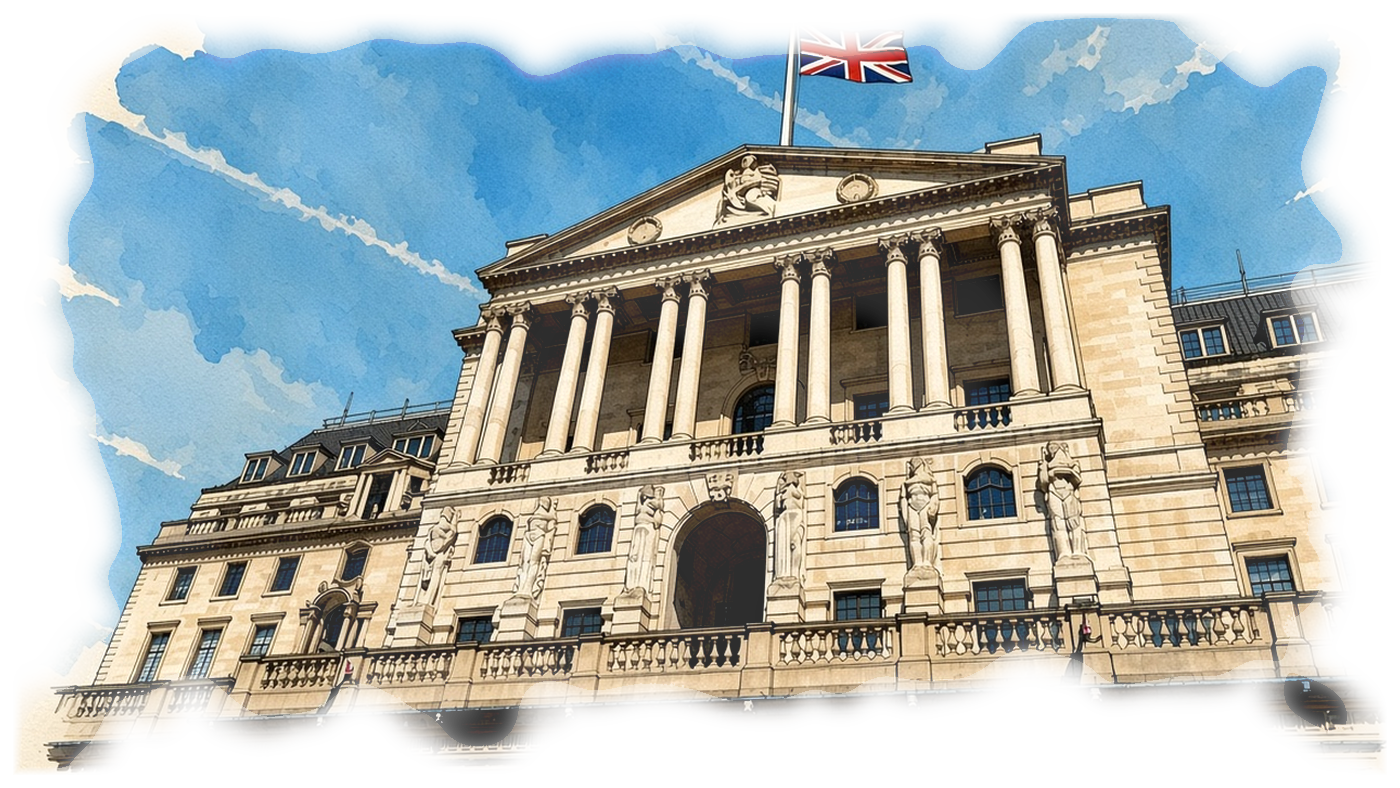
The Bank of England on Threadneedle Street, London, July 2022.Illustration by Agentic Newsgathering, based on a photo by acediscovery / Wikimedia Commons (CC BY 4.0)
The Bank of England raised Bank Rate by a quarter point to 4%, its first increase in more than three years, in an 8–1 vote of the Monetary Policy Committee. One member, Catherine L. Mann, preferred a half-point rise to 4.25%. The Bank said months of elevated oil and gas prices from the Middle East conflict have left enough inflation in the pipeline to warrant the move, even though knock-on effects into other prices and wages remain limited so far. UK consumer-price inflation was last reported at 3.5%; the Bank now expects it to reach around 5% by the middle of next year. Governor Andrew Bailey said the increase "shouldn't be seen as the first in an inevitable long sequence of hikes," but warned that "unless the conflict in the Middle East is resolved, neither does it seem likely to be the last increase." Tracker mortgage holders face higher monthly payments; savers may see better returns. The Bank's next rate decision is due December 17.
The vote
The Monetary Policy Committee voted 8–1 to raise Bank Rate by 0.25 percentage points, to 4%. Andrew Bailey, Sarah Breeden, Swati Dhingra, Megan Greene, Clare Lombardelli, Huw Pill, Dave Ramsden and Alan Taylor backed the quarter-point step. Catherine L. Mann voted for a 0.5-point rise to 4.25%, arguing from a risk-management and credibility standpoint that a larger move was needed. The Bank published the Monetary Policy Summary and minutes on November 5 for a meeting that ended November 4. It was the first Bank Rate increase since August 2023. Until this meeting the Bank had held while peers including the Federal Reserve and the European Central Bank had already tightened in response to Iran-war energy costs.
Why the Bank moved
The conflict in the Middle East is in its ninth month. Global energy prices have stayed high; Brent crude averaged about $108 a barrel over the 15 working days to October 27 in the Bank's conditioning data, well above July assumptions. Direct energy effects contributed about one percentage point to September's 3.5% CPI reading, mostly through fuels. The Bank's staff near-term projection, based on those energy prices, puts headline CPI around 4.5% in early 2027 and around 5% by mid-2027. Household energy bills under the Ofgem price cap are set to rise from the equivalent of about £1,723 a year for a typical Great Britain household to about £2,150 in January, the Guardian reported from the Bank's briefing, with a further rise expected in April.
The minutes say there is still limited evidence of second-round effects in wages and broader prices. Many firms have absorbed higher oil and gas costs through hedging, fixed contracts and thinner margins. The Committee judged those buffers temporary if the energy shock persists, and that pipeline pressure was now large enough to raise Bank Rate. Activity data have been stronger than expected, adding to the case for a modest tightening. Budget measures announced late October are projected to shave about a quarter point off CPI by mid-2027.
Bailey's warning
At the press conference Bailey tied the next moves to the war. "Today's increase shouldn't be seen as the first in an inevitable long sequence of hikes," he said. "But unless the conflict in the Middle East is resolved, neither does it seem likely to be the last increase." In the minutes he wrote that, without news that softens inflation risks, he can see the argument for a further increase and then a more conditional approach. Deputy Governor Clare Lombardelli and Chief Economist Huw Pill also pointed to a likely further near-term hike; Megan Greene spoke of additional hikes depending on pay, pricing and slack. Alan Taylor framed the move as a "risk-management 'one-for-now' insurance hike," not the start of a pre-set cycle.
Bailey called the sharp drop in oil prices after the U.S. midterm results "encouraging" but said earlier dips had proved temporary and that "a significant amount of inflationary pressure" was already in the pipeline. "What is the best thing that can happen? It is to resolve the conflict in the Middle East," he said.
Who feels it
Bank Rate is what the Bank charges other lenders; it feeds through to mortgages, loans, credit cards and savings. UK Finance estimated that about 510,000 tracker-mortgage holders would see monthly repayments rise by roughly £31 after a 0.25-point step, the BBC reported. Fixed-rate borrowers see no immediate change. Chancellor John Healey said the Iran conflict was reaching into family and business budgets and pointed to budget steps including an energy payment, a continued VAT cut on electricity and a fuel-duty freeze. Real post-tax household income is still expected to fall this year and next under the Bank's central view. Inflation does not return to the 2% target until late 2028 in that projection. In an adverse scenario with oil near $130 a barrel, inflation could hit about 6.2% in 2027.
Sterling firmed against the dollar after the decision. Markets priced a live chance of another move at the December 17 meeting, with the path of oil and gas the swing factor.