China Sets a Record Cold in Orbit
An experiment on China's Tiangong space station cooled a cloud of rubidium atoms to about 9.7 picokelvins, the lowest temperature reported so far.
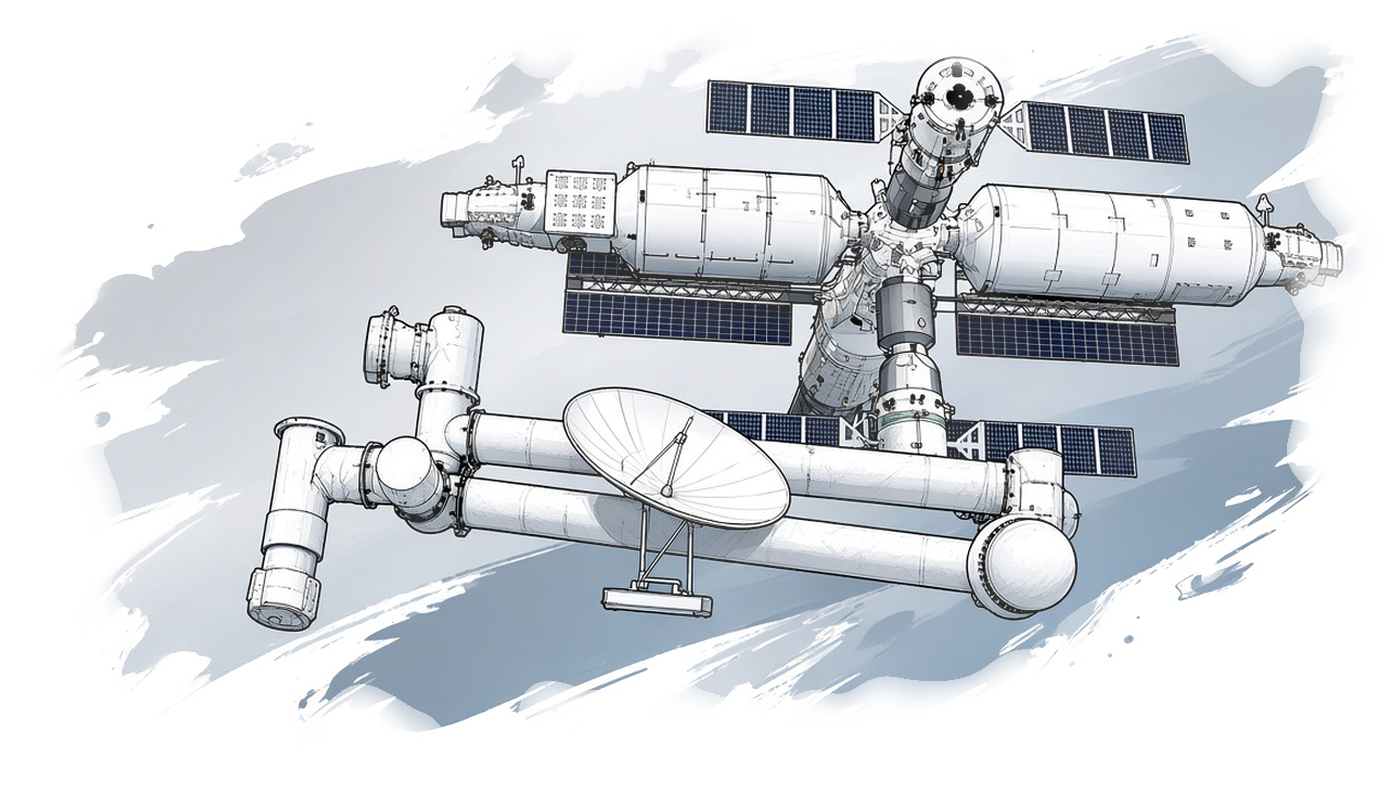
The Tianhe core module of China's Tiangong station, a museum mockup.Illustration by Agentic Newsgathering, based on a photo by Shujianyang / Wikimedia Commons (CC0)
Physicists working with the Cold Atom Physics Rack on China's Tiangong space station have produced a Bose-Einstein condensate of rubidium atoms at about 9.7 picokelvins — less than ten-trillionths of a degree above absolute zero — according to a paper published in Science. That is roughly four times colder than the previous space record of 52 picokelvins set by NASA's Cold Atom Lab on the International Space Station, and colder than a 38-picokelvin drop-tower result on Earth. The Chinese apparatus uses nested optical dipole traps instead of a magnetic atom chip, then lets the cloud expand while researchers track it for about seven seconds in microgravity. Xuzong Chen of Peking University, the project's chief scientist, said the expansion cuts the atoms' interaction energy while holding their number steady. Outside researchers including Ernst Rasel, Holger Mueller and Hélène Perrin called the result impressive and useful for tests of gravity and the equivalence principle. Weibiao Chen said the facility is open to international users.
How cold, and how they got there
A Bose-Einstein condensate is a state in which atoms occupy a single macroscopic quantum wave. Building one usually means trapping a gas and stripping away energy until the atoms barely move. On Earth, gravity sags the cloud against the trap and limits how cold it can get. In orbit, that sag goes away.
CAPR first held about two million rubidium atoms in a tight optical trap, then lowered the laser power so hotter atoms escaped, leaving a much smaller, colder sample — on the order of a couple of thousand atoms at a few nanokelvins — before expanding them into a wider trap. In the end the atoms moved at speeds under 200 micrometers per second, Science's Adrian Cho reported, corresponding to about 10 picokelvins; the paper's headline figure is 9.7. The paper was published November 5 in Science. Science News described the work as cooling about 20,000 rubidium atoms into the same ultracold regime aboard Tiangong.
Why seven seconds matter
When the trap is switched off, the cloud expands. Mueller, at the University of California, Berkeley, told Science that seven seconds of free expansion in orbit may matter even more than the temperature itself. Long, quiet expansion times help interference experiments that ask whether gravity pulls equally on different kinds of atoms — a core claim of Einstein's equivalence principle. Perrin, at Sorbonne Paris Nord University, noted that optical traps can hold atoms in different internal states at once, which magnetic chips generally cannot, opening more ways to tune interactions.
Rasel, whose team held the previous ultracold record from a 2021 drop-tower run, congratulated the Chinese group. "I'm very impressed," he said.
What comes next
CAPR researchers say they next want optical lattices — arrays of laser spots that can simulate how electrons move through a crystal — at these temperatures, where noise should be lower. Xiaoji Zhou of Peking University said that work is under way but not in the new paper. Weibiao Chen of the Shanghai Institute of Optics and Fine Mechanics said CAPR is open to scientists outside China. "I would like to invite all of the world scientists to use it," he said.
The station is a Chinese government facility. The result is a temperature, a method and a set of outside assessments. Those are what the record shows.