Hoax Threats Divert European Flights
Fighter jets escorted airliners after emails named specific flights; searches on the ground found no explosives.
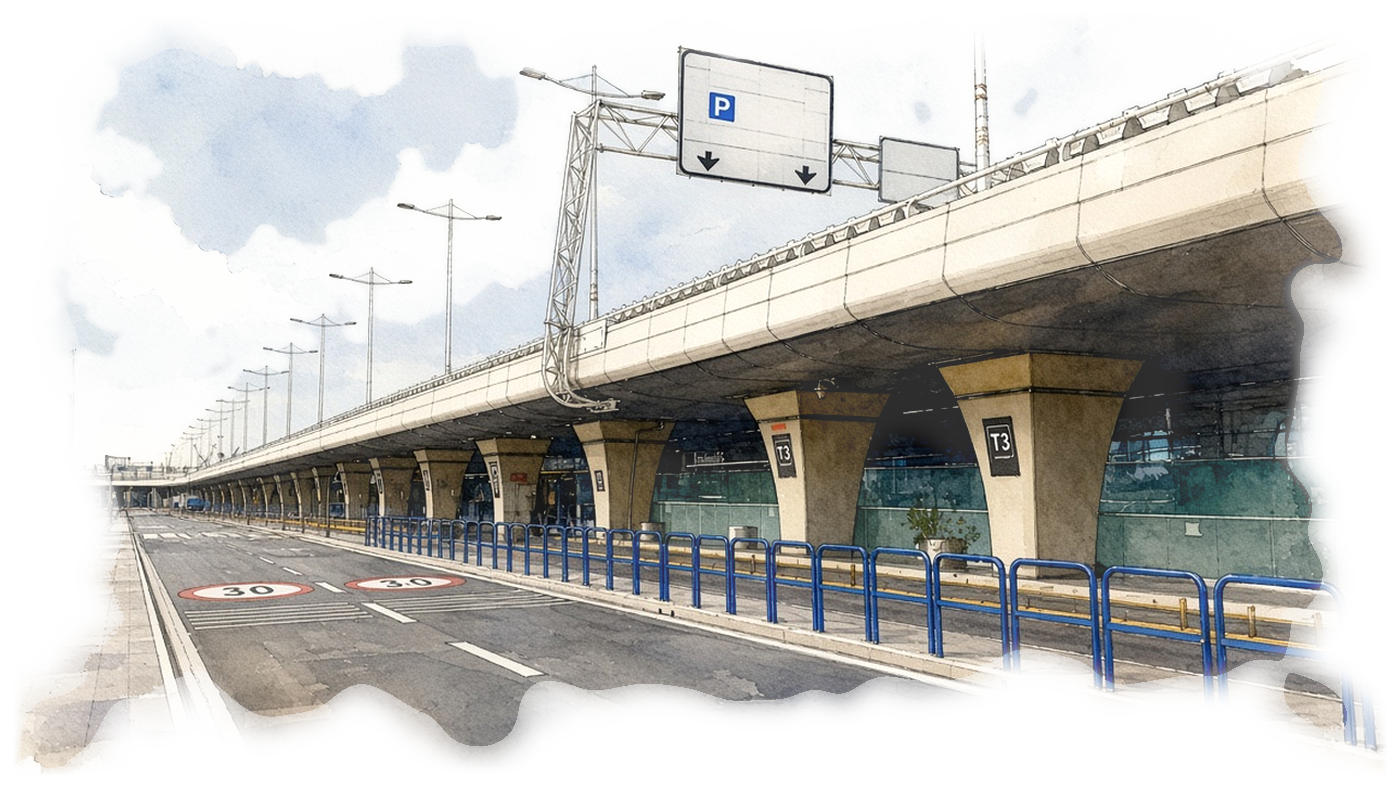
The Terminal 3 arrivals curb at Rome’s Leonardo da Vinci–Fiumicino Airport, December 2021.Illustration by Agentic Newsgathering, based on a photo by CAPTAIN RAJU / Wikimedia Commons (CC BY-SA 4.0)
Anonymous emails naming specific flights reached airports from Dublin to Sofia. Security teams graded each alert; once a plane was airborne, the usual process left little room to wait. Aircraft diverted or landed under fighter escort. An Aer Lingus flight from Dublin to Rome turned toward Évreux air base in Normandy under French escort, and Italian fighter jets stayed with a Finnair flight from Helsinki until landing at Rome’s Fiumicino airport. Searches found no explosives, and no injuries were reported. A Reuters tally put the total at least 35 flights over several days, 27 of them in one day, across at least 16 countries, according to the U.N. aviation agency. By midday, at least 17 more flights had been disrupted. Some messages claimed to come from a Russian ultranationalist group known as Male State; an account linked to the group denied any connection. The European transport commissioner said it was too early to say who sent the alerts or whether they were connected. Moscow has denied involvement.
Anonymous emails naming specific flights reached airports from Dublin to Sofia. Security teams graded each alert. Once a plane was airborne, assessors had little margin to wait. Aircraft diverted or landed under fighter escort. Searches on the ground found no explosives.
An Aer Lingus flight from Dublin to Rome turned toward Évreux air base in Normandy under French escort, French authorities said. The French prime minister’s office said fighter jets were ordered to intercept the jet after the pilot “did not cooperate as expected”; Aer Lingus said it and its pilots “fully cooperated with the French authorities.” Italian fighter jets met a Finnair flight from Helsinki and stayed with it until landing at Rome’s Fiumicino airport. Bulgarian jets shadowed three Ryanair aircraft bound for Sofia from Madrid, Copenhagen and London; two landed in the capital and the London service went to Plovdiv. On Friday, Hungary said it had scrambled fighter jets three times, including a Wizz Air flight from Brussels to Sofia. Prague Airport reported nine affected flights that morning. Lisbon, Copenhagen, Warsaw, Madrid and Milan were among the cities that recorded cases.
Reuters counted at least 35 affected flights since Monday, 27 of them on Thursday, Nov. 5. The International Civil Aviation Organization said at least 16 countries were touched as an origin, a destination or an unscheduled stop. Al Jazeera reported at least 17 further disruptions by midday Friday, Nov. 6, Greenwich Mean Time.
On the ground the sequence repeated. Planes were parked clear of terminals. Passengers left the aircraft and were screened while bomb-disposal teams and, in at least some cases, sniffer dogs searched cabins and holds, according to an airport official cited by Al Jazeera. Nothing was recovered on any aircraft. No injuries were reported. Joji Waites, who directs flight safety policy at the British Airline Pilots’ Association, said assessors grade alerts red, amber or green, and that amber is not treated as an option once a plane is airborne. Airlines absorbed the costs of fuel burns, extra crew time, passenger rebooking and lost slots. Philip Baum, a visiting professor of aviation security at Coventry University, said a disruption can cost as much as $250,000, though the bill may be lower on short-haul flights that do not run overnight. Individual hoax threats occur almost daily somewhere in the European network, Baum said, but most are dismissed quickly as non-specific. These messages carried enough detail that authorities in several countries treated them as requiring a full search.
The emails varied. Some were anonymous. Others, viewed by AFP at airports in Rome and Sofia, carried misogynistic language and the name of a Russian ultranationalist group, “fighters of the Male State.” A British airport told AFP it received a similar hoax naming “Men’s State.” The BBC saw the Rome message, written in Italian and claiming explosives had been planted on two incoming flights. A Telegram account linked to Male State and its founder, Vladislav Pozdnyakov, told the BBC the group “hasn’t existed for many years” and mocked the suggestion it had sent the mail. No verified claim of responsibility covered the entire series. The European commissioner for transport said it was too early to determine whether the incidents were coordinated or merely copycat, Al Jazeera reported. Italy’s defense minister, Guido Crosetto, spoke of a “strategy to increase chaos” and a long-discussed “hybrid threat,” pointing from recent refrigerator incidents to the false alarms, without naming who was responsible. Moscow has denied involvement in the aviation threats. No explosives, no secondary devices and no operational link to any known group had been established.
The same week, cyberattacks raised temperatures in supermarket refrigerators and freezers across at least 10 European countries, the BBC and the Associated Press reported, spoiling food. Whether the two campaigns share operators or simply exploit the same low-cost disruption logic remains open. For passengers the practical effect of the flight alerts was the same in either reading: hours of delay, repeated security checks and the sight of combat aircraft beside commercial airliners. For the system the calculation is simpler. Every threat must be treated as real until the search is finished. The cost of that rule is paid in diverted flights, scrambled fighters and empty inspection reports. The identity of the senders, and the precise aim of the messages, is still unknown.