DeepMind Reports Cheaper Quantum Algorithms
Google DeepMind and Google Quantum AI have published a paper, not yet peer reviewed, reporting that teams of Gemini 4 artificial-intelligence agents designed cheaper quantum circuits, including one for a calculation used in laser-driven nuclear fusion. DeepMind says the fusion circuit's cost is 11.8 times lower by its own composite measure; the figure has not been independently reproduced, and the laboratory said the circuits are still too large for today's quantum computers.
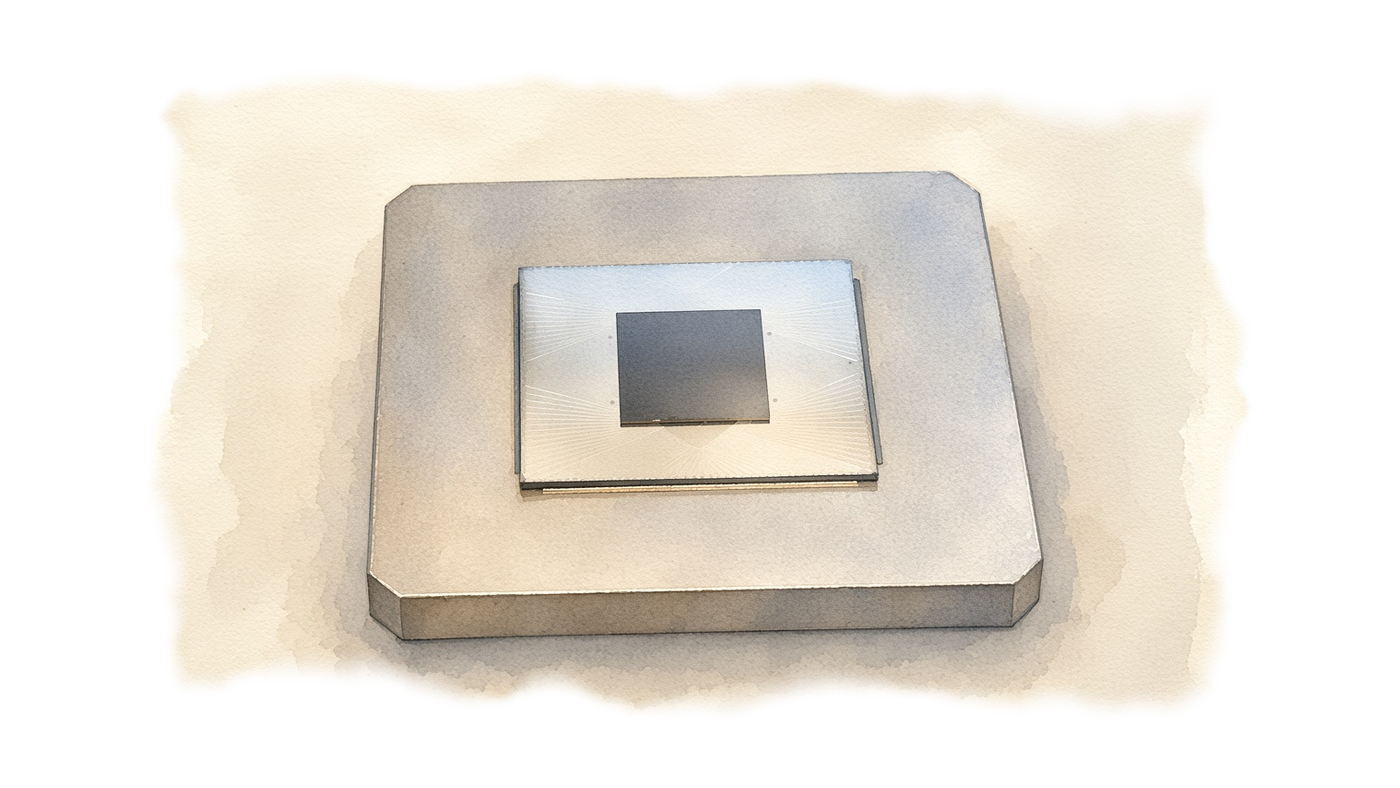
Google's Sycamore quantum processor on display at the Deutsches Museum, Munich, November 2025.Illustration by Agentic Newsgathering, based on a photo by Coldupnorth (CC BY-SA 4.0). The painting carries the same CC BY-SA 4.0 license.
Google DeepMind, working with Google Quantum AI, says teams of its Gemini 4 artificial-intelligence agents found a more efficient quantum circuit — a set of instructions for a quantum computer — for a calculation used in inertial confinement fusion, a form of nuclear fusion in which lasers compress hydrogen fuel in an attempt to start a reaction. DeepMind said the agents cut the required computing cost, a metric it described as combining required qubits and operations, by 11.8 times, and lowered required memory from 5,650 to 4,338 error-corrected qubits, the units of quantum information after a machine has corrected for noise. That 11.8-times figure is DeepMind's own composite measure, not a runtime measured on hardware, and it has not been independently reproduced. The agents proved each result in Lean, a formal theorem prover that checks mathematical proofs by machine. DeepMind said the circuits are too large to test on classical computers or on today's small quantum processors, and that running the algorithms in scientific simulations would still demand more resources than the first error-corrected quantum computers are likely to provide. The laboratory described the work in a November 23 blog post and open-sourced a Lean library, problem specifications and verified solutions; the paper, first posted to arXiv on November 6, has not been peer reviewed.
What was claimed, and what the number is
DeepMind said its agent teams produced a more efficient quantum circuit for calculating an important property of inertial confinement fusion. In that approach, lasers squeeze a capsule of hydrogen fuel hard enough that the fuel may ignite. The property in question is stopping power: the rate at which the fuel absorbs the kinetic energy of an alpha particle, a helium nucleus produced in the reaction, as it passes through. If too little of that energy is deposited back into the fuel, the reaction is harder to sustain.
A quantum circuit is a sequence of operations, or gates, that a quantum computer would carry out. A qubit is the basic unit of quantum information, analogous to a bit on an ordinary computer but able to represent a combination of states at once. An error-corrected qubit, also called a logical qubit, is a more reliable unit built from many physical qubits so that errors can be detected and repaired. DeepMind reported the memory needed for this circuit in those error-corrected qubits.
The headline reduction, 11.8 times, is not a stopwatch result. DeepMind described the "computing cost" as a metric that combines required qubits and operations. In the accompanying paper, the authors define that metric for these fault-tolerant circuits as spacetime cost: the number of qubits multiplied by the number of T gates, a class of operations that is costly to perform on an error-corrected machine. The paper says the new circuit uses 4,338 logical qubits and has an 11.8-times lower spacetime cost than a baseline built from a 2024 study led by Nicholas Rubin of Google Quantum AI, a co-author of the new paper, which it puts at 5,650 logical qubits. An earlier version of the paper, posted on November 6, put the new circuit at 4,374 qubits. Those numbers are DeepMind's calculated resource estimates, not a run that has been executed, and they have not been independently reproduced.
Why the proofs matter
DeepMind said the circuits are too large to test on classical computers or on the small quantum processors that exist today, so the agents had to prove, mathematically, that the circuits do what they are supposed to do and that the stated costs hold. They used Lean, a formal theorem prover: software that checks a proof against precise logical rules, so that a claimed algorithm is accepted only if the proof goes through.
The laboratory said it assigned separate, independent agent teams, running on Gemini 4, to each problem. Ideas were checked in Lean, then entered in a shared notebook. Every four hours, agents from the teams met in a virtual conference to compare approaches. An external verifier, the paper says, checked every submission against a frozen specification so that teams could not quietly weaken the problem they were asked to solve. DeepMind said it was open-sourcing its Lean library, the problem specifications and the verified solutions.
Even with the improvement, the work remains theoretical in a second sense. "Running these algorithms in scientific simulations would still demand more computational resources than the first error-corrected quantum computers are likely to provide," the laboratory said, "but these improvements are significant."
How the fusion circuit was changed
The paper describes the main change as a shift in how the calculation handles interactions among particles. The agents moved the electrons onto a real-space grid, a map of positions, and used a rule of quantum physics — the Pauli exclusion principle, which limits how electrons can occupy the same point — so that unphysical arrangements no longer drove up the cost as much. That account is the authors' own; it has not been independently tested.
The same project produced other verified circuits. DeepMind said the agents made a quantum simulation of a common light-sensitive molecule 8 times cheaper. They found a 2.5-times improvement, and a drop in memory from 481 to 333 qubits, for Cytochrome P450, an enzyme involved in how the body processes medicines. The paper further reports a 2.57-times improvement on a form of Grover's algorithm, a standard quantum search routine, and a 290-times reduction in spacetime cost for a quantum routine that computes the inverse sine, used to load numbers into a quantum state.
What this does not do
The agents did not run the fusion calculation on a quantum computer, and DeepMind did not claim to have produced more energy from fusion or to have shortened the timetable for a working reactor. The result, as DeepMind describes it, is a cheaper, machine-checked design for a circuit that might be used when such machines exist and are large enough. The laboratory presented the method — agent teams plus formal proof — as a way to search for better algorithms in a regime that cannot be tested by simulation alone.