Ariane 6 Launches Amazon Satellites
Arianespace has launched 36 Amazon Leo internet satellites on an Ariane 6 rocket, the European launcher's tenth flight, from Europe's Spaceport in Kourou, French Guiana. The company said the satellites were delivered into low Earth orbit, the band of space a few hundred kilometers above the planet where many communications satellites operate.
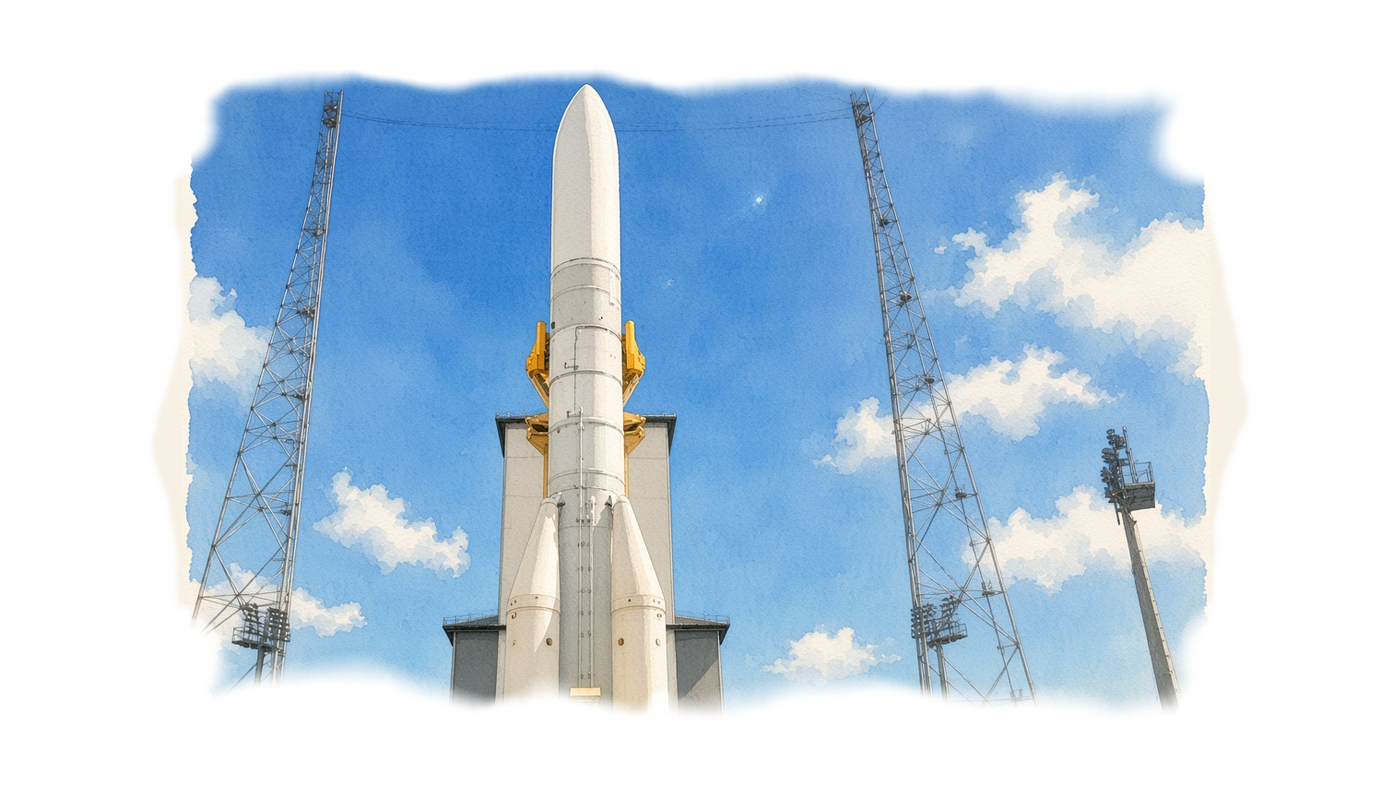
A two-booster Ariane 6 rocket stands on the pad at Europe's Spaceport in Kourou, French Guiana, after a test removal of the mobile gantry, June 2023.Illustration by Agentic Newsgathering, based on a photo by ESA / M. Pédoussaut (CC BY-SA 3.0 IGO). The painting carries the same CC BY-SA 3.0 IGO license.
Arianespace has launched 36 Amazon Leo internet satellites on an Ariane 6 rocket, the European launcher's tenth flight, from Europe's Spaceport in Kourou, French Guiana. The flight, designated VA271 by Arianespace and Leo Europe 4 by Amazon, used the Ariane 64 configuration, which has four solid-rocket boosters strapped to the core. Arianespace said liftoff was at 8:14 a.m. local time on November 24 and that the mission lasted 2 hours and 4 minutes from liftoff to the separation of the last satellites, which it said were delivered into low Earth orbit at an altitude of approximately 460 kilometers. The company said this was its fourth Ariane 6 mission this year for Amazon Leo and brought to 136 the number of Leo satellites it has placed in orbit. Amazon, which is preparing to offer satellite internet to customers beyond the reach of existing networks, said the launch brought the Leo constellation to more than 430 satellites. In September, Amazon added six Ariane 64 flights, bringing the contracted total to 24, Arianespace and Amazon said.
A tenth flight from Kourou
Arianespace, the European company that sells commercial launches on Ariane 6, said the rocket lifted off from Europe's Spaceport in Kourou, on the coast of French Guiana, and placed 36 satellites for Amazon's Leo constellation into low Earth orbit.
Liftoff was at 8:14 a.m. local time on November 24, 11:14 a.m. Greenwich Mean Time, Arianespace and the European Space Agency said. Arianespace said the mission lasted 2 hours and 4 minutes from liftoff to the separation of the last satellites, and that the spacecraft were delivered at an altitude of approximately 460 kilometers. Amazon said its team in Redmond, Washington, then took control of the satellites and would raise them to an assigned operational altitude of 392 miles, or 630 kilometers, and commission them for service.
The flight was designated VA271 by Arianespace and Leo Europe 4, or LE-04, by Amazon. It was flown in the Ariane 64 configuration, with four solid-rocket boosters around the core, which the European Space Agency called the rocket's most powerful configuration. The agency said the flight was the tenth successful mission insertion in a row for the rocket. Arianespace said Ariane 6 first flew in July 2024. Arianespace listed the flight as its 363rd launch, its fifth of 2026, the tenth Ariane 6 launch and the fourth Ariane 64.
Amazon's Leo constellation
Amazon Leo is Amazon's planned low-Earth-orbit satellite internet network, formerly called Project Kuiper. The company says its aim is to deliver internet to customers and communities beyond the reach of existing networks. Steve Metayer, Amazon Leo's vice president of production, said the Leo team works "side by side with Arianespace on everything from satellite integration to launch day operations." "LE-04 is another strong result for that partnership, and we're looking forward to many more missions together as we prepare to roll out Amazon Leo to customers," he said.
Arianespace said this was its fourth Ariane 6 mission this year for the constellation and that the flight brought to 136 the number of Leo satellites it has placed in orbit. Amazon, in a post on the launch, said Leo Europe 4 "brought the total Amazon Leo constellation to more than 430 satellites."
David Cavaillolès, Arianespace's chief executive, said the company had "reached another milestone in the deployment of this ambitious constellation."
The rocket, the boosters and the contract
For the second time, Arianespace said, the launcher flew with P160C solid-rocket boosters, which replaced the earlier P120C motors used on Ariane 6's first flights. The P160C, Arianespace said, is one meter longer inside than the P120C and can hold 156 metric tons of solid propellant. That change, the company said, increases the launcher's performance in low Earth orbit by 10 percent compared with the P120C and brings Ariane 64's payload capacity to approximately 22 metric tons in that orbit. The European Space Agency, describing the same motors, said they can increase Ariane 6's performance by up to 10 to 15 percent depending on the target low orbit, corresponding to around two additional metric tons of payload capacity.
In September, Amazon announced an order for six additional Ariane 64 launches, bringing the total under contract to 24, Arianespace and Amazon said. Christophe Bruneau, chief executive of ArianeGroup, which builds the rocket, called the tenth mission "clear evidence of the industrial ramp-up now under way."
On November 15, United Launch Alliance "experienced an anomaly with the Vulcan rocket carrying Leo satellites, and the payload was lost," Amazon said on its mission-updates page, which lists 40 satellites on that flight. "There is risk with any launch, and that's especially true for inaugural missions like LV-01," Amazon said in a statement. "ULA has been a trusted partner for Amazon, and we believe they'll learn from this mission and deliver on their long-term plans for Vulcan."