China Flies Its First Foreign Astronaut
China launched the Shenzhou-24 crew to its Tiangong space station, sending Muhammad Zeeshan Ali of Pakistan, the first foreign astronaut to fly to the station and the first foreigner on a Chinese crewed flight. Xinhua, citing the China Manned Space Agency, said the spacecraft successfully docked with the station.
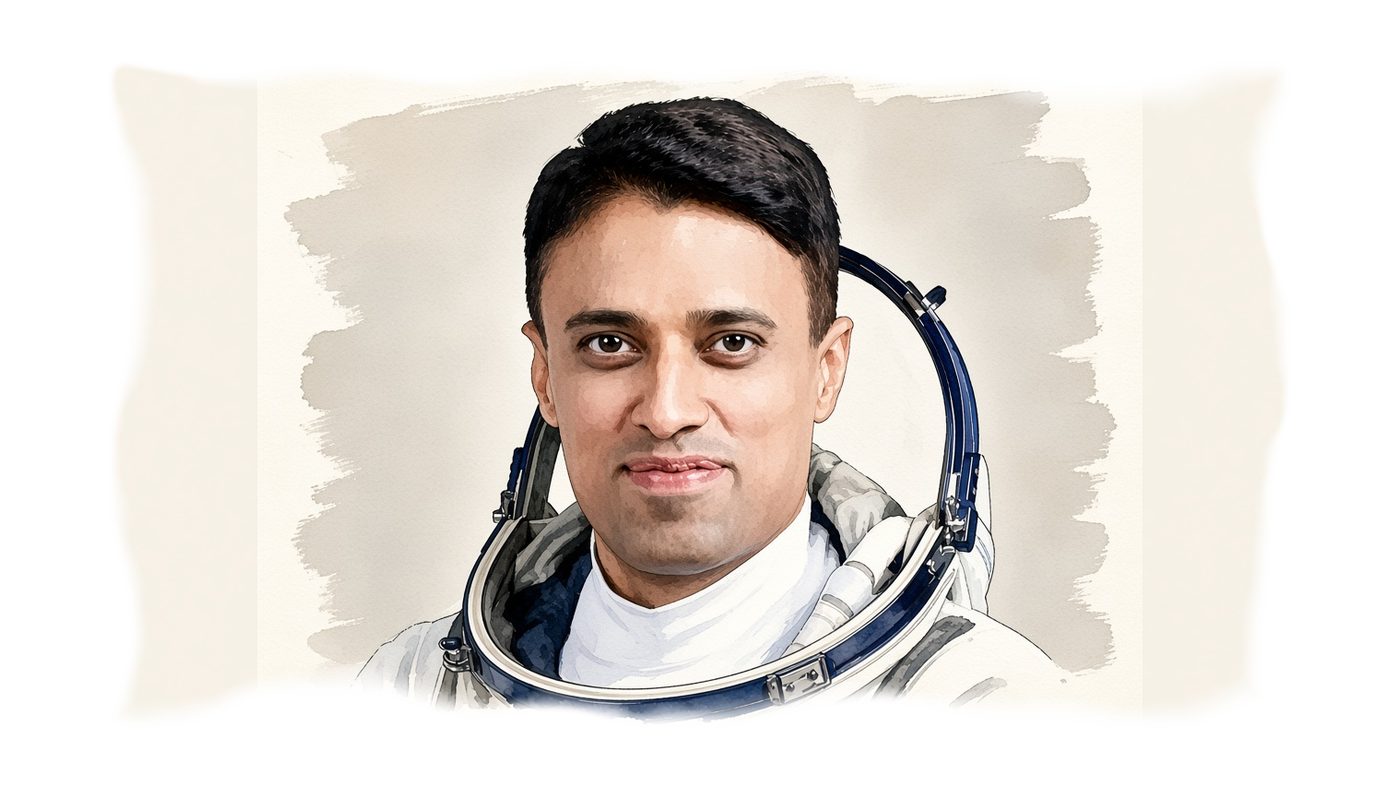
Pakistani astronaut Muhammad Zeeshan Ali in his spacesuit, November 2026.Illustration by Agentic Newsgathering, based on a photo by China News Service (CC BY 4.0). The painting carries the same CC BY 4.0 license.
China launched the Shenzhou-24 spacecraft from the Jiuquan Satellite Launch Center, in the Gobi Desert, carrying Tang Hongbo, Wu Yi and Muhammad Zeeshan Ali of Pakistan, the first foreign astronaut to fly to China's Tiangong space station and the first foreigner on a Chinese crewed flight. Liftoff was at 7:18 p.m. ET on November 24, 8:18 a.m. Beijing time on November 25, on a Long March 2F rocket. Xinhua and the Associated Press said the craft separated from the rocket and entered its planned orbit; the BBC said officials declared the launch a complete success. Xinhua, citing the China Manned Space Agency, said the spacecraft successfully docked at the forward port of the Tianhe core module, the station's central living and control unit. Ali is due to stay about a week and return with two of the three Shenzhou-23 astronauts already on board, Zhang Zhiyuan and Li Jiaying. Tang, who is making his third visit to the station, and Wu, on his first flight, are due to remain.
Liftoff from Jiuquan
The Long March 2F rocket carrying Shenzhou-24 lifted off from the Jiuquan Satellite Launch Center. Xinhua, the official Chinese news agency, named the crew as Tang Hongbo, Wu Yi and Muhammad Zeeshan Ali. The Associated Press said the spacecraft successfully separated from the rocket and entered its predetermined orbit. The BBC, citing official statements, said the mission was declared a complete success, that the craft had entered its preset orbit and that systems were functioning well.
Liftoff was at 7:18 p.m. ET on November 24, which was 8:18 a.m. on November 25 in Beijing. Tiangong, whose name is often rendered as "Heavenly Palace," is China's permanently crewed orbital station, assembled in low Earth orbit and operated by the China Manned Space Agency. Shenzhou, "Divine Vessel," is the agency's crewed spacecraft. Jiuquan, in the Gobi Desert in northwest China, is the launch site used for China's crewed flights. The Long March 2F is the rocket assigned to those flights.
The first foreign astronaut on Tiangong
Xinhua said Ali is the first foreign astronaut to visit Tiangong and that Shenzhou-24 is the first joint Chinese-foreign flight in the manned space program. At a pre-launch briefing, Zhang Jingbo, a spokesman for the agency, said the mission would be the first time a Chinese crew flew with a foreign astronaut.
The Associated Press said Ali is 40, Tang is 51 and Wu is 39. Ali is a former Pakistan Air Force pilot, Xinhua reported. Tang is on his third visit to the station, which the agency said makes him the first Chinese astronaut to go there three times. Wu is on his first spaceflight.
Ali began training at the Astronaut Center of China in Beijing in April, Al Jazeera reported. Zhang said China looked forward to working with more countries and regions in space, Xinhua reported. Officials have described the flight as a step in space cooperation between China and Pakistan.
Docked at the Tianhe core module
After reaching orbit, Shenzhou-24 docked at the forward port of the Tianhe core module, Xinhua said, citing the China Manned Space Agency. Tianhe is the station's central module, the unit that houses the main living quarters and controls. Officials had said a successful docking would form a three-module, three-ship combination: the station's three core modules plus three visiting spacecraft. The BBC had reported that docking was due about three and a half hours after launch.
A short stay, and a longer one
Pakistan's Space and Upper Atmosphere Research Commission said Ali is due to remain on Tiangong for about a week, Al Jazeera reported. He is scheduled to return to Earth on the Shenzhou-23 spacecraft with two of the three astronauts already on board, Zhang Zhiyuan, the return commander, and Li Jiaying, Xinhua reported. After the crews change over, Tang and Wu are due to remain at the station with Zhu Yangzhu, a Shenzhou-23 astronaut who, the China Manned Space Agency said, will continue a year-long stay in orbit.
Xinhua said the mission plans more than 90 experiments and technology tests, including work using a cold-atom interferometer, a precise instrument that uses clouds of ultra-cold atoms to measure motion, and studies of how the space environment affects vascular aging. Ali is to work on four China-Pakistan projects in biotechnology and materials and run an experiment on photosynthetic cyanobacteria, Zhang Jingbo, the agency's spokesman, said, according to Xinhua.
The outgoing Shenzhou-23 crew had been on the station since May 25, the China Manned Space Agency said. Once the handover is completed, the usual pattern is for the arriving Chinese astronauts to begin a roughly six-month tour; Ali's visit is shorter by design.