Russian Warship Sinks in Libya
A Russian navy corvette, the Merkury, sank at its pier in Benghazi after explosions that officials of Libya's eastern government blamed on suspected Ukrainian sea drones. No one has claimed responsibility for the attack, and there was no immediate comment from Russian authorities.
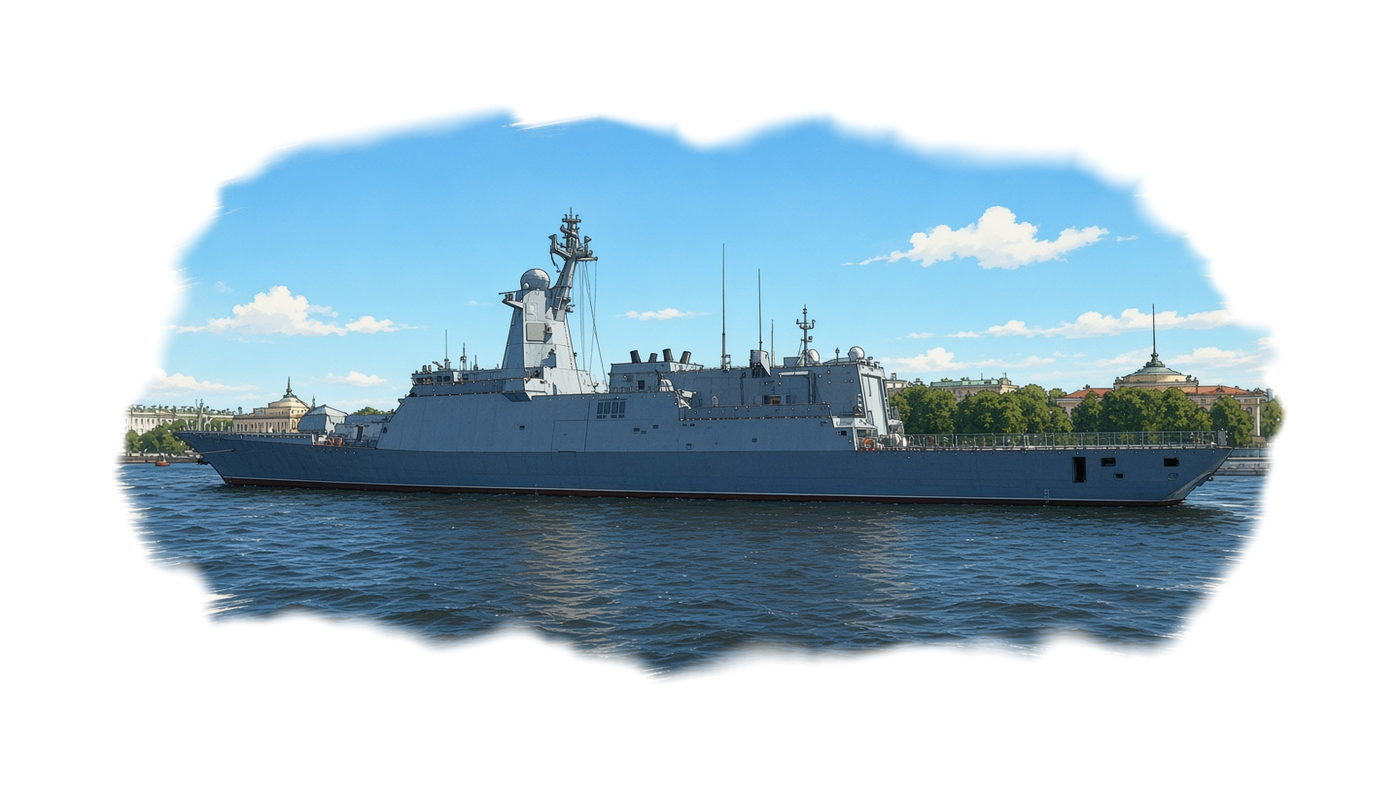
The Russian navy corvette Merkury in St. Petersburg during the Navy Day parade, July 2022.Illustration by Agentic Newsgathering, based on a photo by 13243546A (CC BY-SA 4.0). The painting carries the same CC BY-SA 4.0 license.
The Russian navy corvette Merkury sank at its pier in the eastern Libyan port of Benghazi after explosions that officials of the country's eastern government blamed on suspected Ukrainian sea drones. Officials told the Associated Press that at least four drones were intercepted and destroyed and that two struck the warship. The vessel had docked to refuel and take on supplies on its way back to Russia. Satellite images from the firm Vantor showed the ship capsized, with only its bow visible above the water and debris along the pier. Hours later, officials said, a sea drone hit a cargo ship off Benghazi; the eastern government's health ministry said the crew was rescued and that some members had minor injuries. No one has claimed responsibility, and there was no immediate comment from Russian authorities. Benghazi is controlled by the Libyan National Army, led by Gen. Khalifa Haftar, which is aligned with Russia. Prime Minister Osama Hammad of the eastern-based government asked the United Nations for an international investigation, Al Jazeera reported, including into whether the drones were launched from western Libya.
A corvette sinks at the pier
A Russian navy corvette, the Merkury, capsized and sank at its berth in Benghazi after explosions at the port. Officials of Libya's eastern government said the ship had been struck by suspected Ukrainian sea drones. The officials told the Associated Press, the Guardian reported, that several Ukrainian sea drones were launched at the vessel, that at least four were intercepted and destroyed, and that two hit the warship and set off an explosion.
The Merkury had stopped in Benghazi to refuel and take on supplies while returning to Russia, the officials said, under a cooperation arrangement with the eastern authorities. Satellite imagery from the company Vantor showed the corvette capsized, with only its bow still visible above the water, smoke rising from part of the superstructure and debris scattered along the pier. Al Jazeera described the Merkury as a small warship.
The eastern administration said port and naval-base facilities, including warehouses, were safe, that the fire had been brought under control, and that normal operations would resume once the site was secured. It condemned the suspected attack as a violation of Libya's sovereignty and a threat to maritime safety. "The Libyan government will not allow Libyan ports, territory or territorial waters to be turned into an arena for settling scores or exporting international conflicts," it said. Al Jazeera reported that the statement added that Libya was not a party to the war between Russia and Ukraine.
No one has claimed responsibility for the strike, and there was no immediate comment from Russian authorities. The Guardian noted that Benghazi is more than 1,000 miles from southern Ukraine.
A second ship, and a request to the United Nations
Hours later, officials said a sea drone struck a cargo ship off the coast of Benghazi. The eastern government's health ministry said the crew had been rescued and that some members were in stable condition with minor injuries. The Guardian named that ship as the Ascalon, a Russia-linked cargo vessel said to be carrying military supplies. Al Jazeera described it as a Malta-flagged commercial vessel and did not use that name.
Benghazi is held by the self-styled Libyan National Army, led by Gen. Khalifa Haftar, which controls eastern and southern Libya and has been aligned with Russia. Russian ships have used the port to supply Russian mercenary forces in Africa. Libya has been split, since 2011, between a United Nations-recognized government in Tripoli and a rival administration in the east.
Prime Minister Osama Hammad of the eastern-based government said his administration had submitted a formal request to the United Nations General Assembly and Security Council for an international investigation, Al Jazeera reported. Hammad asked for an inquiry into suspicions that the boats had been launched from western Libya and for verification of the presence of Ukrainian experts in the country, as well as formal explanations from Kyiv. Unnamed sources told the Associated Press, according to Al Jazeera, that the drones had been launched from a base run by Ukrainian forces in western Libya. Those launch claims have not been independently confirmed.
The United Nations mission in Libya expressed serious concern over the two drone attacks off Benghazi and called for an immediate, independent and transparent investigation, the Guardian reported. The eastern authorities said they had opened a joint investigation with Russia to "uncover the circumstances of the attack, its source, and the party behind it" and would take legal and diplomatic measures against anyone found responsible. The naval analyst H.I. Sutton told the Guardian that the attack was probably conducted by sea drones, after a photograph of one emerged that appeared to have been taken off the Libyan coast. He said the drone was "also likely the type used in the subsequent attack" on the cargo ship.
In a separate episode the day before, a drone struck the Russian cargo ship Sparta II in the Baltic Sea near Finnish waters. Finland's border guard attributed that strike to Ukraine. In March, a Russian liquefied-natural-gas carrier sank off the Libyan coast after an attack that President Vladimir Putin of Russia blamed on Ukraine.