Riemann Proof Passes Machine Checks
Prime numbers are essential to widely used encryption that protects online banking and other communications, and a proof that has now passed machine checks says they are spread out in the pattern the Riemann hypothesis predicts. Scientific American reported that settling the hypothesis gives no known shortcut for breaking that encryption. The proof, which an Anthropic mathematician produced with the company's artificial-intelligence model, was certified by the communities that maintain the Lean proof assistant and its main mathematics library, though it has not been peer reviewed.
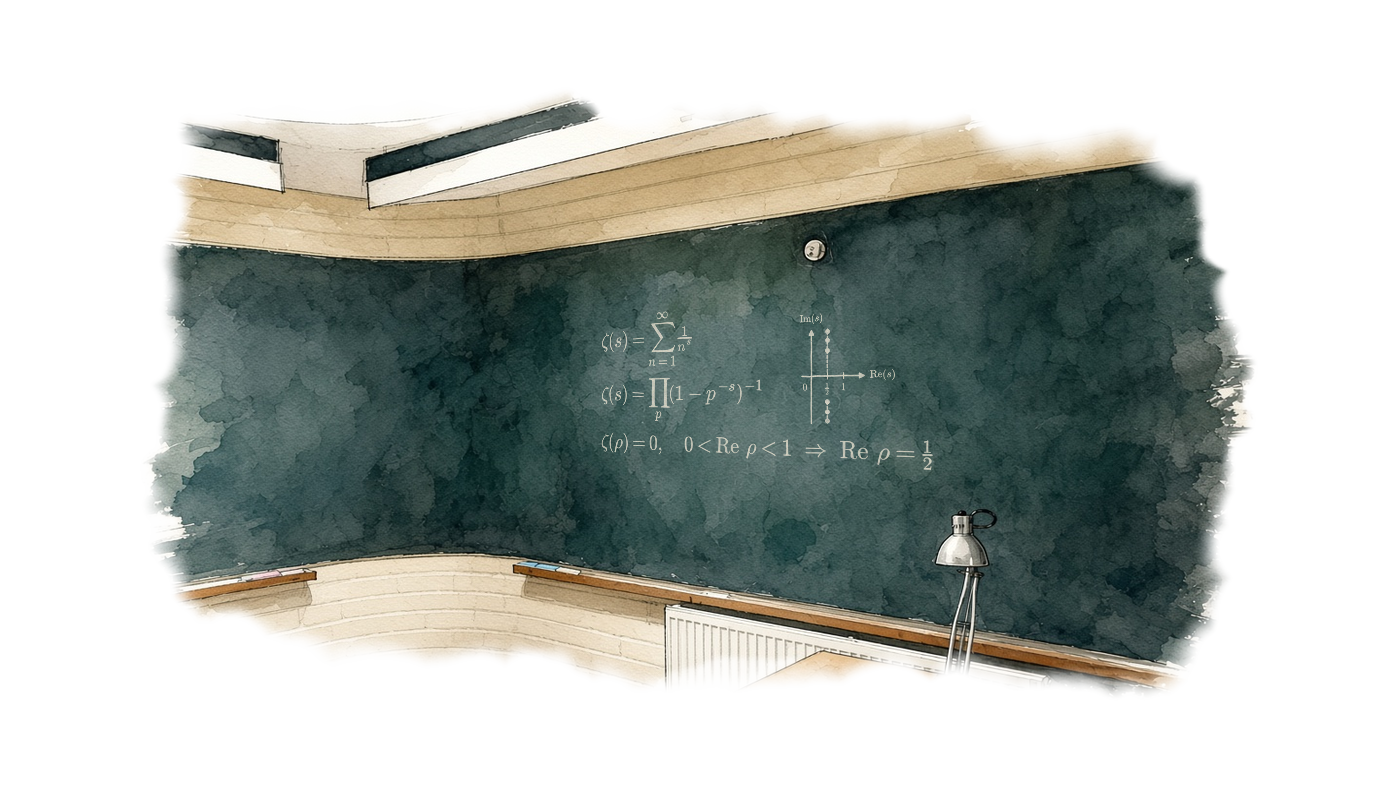
A blackboard in a house for visiting mathematicians at the University of Warwick, England, March 2013, with Riemann hypothesis formulas added by Agentic Newsgathering.Illustration by Agentic Newsgathering, based on a photo by Nicholas Jackson (CC BY-SA 3.0). The painting carries the same CC BY-SA 3.0 license.
Prime numbers are essential to the encryption behind online banking and other communications, and a newly released proof says they are spread out in the pattern the Riemann hypothesis predicts. Scientific American reported that the result gives no known shortcut for breaking that encryption. Within mathematics, hundreds of papers already assume the hypothesis is true, a Rutgers University mathematician told the magazine earlier this year. Levent Alpöge, a mathematician at the San Francisco company Anthropic, released the proof, written in the Lean language, and said he produced it over about six weeks with Claude, the company's artificial-intelligence model. The hypothesis was first posed in 1859. The Lean Focused Research Organization (Lean FRO) and the Mathlib Initiative said in a joint statement that they have full confidence the proof is correct. Dozens of people compiled the development without errors, the groups said, and it was checked by Lean's official kernel and by independent checkers. The library comprises about 17 million lines of code. Andrew Sutherland of the Massachusetts Institute of Technology told Scientific American the chance that anything is fishy is approximately zero. There is not yet a peer-reviewed, human-readable paper setting out the argument, and the Lean and Mathlib groups said they look forward to work that explains the new ideas.
What it means for encryption and for mathematics
Prime numbers, those divisible only by themselves and 1, are essential to RSA, a widely used encryption scheme whose security depends on how hard it is to break enormous numbers into their prime factors, Scientific American reported. A proof about the pattern of the primes would not threaten online banking or encrypted communications, at least not directly, the magazine said: telling whether a number is prime is a different task from finding the prime factors of the huge numbers behind RSA, and the hypothesis offers no known shortcut for the second.
Inside mathematics, many results depend on the hypothesis. "There are hundreds of papers that prove 'x is true if RH holds,'" Alex Kontorovich, a mathematician at Rutgers University, told Scientific American in May. "We've already been assuming it was true for a long time." New Scientist reported that results built on the assumption that Riemann was right "will now stand on firmer ground." One early example is a fast test for whether a number is prime that the computer scientist Gary Miller published in 1976; it depends on an extended form of the hypothesis being true.
A formal proof, checked by machines
Levent Alpöge, a mathematician who works at Anthropic, has released a formal proof of the Riemann hypothesis written in Lean, a programming language used to check mathematical arguments step by step. He said he produced the argument with Claude, the company's artificial-intelligence model, over about six weeks.
The Lean Focused Research Organization and the Mathlib Initiative, the organizations that maintain the proof assistant and its principal library of formalized mathematics, said in a joint statement that they have full confidence that Alpöge's proof is correct. The development depends directly only on Mathlib, they said, and it proves the statement of the Riemann hypothesis already recorded in that library. They said the work meets four criteria, set out on the Xena project blog, for a complete formal proof: the statement is the accepted one, the library compiles, the code proves exactly that statement and the exported proof is valid. Checkers that accepted it include Lean's official kernel and tools known as con-leche and con-ron, which come with a formal proof, relative to set theory, that they cannot accept a false proof.
Dozens of people compiled the development without errors and reproduced the same raw proof export, the groups said, and two independent comparison tools confirmed that the theorem proved is exactly the statement in Mathlib. The library comprises about 17 million lines of Lean code. Michael Rubinstein, a mathematician at the University of Waterloo, wrote that the release consists of 175,187 files. In checks he ran on November 21, he said, all of those modules compiled, Lean's kernel accepted a replay of the proof, the development used only Lean's three standard axioms, and an independent kernel, nanoda, checked 1,484,729 declarations without errors.
Andrew Sutherland, a mathematician at the Massachusetts Institute of Technology who compiled the development independently, told Scientific American, "Honestly the chance that anything is fishy here is approximately zero." Kevin Buzzard, a mathematician at Imperial College London, had earlier written that the first question was whether the statement in the Lean code matched the actual theorem, and he had awaited a "comparator run" to check the code against tampering and with several independent kernels. Scientific American reported that the run has now been completed.
The groups posted their statement on November 21, a day after Alpöge released the formalization. Alpöge's announcement came one day after Anthropic's stock-market debut, timing he addressed in comments reported by the Guardian. "The precise timing is horrible," he said. "If I could have, I'd have finished this all much earlier."
What the hypothesis asks, and what is still missing
The German mathematician Bernhard Riemann posed the hypothesis in 1859. It concerns the zeros of the Riemann zeta function and, if true, would describe how prime numbers are distributed. In 2000 the Clay Mathematics Institute listed it among seven Millennium Prize Problems and attached a $1 million prize to each.
Alpöge wrote that he and Claude "have had a great time together." In comments reported by the Guardian, he first said Claude "far outpaced me near the finish line," then sharpened the line: "No, Claude flew, and danced, and sparkled near that finish line."
What has not appeared is a paper that mathematicians have refereed through peer review in the usual way. The Lean and Mathlib groups said they look forward to activity in the mathematical community that will help explain the new ideas in the proof.
Rubinstein posted a 164-page working draft, dated November 21 and written with Claude and with the models Codex and Gemini, that attempts to set out part of the argument in prose. He cautioned that a central inequality in the write-up, labeled (M), was taken from the Lean development and has not been proved on paper. He also recorded that the Lean formalization extends to a related statement, the generalized Riemann hypothesis for Dirichlet L-functions.