Climate Talks End Without a Deal
The United Nations climate summit in Antalya, Turkey, ended without adopting its main agreement after the European Union, Britain and other countries rejected a cover decision that did not mention fossil fuels.
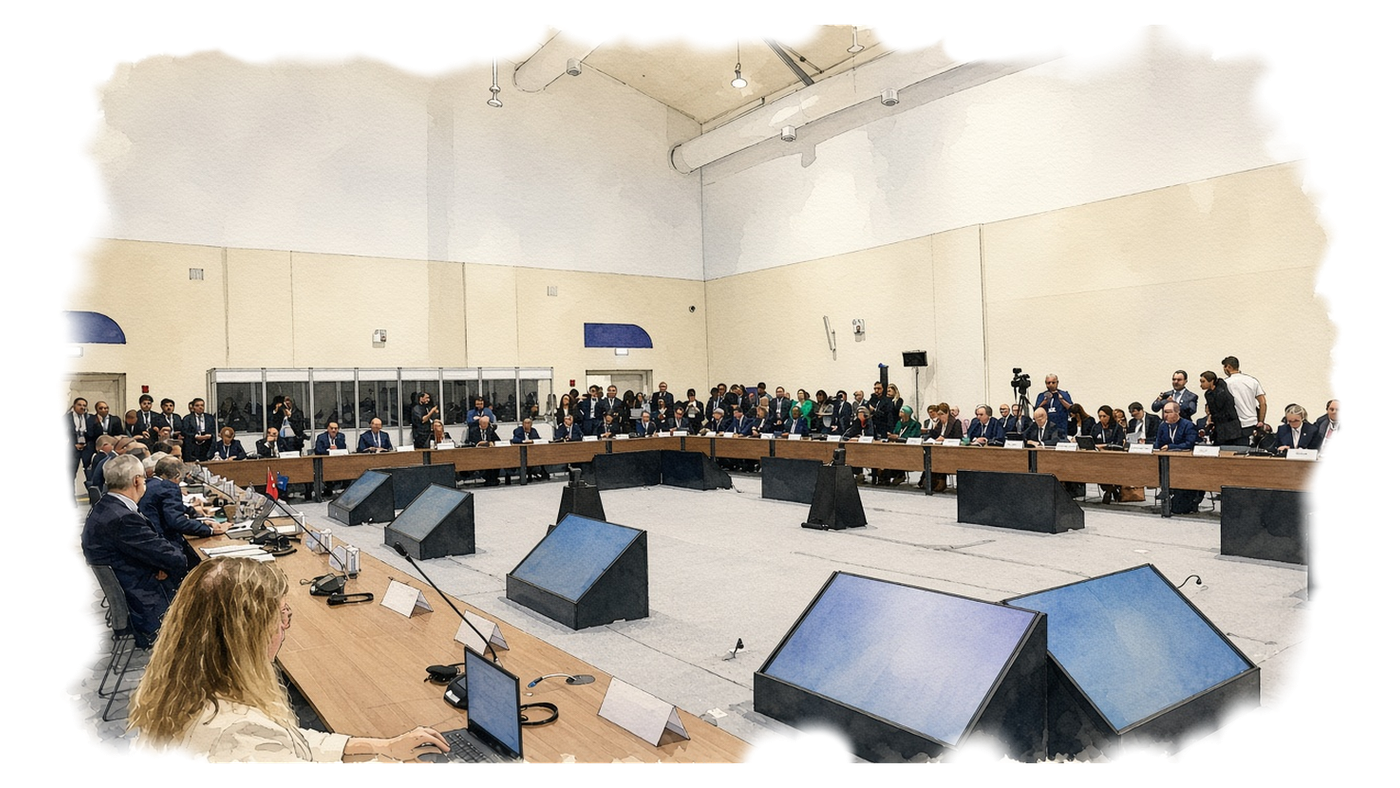
Delegates at a COP31 meeting of energy ministers in Antalya, Turkey, November 10, 2026.Illustration by Agentic Newsgathering, based on a photo by Necati Savas / European Union, 2026, EC - Audiovisual Service (CC BY 4.0). The painting carries the same CC BY 4.0 license.
COP31, the United Nations climate conference in Antalya, Turkey, ended without adopting its main political agreement, a cover decision drafted by the Turkish and Australian co-presidencies and referred to as the Antalya pact. The European Union, Britain, Panama and the Marshall Islands rejected the text, which did not mention fossil fuels and included language on carbon capture and storage. The Guardian reported that Norway also objected. Ireland's environment minister, Darragh O'Brien, speaking for the EU, said the bloc would not endorse a decision that "does not even mention fossil fuels." Murat Kurum, Turkey's environment minister and a conference co-president, told delegates there was no consensus on the document and that the decisions had not been adopted. China, Pakistan and the African Group, speaking through Ghana, did not object. The conference did adopt smaller decisions, including on a just transition. The talks ran two weeks plus two days of overtime and were the longest United Nations climate summit on record. UN Secretary-General António Guterres said he was deeply disappointed and called the outcome a setback. The next conference, COP32, is scheduled for Addis Ababa.
A cover decision that did not pass
The 31st United Nations climate conference closed in Antalya without adopting its central political text. Close to 200 countries had met for two weeks under the joint presidencies of Turkey and Australia.
The talks had been scheduled to end on Friday, continued through two days of overtime and became the longest United Nations climate summit on record. The draft cover decision, known as the Antalya pact, invited countries to electrify their economies, called on richer countries to provide finance to poorer ones for adaptation, and asked governments to minimize an "overshoot" of the 1.5 degrees Celsius warming threshold set in the Paris agreement. It did not mention fossil fuels and did not endorse the "transition away from fossil fuels" agreed at COP28 in Dubai. It included provisions on carbon capture and storage.
Murat Kurum, Turkey's environment minister and a co-president of the summit, told the closing plenary that there was no consensus on the document. "I understand that there is no agreement on this text. For that reason, these decisions have not been adopted," he said, according to UN News. The Guardian quoted him saying the presidencies had not imposed the text or issued a take-it-or-leave-it demand.
Darragh O'Brien, Ireland's environment minister, speaking for the European Union, said the bloc would not endorse a cover decision that "does not even mention fossil fuels, which is the key driver of climate change." He said the text "failed to meet the moment" and that the EU would not accept a decision "that greenwashes fossil fuels." The BBC quoted him saying it was "unconscionable that we would have a climate pact that makes no mention of fossil fuels." Panama and the Marshall Islands raised similar objections. The Guardian reported that Norway did as well. UN News reported that the Marshall Islands said accepting the text would amount to a betrayal of its people. Britain's energy secretary, Miatta Fahnbulleh, told the BBC the failure to reach a political agreement was "immensely disappointing."
Saudi Arabia, speaking for the League of Arab States, defended the carbon-capture language and said scientific assessments have identified a role for the technology. China and Pakistan did not object. Pakistan told the conference that climate action is not a menu from which countries can select only what suits them. Speaking for the African Group, Ghana said the group would not stand in the way of consensus, while criticizing what it called a single generic sentence on the just transition and shortcomings on climate finance and loss and damage.
What passed, and what was said at the close
The co-presidencies avoided a total collapse of the conference by putting through decisions on other items, including a just transition intended to help workers in high-carbon industries move to a lower-carbon economy. Simon Stiell, the executive secretary of the United Nations Framework Convention on Climate Change, told the Guardian the process "certainly fell short today," while saying a significant number of agenda items were passed, with "real progress and concrete results." He told delegates, according to UN News, that the world cannot afford a repeat of the moment, and he pointed to the just-transition agreement and to initiatives under the COP31 Action Agenda.
António Guterres, the United Nations secretary-general, said he was "deeply disappointed" that COP31 had ended without consensus on an overarching outcome. "There may be no consensus in the negotiating room. There is no ambiguity in the science," he said. He called the result a setback that did not change the facts, and he said fossil fuels remain the primary driver of global warming.
Chris Bowen, Australia's climate change minister and a co-president of the talks, defended the presidencies' effort. "Australia left nothing on the field," he said, but the red lines the presidencies had tried to negotiate were "unbridgeable." The BBC quoted him pointing to "the most complicated and fraught geopolitical environment in living memory."
Mohamed Adow, the director of the think tank Power Shift Africa, called the summit "the worst Cop ever," a description reported by the Guardian, and said the EU could not wash its hands of wreckage it had helped create. The Guardian reported that more than 130 countries had demanded a text endorsing a transition away from fossil fuels.
Attention now turns to COP32, scheduled for Addis Ababa, Ethiopia. Stiell said the next conference must build on previous achievements rather than step back. The questions that were left open in Antalya, from fossil-fuel language to climate finance, will meet the parties there.