New Mexico Lets a Fusion Company Use Tritium
The New Mexico Environment Department has approved a radioactive materials license authorizing Pacific Fusion to possess and use tritium at a research campus under construction in Albuquerque, the first such license the state has issued to a private fusion company.
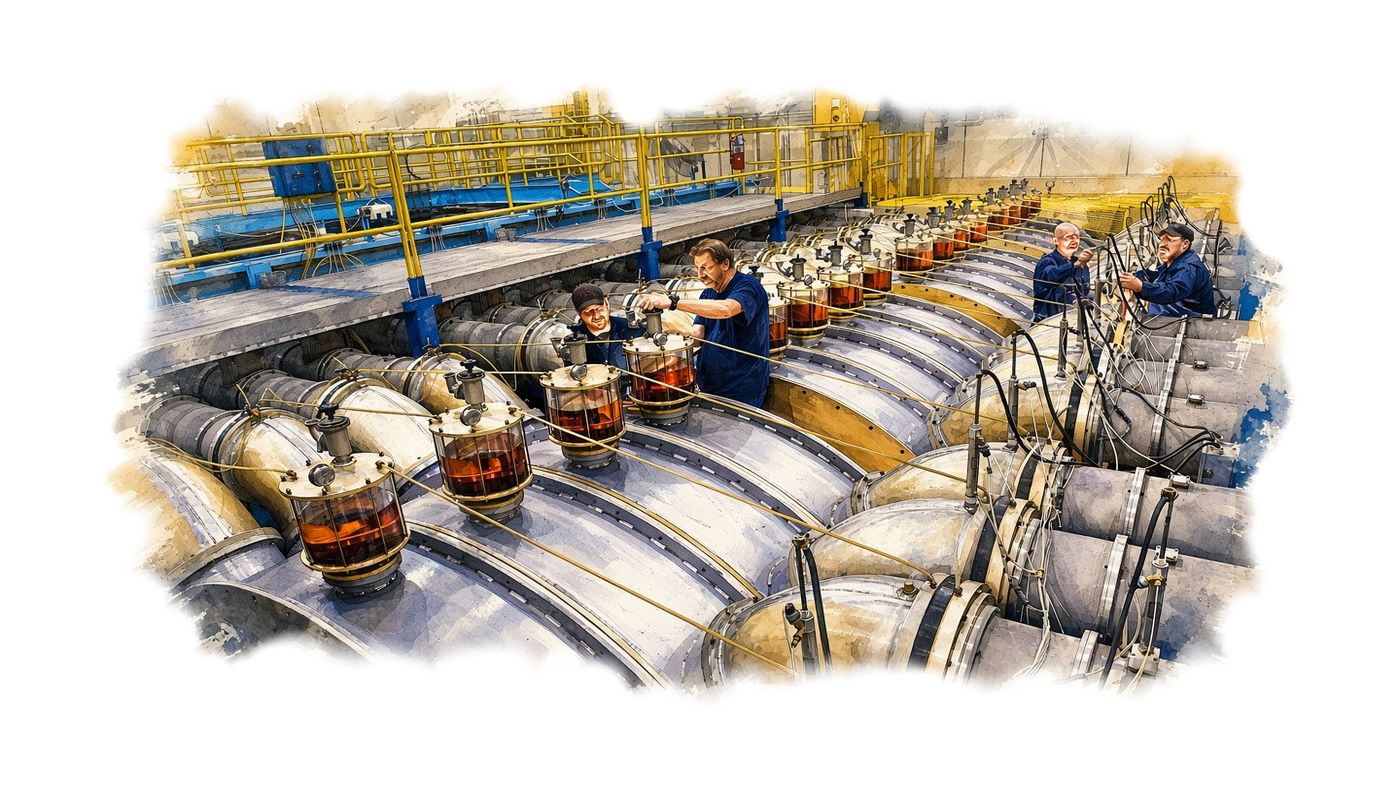
Technicians service the Hermes III pulsed-power machine at Sandia National Laboratories in Albuquerque, August 2011.Illustration by Agentic Newsgathering, based on a US Department of Energy photo (public domain).
The New Mexico Environment Department has approved a radioactive materials license for Pacific Fusion, a California company building a $1 billion research campus at Mesa del Sol in Albuquerque. It is the first license of that kind the state has issued to a private fusion company. The license authorizes the firm to possess and use tritium, a radioactive isotope of hydrogen, in fusion research. The Albuquerque Journal reported that the department granted the license in August and announced it on Friday, and that it allows possession of up to 15,000 curies of tritium, or 1.5 grams. The company has said it will use the material in a closed system and send waste to a licensed facility outside New Mexico. It broke ground on the campus this year and has set a goal of reaching net facility gain by 2030, which it defines as generating more energy output than the energy used to power the system. Environment Secretary James Kenney called the approval "another clear step forward." Carrie von Muench, a co-founder and the chief operating officer, called the license "an essential milestone on our path to putting clean fusion energy on the grid."
A state license for tritium on a new campus
The New Mexico Environment Department has approved a radioactive materials license that allows Pacific Fusion to possess and use tritium at a fusion research campus under construction at Mesa del Sol, on Albuquerque's south side. The company said it is the first radioactive materials license the state has issued to a private fusion company.
Pacific Fusion, which is headquartered in California and was founded in 2023, announced the approval on November 20 and said the license enables it to operate a fusion machine. The Albuquerque Journal reported that the department had granted the license in August and made the decision public that Friday.
Tritium is a radioactive isotope of hydrogen. The Journal, citing the Nuclear Regulatory Commission, said it has a half-life of just over 12 years. The newspaper reported that the license allows Pacific Fusion to possess up to 15,000 curies of tritium, equal to 1.5 grams, and that the company does not plan to hold more than 10,000 curies at once. A company spokeswoman, Joanie Griffin, told the Journal that the tritium would come from a commercial supplier, not from a national laboratory, and she did not name the supplier.
Pacific Fusion has said the tritium will be used in a closed system, meaning the material is meant to remain inside the plant's equipment rather than being released, and that radioactive waste will be disposed of at a licensed facility outside New Mexico. In its statement, the company said fusion is regulated in New Mexico by the Environment Department under a framework similar to that used for hospitals and research facilities.
Kenney, the state environment secretary, said, "New Mexico is proving that we can lead the clean energy transition while creating good-paying jobs and building the industries of the future," and called the approval "another clear step forward." Von Muench said, "This license is an essential milestone on our path to putting clean fusion energy on the grid," and thanked the department for "helping us move quickly and responsibly."
Ground broken, power not yet produced
Pacific Fusion is building a campus it has valued at $1 billion. It broke ground this year; World Nuclear News dated the groundbreaking to August. The company has described a Demonstration System designed to achieve net facility gain by 2030, a target the company defines as generating more energy output than the energy used to power the system. The approach it has described is pulser-driven inertial fusion, in which a pulse of energy is used to compress fuel.
The Journal reported that New Mexico last year approved $776.6 million in industrial revenue bonds for the project, along with $10 million in Local Economic Development Act funds and nearly $4 million in job-training assistance. In its own announcement, Pacific Fusion said the campus is expected to support more than 200 permanent jobs and that it has already hired 90 people at a build center in Los Lunas.