Twin NASA Probes Head for Mars
NASA's two ESCAPADE spacecraft swung past Earth and fired their engines to set course for Mars, the first time the agency has used a powered Earth flyby to get there. They arrive in September 2027.
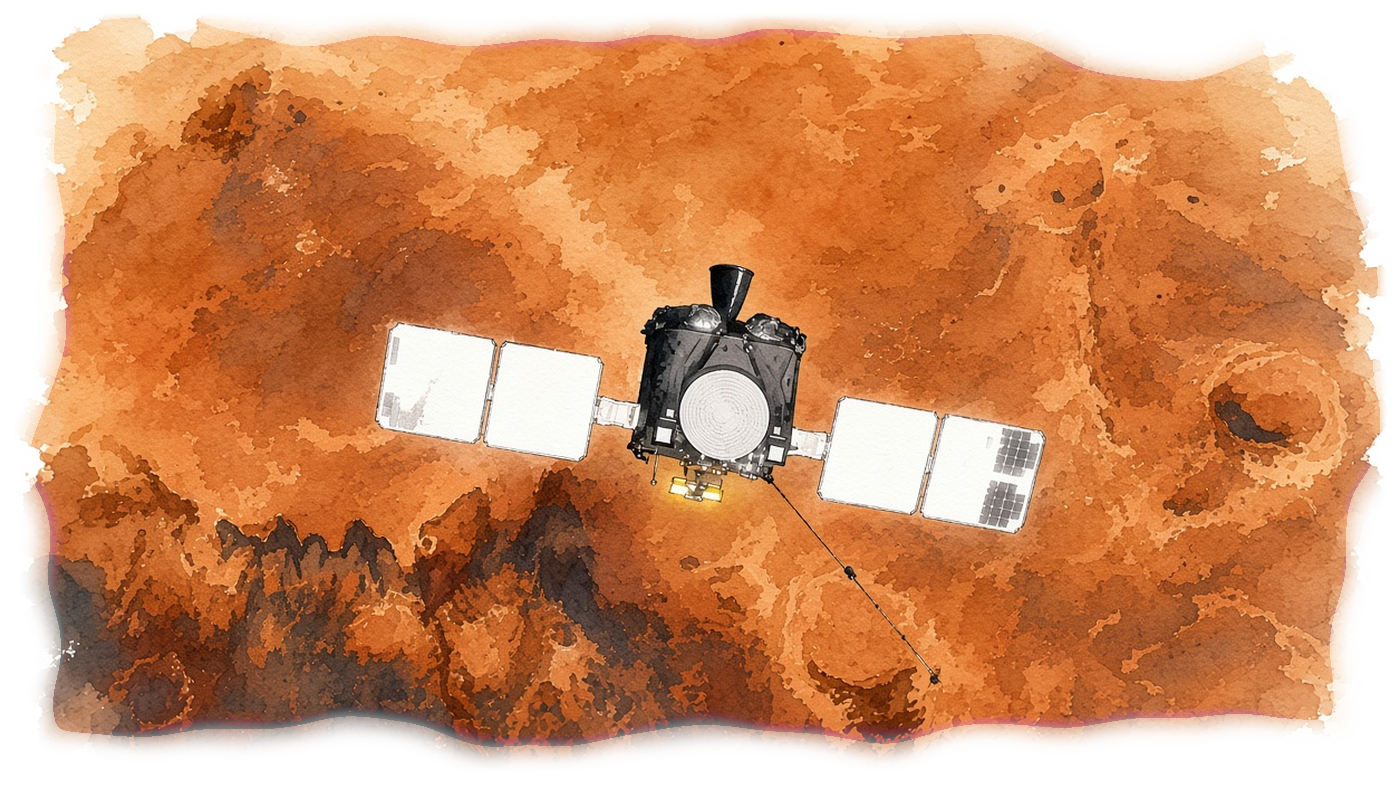
One of NASA's ESCAPADE spacecraft over Mars, from a NASA visualization released in July 2024.Illustration by The Good Times, based on a NASA Scientific Visualization Studio image / Wikimedia Commons (public domain)
NASA's two ESCAPADE spacecraft are on their way to Mars after each flew close past Earth and fired its main engine for about nine minutes, using the planet's gravity and the burn together to slingshot toward the Red Planet. It is the first time NASA has used a powered Earth flyby to send a spacecraft to Mars. "We've now executed this maneuver twice, flawlessly, in just two days," said Asal Naseri, acting associate flight director in NASA's heliophysics division. The probes, nicknamed Blue and Gold and built by Rocket Lab, launched in November 2025 on Blue Origin's New Glenn rocket, when Earth and Mars were on opposite sides of the Sun, and spent nearly a year looping about a million miles from Earth before coming back for the flyby. Mission designer Jeff Parker of Advanced Space said the method lets missions launch almost anytime rather than wait for the planets to line up every two years. The pair reach Mars on Sept. 7 and Sept. 9, 2027, and will fly in formation to study how the solar wind strips away the Martian atmosphere. Science operations are planned to begin in June 2028.
NASA's two ESCAPADE spacecraft, short for Escape and Plasma Acceleration and Dynamics Explorers, are headed for Mars after each completed a powered flyby of Earth. The first, Blue, made its closest approach at about 5 a.m. Eastern on Nov. 7, about 1,000 miles up. The second, Gold, followed at about 6 a.m. on Nov. 9, about 650 miles up. During each pass the spacecraft fired its main engine for about nine minutes, combining the burn with Earth's gravity to slingshot itself onto a path to Mars.
"This is the first time NASA has used a powered Earth flyby to propel a spacecraft toward Mars, and we've now executed this maneuver twice, flawlessly, in just two days," said Asal Naseri, acting associate flight director for NASA's heliophysics division. Rob Lillis of the University of California, Berkeley, the mission's principal investigator, said the burns "were critical in the same way a Mars orbit insertion burn is" and "were executed perfectly."
A different road to Mars
Most Mars missions launch during short windows that open about every two years, when the planets are aligned. ESCAPADE launched on Nov. 13, 2025, on the second flight of Blue Origin's New Glenn rocket, when Earth and Mars were on opposite sides of the Sun. Instead of heading straight out, the pair spent nearly a year in a kidney-bean-shaped loop around a gravitational balance point about a million miles from Earth, then returned for the flyby once the planets lined up.
"This method provides the flexibility to launch almost anytime and then use Earth's gravity to get a boost to Mars, rather than waiting every two years to launch there directly when the planets are aligned," said Jeff Parker of Advanced Space, the lead mission designer.
What they will study
After a 10-month cruise, each spacecraft will fire its engine for about 11 minutes to enter Mars orbit, on Sept. 7 and Sept. 9, 2027. The two will first fly one behind the other in the same orbit, then move into separate orbits, one watching the incoming solar wind and the other measuring how Mars responds in real time. NASA says it will be the first science mission to choreograph two orbiters around Mars. Science operations are planned to begin in June 2028. The aim is to learn how the solar wind, a stream of charged particles from the Sun, drives the loss of the Martian atmosphere, which NASA says could help plan future human missions.
Who built it
The Berkeley Space Sciences Laboratory leads the mission, with Rocket Lab, which built the two spacecraft, NASA's Goddard Space Flight Center, Embry-Riddle Aeronautical University, Advanced Space and Blue Origin. ESCAPADE is the last surviving mission of NASA's low-cost SIMPLEx program; the program's other missions were canceled or failed after launch, and NASA has not asked for new proposals.