Russia and Ukraine Agree a Prisoner Swap
Two days of US-brokered talks in Abu Dhabi ended with a deal in principle on a large prisoner exchange and no breakthrough on ending the war. Trump's envoys now head to Putin, then to Zelensky.
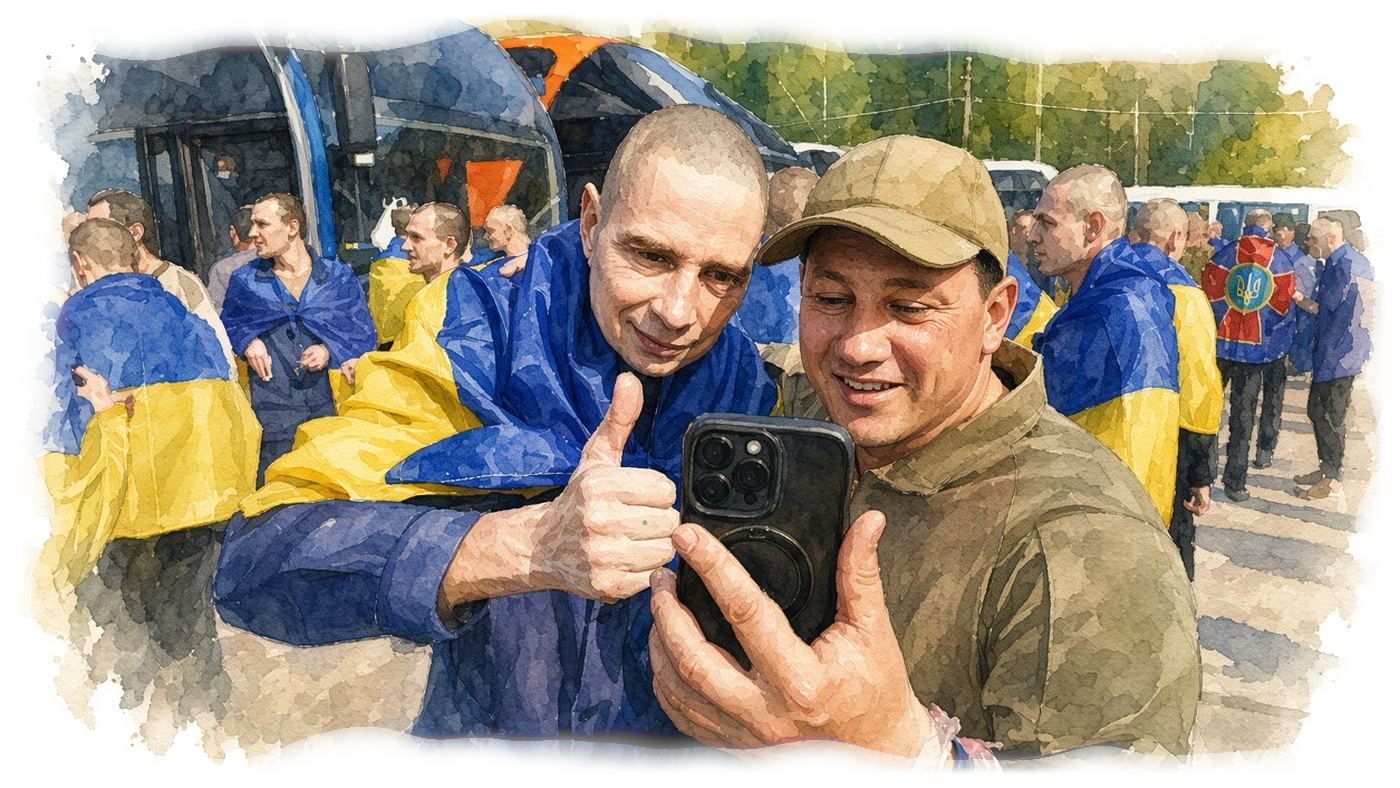
Freed Ukrainian prisoners of war on their return home after an earlier exchange, May 2025.Illustration by The Good Times, based on a photo by the Office of the President of Ukraine / Wikimedia Commons (CC0)
Russia and Ukraine agreed in principle on a large exchange of prisoners of war as two days of three-way talks with the United States ended in Abu Dhabi, the first meeting of the delegations since February. Jared Kushner, President Trump's son-in-law and one of his two envoys, called it "the biggest humanitarian release of prisoners" and said the numbers would be finalized the next day. Russia's state news agency TASS later reported that the exchange should happen in two to three weeks. Vladimir Medinsky, who led Russia's team, and Rustem Umerov, who led Ukraine's, both confirmed the plan; Medinsky said the agreement was "in principle." There was no deal on a ceasefire or on territory. Russia still demands the part of Ukraine's Donetsk region that Kyiv holds, and Medinsky said "every inch" would be "returned to Russia one way or another." Kushner said the hardest question remains territory and that "there is no trust right now between the sides." He and envoy Steve Witkoff fly to Moscow to meet Vladimir Putin, then to Dublin to meet Volodymyr Zelensky. European governments, the EU and NATO were in Abu Dhabi but outside the three-way room; Kushner said getting them added is on his agenda with Putin.
Russia and Ukraine agreed in principle on a large exchange of prisoners of war as two days of three-way talks with the United States ended in Abu Dhabi, the capital of the United Arab Emirates. It was the first face-to-face meeting of the Russian and Ukrainian delegations since a round in Geneva in February.
"One of the positives is we agreed that we're going to have the biggest humanitarian release of prisoners, which we're going to finalize the numbers tomorrow," said Jared Kushner, President Trump's son-in-law, who mediated with envoy Steve Witkoff. Vladimir Medinsky, the head of the Russian delegation, and Rustem Umerov, who led Ukraine's team, confirmed the exchange. Medinsky stressed that the agreement was "in principle" and said details would be announced soon. TASS reported that the exchange should happen in two to three weeks. Kushner said he would take the talks' results to President Vladimir Putin "because we see some openings and some opportunities there," and would then "explore some of the ideas we came up with" with President Volodymyr Zelensky in Dublin.
What did not move
The talks produced no ceasefire and no deal on territory. Ukraine wants to freeze the front line and keep the part of the eastern Donetsk region it still holds, which it says is essential to its security. Russia demands that Ukraine give it up. "Every inch" of land would be "returned to Russia one way or another," Medinsky said.
Kushner said territory remains the hardest question and that a postwar security framework depends on the war ending first, which cannot happen "until there's an agreement on territory and on all other bilateral issues." "These deals are very hard and complex," he said. "The reality is there is no trust right now between the sides and that is to be expected after a conflict like this."
Davyd Arakhamia, a member of Ukraine's team, called the round "one of the hardest" and said the Russians "came with very strict directives," though he said he felt "good momentum" and wants the next round to include Europe. Medinsky said "a lot depends on Ukraine, on the position of the US, and on whether Europe comes to its senses."
Europe outside the room
The second day centered on what both sides called the security architecture of Europe. For Kyiv, that means guarantees that allies would come to its aid if Russia attacked again. For Moscow, it means limits on NATO in Eastern Europe. Medinsky likened the framework he wants to "a new Yalta and Potsdam," the 1940s conferences that divided postwar Europe. Representatives of Britain, other European governments, the EU and NATO were in Abu Dhabi and met separately with the American and Ukrainian teams; the Kremlin said its delegation had no contact with them. Kushner said getting the Europeans "added to the format" would be on his agenda with Putin. Zelensky, who did not attend the talks, said it was not possible to think about European security "without Europe." A German government spokesperson said agreements cannot be carried out "if no consensus can be reached among Nato members."
Next stops
Kushner and Witkoff fly to Moscow to meet Putin on Nov. 12, then to Dublin to brief Zelensky.
The fighting continued during the talks. Russia's Defense Ministry said it downed 627 Ukrainian drones overnight; a regional governor said drones started a fire at the Baltic port of Ust-Luga, one of Russia's main oil-export terminals, injuring three workers. In Ukraine's Odesa region, local officials said a Russian daytime attack on a market killed three people and injured 11.