Fossil Emissions Set to Dip
The world's carbon dioxide from fossil fuels is projected to fall 0.4% this year, mostly because less oil is being burned, the Global Carbon Project says. US emissions are set to fall 1.3%.
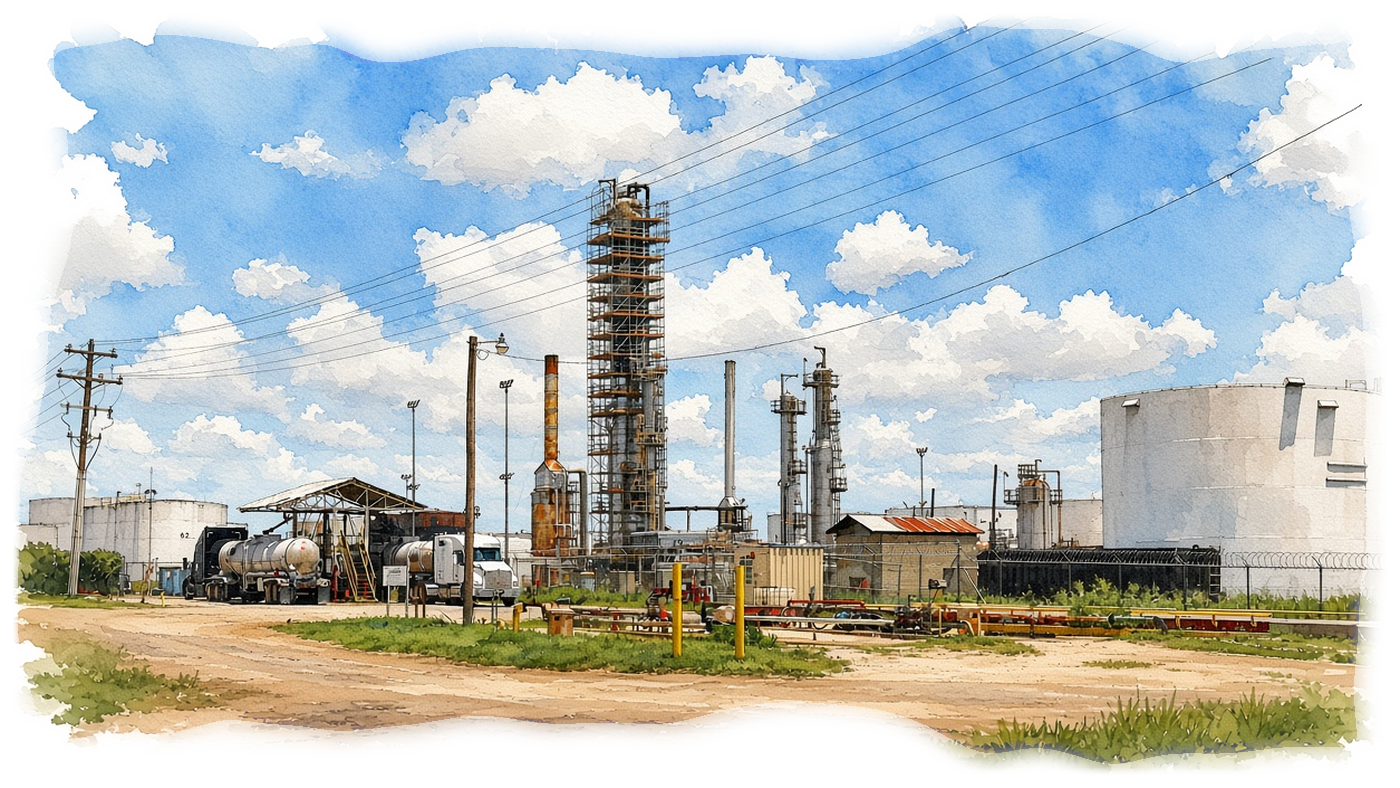
An oil refinery in Wilson County, Texas, June 2025.Illustration by The Good Times, based on a photo by Larry D. Moore / Wikimedia Commons (CC BY 4.0)
Carbon dioxide from burning fossil fuels is projected to fall 0.4% this year, to 38.2 billion metric tons, according to the Global Carbon Budget, the annual estimate from the international Global Carbon Project. The drop comes mostly from oil, down 1.9% in every major region and in shipping and aviation, which the scientists call a likely short-term response to the energy shock from the Iran conflict. Gas is down 0.3% and coal up 0.6%. Emissions are projected to fall 1.3% in the United States, 0.9% in China and 1.5% in the European Union, and to rise 4.4% in India. The range runs from a 1.5% fall to a 0.6% rise, so a small increase cannot be ruled out. Solar, wind and electric vehicles now offset about two-thirds of the emissions that rising energy demand would otherwise add. Emissions from land use, driven this year by peat fires and forest loss in Southeast Asia, are set to rise, so total emissions reach a record 43.3 billion metric tons. Carbon dioxide in the air is on track to reach 427.7 parts per million, 54% above preindustrial levels.
Carbon dioxide from fossil fuels is projected to fall about 0.4% this year, to 38.2 billion metric tons, according to the Global Carbon Budget 2026, the 21st annual estimate by the Global Carbon Project, an international research team. Its estimate is preliminary, with a range from a 1.5% fall to a 0.6% rise, so a small increase cannot be ruled out. Fossil emissions rose 1.2% in 2025.
Oil drives the drop
Oil emissions are projected to fall 1.9%, with declines in every major region and in international shipping and aviation. The report calls this likely a short-term response to the energy shock set off by the Iran conflict and the closure of the Strait of Hormuz. Natural gas emissions are projected to fall 0.3%, with a drop in China offset by a rise in the United States. Coal emissions are projected to rise 0.6%, with a strong increase in India partly offset by strong decreases in the US and the European Union.
By country, fossil emissions are projected to fall 1.3% in the United States, 0.9% in China, which accounts for about a third of the world's total, and 1.5% in the EU, and to rise 4.4% in India. China shows the largest drop in oil emissions, 4.6%.
Clean energy's share
Research by the same team, published alongside the report in Nature Climate Change, finds that the growth of solar and wind power and electric vehicles now offsets about two-thirds of the emissions that rising energy demand would otherwise add. Glen Peters of the CICERO Center for International Climate Research, a co-author, said a one-year drop "is not a peak, unless it is driven by structural change," and that the spread of clean energy is "not sufficient to lock in a peak in global emissions."
Land and the total
Emissions from land-use change, such as deforestation, are projected to rise this year, driven mainly by peat fires and forest degradation in Southeast Asia linked to the developing El Niño. That brings total carbon dioxide emissions, fossil and land use together, to a projected record 43.3 billion metric tons, up from 42.8 billion in 2025. Over the past decade, total emissions grew an average 0.3% a year, against 1.7% a year in the decade before.
The land carbon sink in 2025 was the highest on record, rebounding after the 2023-24 El Niño; the current El Niño is expected to weaken it in 2027. Land and ocean together have absorbed 49% of human emissions over the past decade. The concentration of carbon dioxide in the atmosphere is set to reach 427.7 parts per million this year, 54% above preindustrial levels.
The report puts the remaining budget for holding warming to 1.5 degrees Celsius at 150 billion metric tons, less than four years of emissions at this year's rate, with human-caused warming at 1.37 degrees in 2025. The figures come as world leaders meet at the UN climate conference in Antalya, Turkey.