Waiting on the Free Bus
The war over free buses was lost in Albany months ago. City Hall is still fighting it in press statements, and the mayor owes New Yorkers a plain answer.
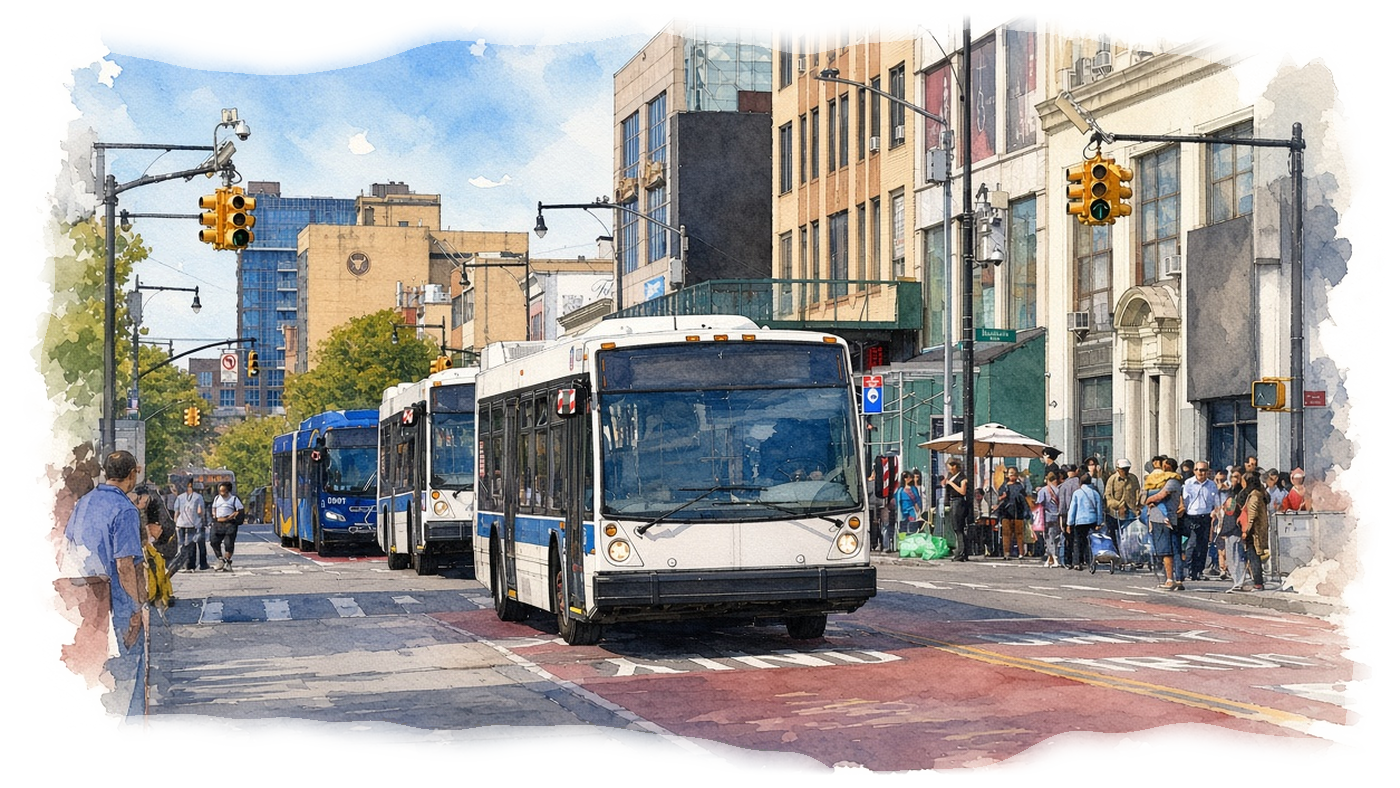
Q17 buses on Main Street in Flushing, Queens, September 2025.Illustration by The Good Times, based on a photo by 4300streetcar / Wikimedia Commons (CC BY 4.0)
"As Mayor, he'll permanently eliminate the fare on every city bus." That sentence ran on Zohran Mamdani's campaign platform under the heading "Fast, fare free buses," next to a promise to make them faster with priority lanes, queue-jump signals and loading zones to keep double-parkers out of the way. "Fast and free" was one of the three big commitments of his campaign, alongside a rent freeze and free childcare. It was simple, and plenty of New Yorkers took it at face value. They had good reason to. A candidate told them the bus fare was going away. They are still paying $3 a ride.
Start with what is fair to the mayor. The buses are not his. They are run by the Metropolitan Transportation Authority, which the state controls, and the MTA board sets the fare. Free buses require the governor, the Legislature and the MTA to agree and to pay. No mayor can make them happen alone.
That is exactly why the promise deserves scrutiny. Mamdani understood this better than almost anyone running. As a state assemblyman he helped write the free-bus pilot that made one route in each borough free from 2023 into 2024, and he campaigned on its results. He knew who controlled the fare and who controlled the money. He promised it anyway, as if it were his to give.
Then there is the price. His team put the cost of free buses at about $700 million a year. Others put it well above that. The MTA collected close to $630 million in bus fares in 2025. The city's Independent Budget Office estimated in June that fare-free buses would cost just over $1.1 billion a year by 2027, and MTA Chair Janno Lieber has cited a price of roughly $1 billion. The campaign's lower figure was the friendliest number on offer, and it was still a lot of money to find.
His plan for finding it was to raise the state corporate tax rate to 11.5 percent and add a 2 percent income tax on New Yorkers earning more than $1 million a year. Both increases needed Albany, and Gov. Kathy Hochul made clear she would not raise taxes on the wealthy. When interviewers pressed the candidate and then the mayor-elect on the money, he gave the same answer more than once: if there were other ways to raise it, what mattered was that it got funded. That is a goal, not a funding plan, and the whole promise rested on it.
His first months in office went the way the math said they would. Hochul was openly cool to the idea. Lieber said repeatedly that he would rather see the city expand Fair Fares, its half-price program for low-income riders. In the spring both houses of the Legislature floated reviving the old pilot, one free route per borough in the Assembly's version and three per borough in the Senate's, at $15 million to $45 million. That was a small fraction of the cost of the citywide promise. By April the mayor had conceded that citywide free buses would not happen this year and turned to promoting the smaller pilot. When the state budget finally passed at the end of May, two months late, it did not make the buses free.
His spokesman kept saying the mayor remained committed to fast and free buses. But a commitment with no money behind it, no vote scheduled and no date attached doesn't change anything for the people paying the fare.
In July the mayor joined Hochul and Lieber in Downtown Brooklyn to release "Next Stop," a 51-page city-state plan worth nearly $900 million. It aims to cut up to six minutes off trips on 50 priority routes through all-door boarding, more bus lanes, and more seating and shade at stops. This is real work, and faster buses matter to millions of riders. But the plan said nothing about fares. Asked about that, the mayor said, "I've been very clear with New Yorkers that my commitment is to make buses fast and free. Today we stand together on how we deliver the fast." He delivered the fast half that day. The free half came up only when a reporter asked.
The city did spend money on fares that summer, through a different program. The city budget raised the Fair Fares income limit to 200 percent of the federal poverty line, which makes about 340,000 more New Yorkers eligible, for roughly 1.3 million in all. It is a sensible expansion. It is also the means-tested approach the mayor has long said he sees as less effective than a universal one. He signed on to it, which was the practical choice. What he did not do was tell riders how, or whether, the universal version would follow.
The clearest test of City Hall's position came in October. On Oct. 6, four MTA fare inspectors from the agency's EAGLE teams stopped Kyle Taylor, a Brooklyn public school aide, as he tried to get off a B14 bus in Brownsville. Taylor said he had paid, using a paper transfer from an earlier bus, which left him nothing to show them. Surveillance video from the stop shows the four inspectors slamming him against a bus shelter and wrestling him to the ground. EAGLE inspectors are not police and cannot arrest anyone. The MTA took the four inspectors out of service pending an investigation. On Oct. 22, after learning of a second, older confrontation, Lieber ordered all EAGLE teams off the street until he was satisfied with their training and reporting.
City Hall's response was to restate the promise. "No New Yorker should be concerned for their safety over three bucks," said Jeremy Edwards, a spokesman for the mayor, and the mayor's office said the episode showed why the fare should be eliminated. Lieber's reply was that an "unfortunate physical conflict" between a rider and MTA staff "doesn't mean you get rid of fare payment." The substance of the mayor's answer was right: nobody should be hurt over a $3 fare. But the episode was about how the MTA enforces its fare, and the mayor responded with the same promise he still has no money for. The statement offered no funding source and no timeline, and the $3 fare it said nobody should be hurt over is still in effect.
By fall the record was hard to argue with. Close to half of bus riders were skipping the fare, by the MTA's own count. Lieber kept saying the MTA was not pushing for free buses. The leaders of the mayor's own City Council said they would rather keep expanding Fair Fares. At the end of October, amNewYork wrote that the mayor had so far worked only on making buses fast, "leaving the push for eliminating bus fares on the back burner." The loudest push for free buses was coming from a riders' advocacy group, which launched its own campaign to organize bus riders, not from City Hall.
The record, then. The fare is still $3. The governor refused the tax increases that were supposed to pay for free buses, and the state budget did not make them free. The MTA has said it is not pushing for them. The mayor has delivered a plan to speed up buses and a larger discount for the lowest earners, and both are good. Neither is the promise he made, and his office's answer to every question about that promise has been the same: he remains committed.
More than ten months into his term, that answer is not enough. The fare is still $3, and the New Yorkers who took the mayor at his word deserve a straight answer from him. Either he lays out where the money will come from, what Albany has to pass and when buses will be free, or he says plainly that free buses are not happening this term and explains why.
- Zohran for NYC campaign platform, archived July 2, 2025
- CNN, Nov. 4, 2025
- Fox Business
- RealClearPolitics/PIX11, Nov. 20, 2025
See all (24)Show fewer
- amNewYork, Fair Fares or free buses
- amNewYork, one-house budgets
- Gothamist, pilot revival push
- Streetsblog Empire State
- Streetsblog Empire State, April 17, 2026
- New York Post, April 8, 2026
- Politico, April 8, 2026
- New York Focus, May 29, 2026
- City & State, July 8, 2026
- amNewYork, July 9, 2026
- Gothamist, Aug. 3, 2026
- Gothamist, Oct. 15, 2026
- amNewYork, Oct. 23, 2026
- Gothamist, Oct. 29, 2026
- amNewYork, Oct. 29, 2026
- City & State, Oct. 30, 2026
- Streetsblog NYC, Nov. 3, 2026
- NYC Rules, Fair Fares amendment
- amNewYork, Oct. 15, 2026
- NY1, Oct. 16, 2026