Ukraine Talks Open in Abu Dhabi
Ukrainian, Russian and American officials held four hours of three-way talks in the UAE capital on ending the war, their first such round since a Geneva meeting ended without a breakthrough. A second day follows.
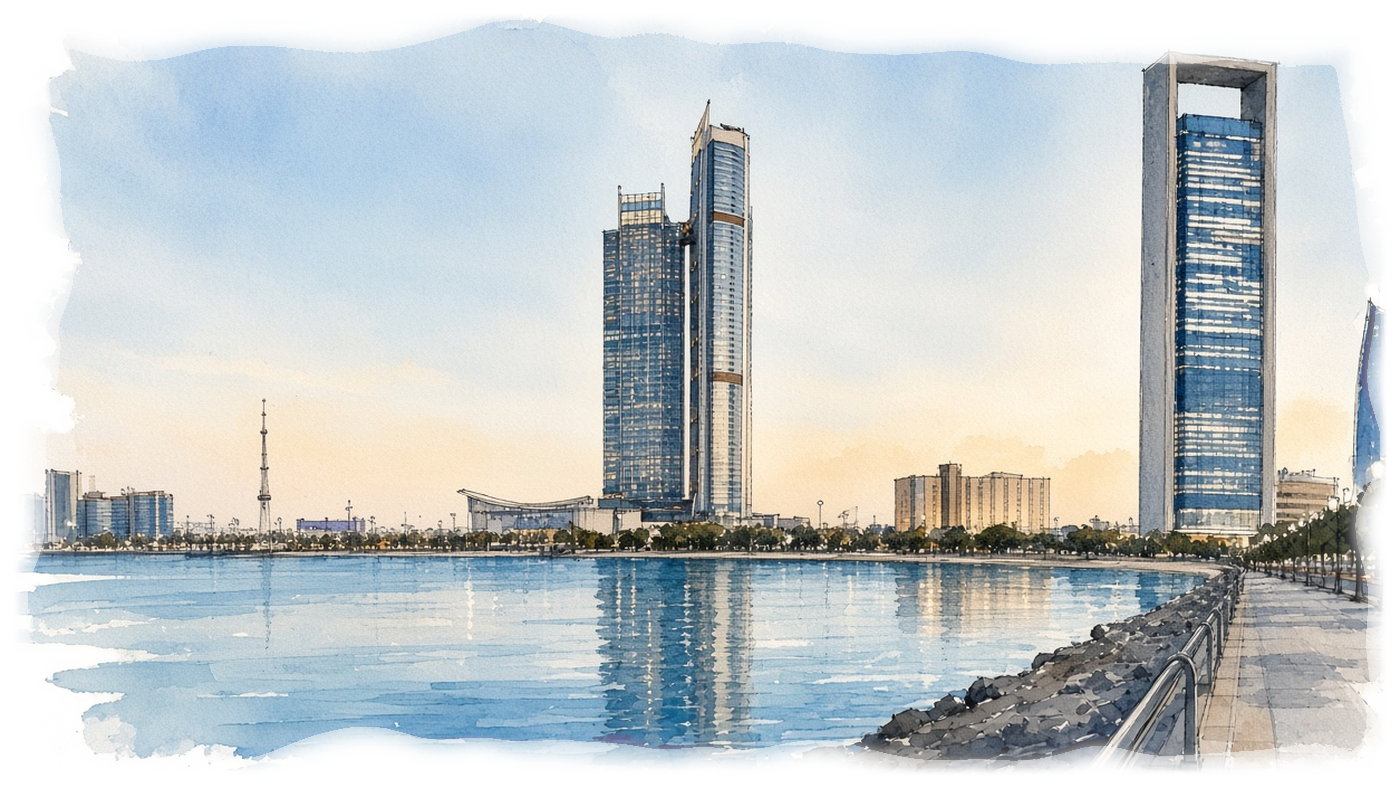
The Abu Dhabi skyline across the water from the Corniche, February 2019.Illustration by The Good Times, based on a photo by Tetraeder / Wikimedia Commons (CC BY-SA 4.0); the painting is CC BY-SA 4.0
Delegations from Ukraine, Russia and the United States held four hours of three-way talks in Abu Dhabi on ending Russia's war in Ukraine, the first such round since a Geneva meeting in February ended without a breakthrough. US envoys Steve Witkoff and Jared Kushner led the American side. Kushner told the delegates the US had "narrowed the gaps" between Moscow and Kyiv, without giving details. Rustem Umerov, head of Ukraine's Foreign Intelligence Service and a member of its delegation, said the agenda covered a cessation of hostilities, postwar security guarantees, reconstruction and humanitarian steps. President Volodymyr Zelensky, who did not attend, called the day "constructive and quite substantive," and Secretary of State Marco Rubio called it "very productive." The main dispute is unchanged in public: Russia wants Ukraine to give up the parts of Donetsk it still holds, and Kyiv wants to freeze the front line. Russia's foreign minister, Sergei Lavrov, said Moscow would not agree to a truce. A second day of talks was scheduled to follow.
Ukraine, Russia and the United States opened two days of three-way talks in Abu Dhabi aimed at ending the war, with the United Arab Emirates hosting and Washington mediating. The first session ran about four hours.
"We have moved to the trilateral Ukraine-US-Russia format," Rustem Umerov, the head of Ukraine's Foreign Intelligence Service, wrote on Telegram. He said the agenda covered a cessation of hostilities, reliable postwar security guarantees, Ukraine's economic recovery and humanitarian measures. The last three-way round, in Geneva in February, ended without a breakthrough, and none had been held since.
Who was in the room
The US side was led by Steve Witkoff, President Trump's peace envoy, and Jared Kushner, the president's son-in-law. Russia sent Kremlin aide Vladimir Medinsky, deputy foreign ministers Sergei Ryabkov and Mikhail Galuzin, spy chief Igor Kostyukov and army general Yury Zhigarlovsky. Ukraine's team included Umerov, Zelensky's chief of staff Kyrylo Budanov, lawmaker Davyd Arakhamia, deputy head of the president's office Serhii Kyslytsia and Vadym Skibitskyi, a deputy chief in the Defense Ministry's Main Intelligence Directorate. Before the three-way session, the Ukrainians met officials from Britain, France, Germany, Italy, NATO and the European Commission, and Witkoff and Kushner met the Europeans on the sidelines. Sheikh Abdullah bin Zayed, the UAE's foreign minister, attended the opening of the round, which his ministry called the third round of trilateral talks between Russia, Ukraine and the United States.
What was said
Kushner told the delegates the US had "narrowed the gaps" and hoped to reach a "solution that hopefully ends the war," without giving details. A day earlier he had written that the talks could at most "build momentum toward the next phase of negotiations." Zelensky, speaking from Copenhagen, called the first day "constructive and quite substantive" and said prisoner-of-war exchanges were discussed. Asked about the American approach, he said, "I see changes. I'm very happy with what I hear." Rubio, in Paris, called the meeting "very productive" and said the Europeans "are a part of solving this problem for the long term."
What still divides them
The central dispute is Donetsk, the eastern region Russia mostly occupies. Moscow demands that Ukraine hand over the parts it still holds; Kyiv wants to freeze the current line. A US official told reporters before the talks that both sides had privately shown "a little bit of flexibility," and that territory would not be settled until the shape of postwar security was agreed. According to the BBC, the framework under discussion includes security consultations, crisis hotlines, "reciprocal de-escalation measures" and possibly reviving the NATO-Russia Council, largely idle since 2022. Lavrov said a ceasefire would only let Ukraine regroup: "We will not agree to it." Russian strikes on Ukrainian energy sites continued away from the talks.