China's Surplus Passes $1 Trillion
AI hardware sales pushed China's goods surplus past $1 trillion with two months of the year left, a week before Trump and Xi are expected to meet in Shenzhen.
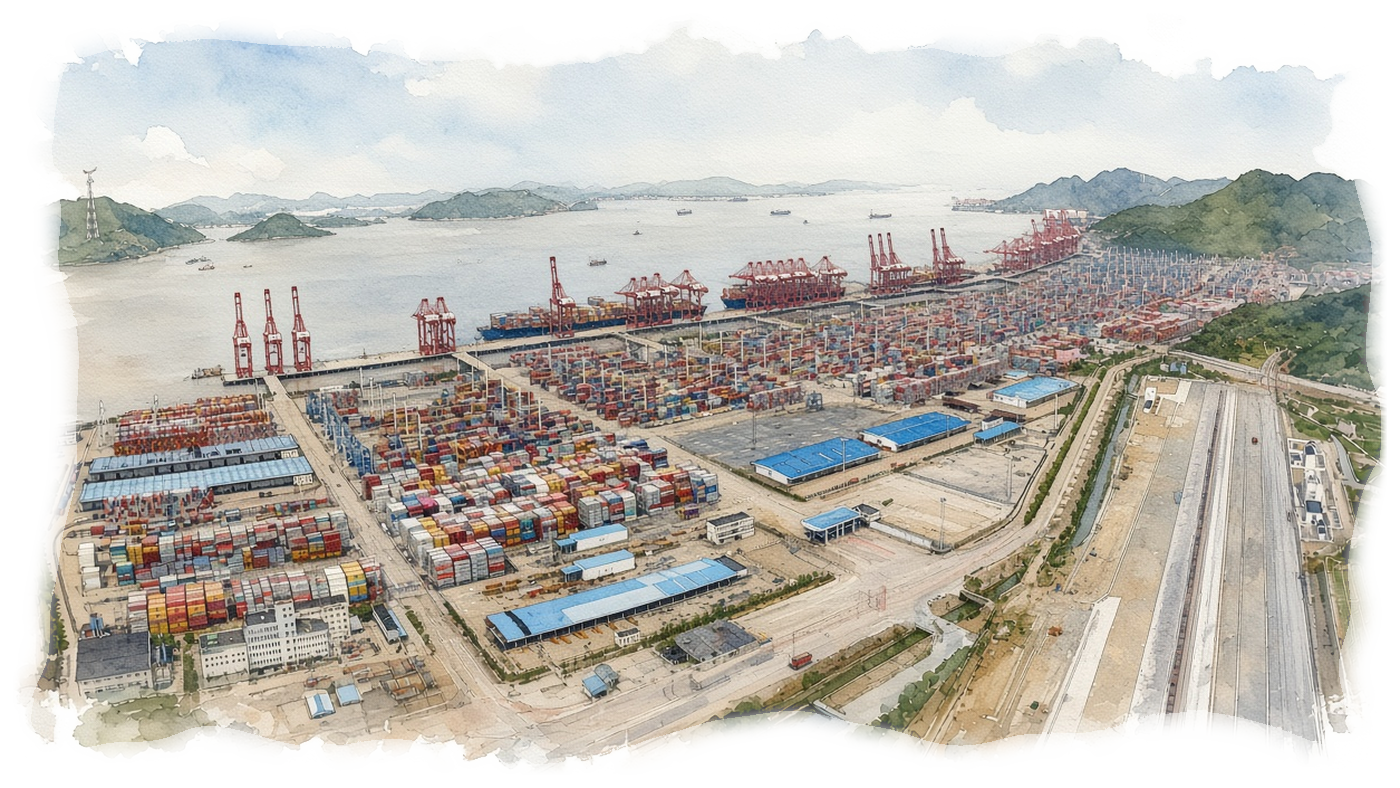
Container stacks and cranes at Ningbo-Zhoushan Port in eastern China, May 2020.Illustration by The Good Times, based on a photo by Nbfreeh / Wikimedia Commons (CC BY-SA 4.0); the painting is CC BY-SA 4.0
China's trade surplus reached $1.04 trillion in the first 10 months of the year, customs data showed, topping $1 trillion for a second straight year and a month sooner than in 2025, when the full-year surplus was a record $1.2 trillion. Exports rose 35.2% in October from a year earlier, beating forecasts, and imports rose 41.6%. Demand tied to the global AI buildout drove much of both: China's semiconductor exports were up 111.1% in the first 10 months, and high-tech exports overall rose 47.9%. Its surplus with the United States was $32.7 billion in October, slightly below September's. With the European Union, the October surplus was $33.4 billion. The figures land a week before President Trump and President Xi Jinping are expected to meet for the third time this year, at the Asia-Pacific Economic Cooperation summit in Shenzhen. Chinese households are still spending little at home: retail sales grew 1.1% in September, and economists say the export engine leaves China exposed if the global AI building boom slows.
China sold $1.04 trillion more in goods than it bought between January and October, according to customs data released in Beijing, the second year in a row the surplus has crossed $1 trillion, and a month earlier than last year. For all of 2025 it was a record $1.2 trillion.
The AI trade
October exports rose 35.2% from a year earlier in dollar terms, after 36.3% in September, beating the 33.5% economists polled by Reuters had expected. Imports rose 41.6%, well above the 32% forecast. Much of both was tied to the worldwide race to build AI infrastructure. According to Reuters, the customs figures show semiconductor exports up 111.1% in the first 10 months and high-tech exports up 47.9%. "Imports were still dominated by AI trade," said Tianchen Xu of the Economist Intelligence Unit, pointing also to copper, liquefied natural gas, oil and coal. According to Reuters, crude oil imports reached their highest level since March as buyers adjusted to supply disruptions in the Middle East, and rare-earth exports rose slightly from September.
Trade with the US and Europe
China's surplus with the United States was $32.7 billion in October, down from $34 billion in September. Trump and Xi are expected to meet next week at the APEC summit in Shenzhen, their third meeting this year, with tariffs on the table. China's surplus with the European Union widened to $33.4 billion in October. Brussels agreed with Beijing last month to cap imports of Chinese hybrid cars at 350,000 a year from December 1, a limit that Brad Setser of the Council on Foreign Relations noted is well below the recent annualized pace of about 800,000. "The risk of additional tariffs and other trade barriers will remain elevated in 2027," said Joe Peissel of Trivium China.
The weakness at home
The export boom is carrying an economy where consumers are holding back after a long property slump. Retail sales grew 1.1% in September, and domestic vehicle sales fell for a 12th straight month in October even as car exports grew. The International Monetary Fund has repeatedly urged Beijing to shift toward growth led by household spending. Yuanliu Hu of Citi Research said export growth could slow to 8% in 2027 as favorable base effects fade and global AI investment moderates.