Nvidia Opens Inquiry Into Its CEO
Independent directors will examine reports that Jensen Huang was targeted by a foreign intelligence effort, and President Trump says the FBI is looking into the matter.
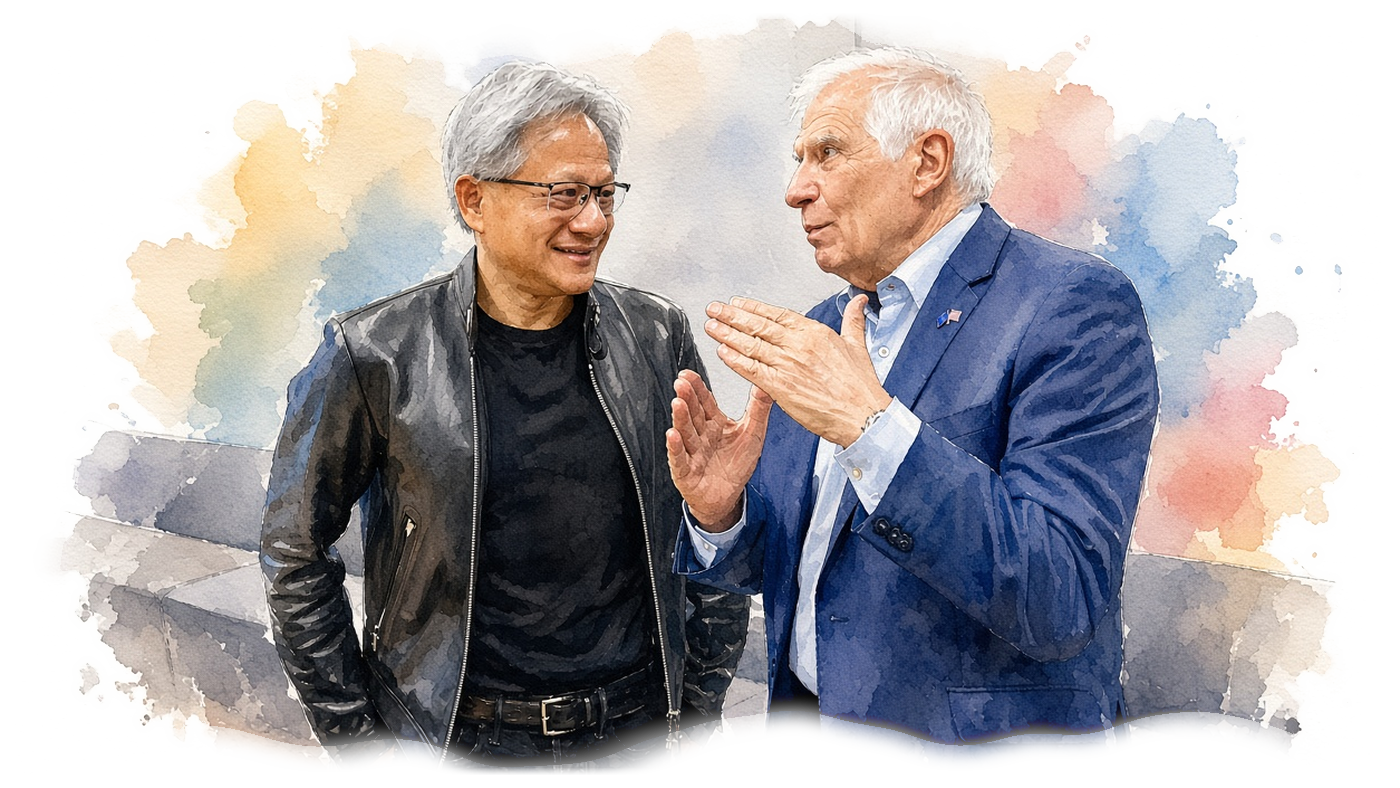
Nvidia chief executive Jensen Huang, left, with Josep Borrell in Santa Clara, California, May 2024.Illustration by The Good Times, based on a photo by Peter Dasilva / European Commission (CC BY 4.0)
Nvidia's board has opened an independent investigation after reports that chief executive Jensen Huang was the target of a foreign intelligence effort. A committee of independent directors, assisted by outside counsel, will oversee the review. The board said it had no reason to believe that U.S. national security or company secrets were compromised and that it has confidence in Huang, who said he supports the inquiry and will cooperate fully. In an email to employees, Huang said he had been unfaithful to his wife and took full responsibility; he did not name anyone. The New York Times reported last month that Huang had a relationship with Alice Huang, a former executive of Megaspeed, a Singapore-based Nvidia cloud partner that U.S. authorities have investigated over suspicions it helped Beijing obtain advanced chips barred from China. Reuters said it could not verify those claims. China's Foreign Ministry called the spy allegations a smear. President Donald Trump said the FBI was looking into the matter, shareholders filed a proposed class action, and Nvidia shares closed down 4.27% at $178.67 while other chipmakers rose.
Nvidia's board of directors has opened an independent investigation "in light of recent reporting" that founder and chief executive Jensen Huang has been the target of a foreign intelligence effort.
A committee of independent directors, assisted by outside independent counsel, will oversee the inquiry, the board said in a statement. "While the Board has no reason to believe that either national security or NVIDIA secrets were compromised, the Board's inquiry will examine all available information," it said. The board said it has confidence in Huang and his leadership team and would give further updates as appropriate.
In an email to employees, obtained and published by CNBC, Huang wrote: "I was unfaithful to my wife. My actions hurt her and our children. There is no excuse for what I did." He said he supported the investigation into the national security concerns raised in news reports and would cooperate fully. "I am committed to protecting NVIDIA and supporting America's national security," he wrote. Nvidia told CNBC that Huang would continue to lead the company "without interruption."
The reporting behind the inquiry
The New York Times reported last month that Huang had a close relationship with Alice Huang, who is not related to him, a Chinese citizen and former executive of Megaspeed, a Singapore-based cloud computing company. The United States has been investigating Megaspeed over suspicions that it helped Beijing gain access to Nvidia's advanced AI chips, which are barred from shipment to China. According to the Times, U.S. authorities concluded that Alice Huang was gathering information for China. Megaspeed lists itself as an Nvidia cloud partner in the Asia-Pacific region.
Reuters said it could not independently verify the claims in the report or Alice Huang's current employment with Megaspeed. Alice Huang did not respond to the Times when it first reported the relationship, and Megaspeed did not immediately respond to Reuters. "The so-called Chinese spy narrative is purely a groundless accusation, slander, and a smear," Chinese Foreign Ministry spokesperson Guo Jiakun told reporters in Beijing.
Washington and the market
Trump said he "was amazed" by the allegations and that he had spoken to Huang, who told him he had no idea the woman was a spy. "I know the FBI is looking into it," Trump said. "I think that he'll be in good shape." The New York Times has reported that Trump was briefed on the relationship and chose not to act on the information, according to Reuters.
Shareholders filed a proposed class action against Huang and the company, accusing them of defrauding investors by concealing his ties to a suspected Chinese spy. House Democratic leader Hakeem Jeffries said Congress needs more answers and called for the House to pass an annual defense bill that includes restrictions on chip sales to China.
Nvidia shares closed down $7.97, or 4.27%, at $178.67, on a day when other chipmakers rallied; Advanced Micro Devices rose 13.26%, according to CNBC. Huang owns roughly 3.6% of Nvidia, making him its fifth-largest shareholder, Reuters reported, citing LSEG data, and the company has no dual-class shares giving him voting control. Nvidia is scheduled to report quarterly results on November 17.
Nvidia's place in AI
Nvidia's chips sit at the center of the global build-out of artificial intelligence, and its market value stood at about $4.5 trillion as of November 6, according to Reuters. Washington has restricted exports of advanced AI chips to China since 2022, and Huang has lobbied President Donald Trump to loosen those limits. Senior Republicans in the House of Representatives have sought briefings from Huang, citing national security concerns.
Huang, 63, co-founded Nvidia in 1993 and has led it since.