Merz Ties the EU Budget to Ukraine Aid
In a letter to EU leaders, the German chancellor calls a shared commitment on Ukraine's funding "an essential prerequisite" for settling other money matters, and outlets differ over whether that is an ultimatum.
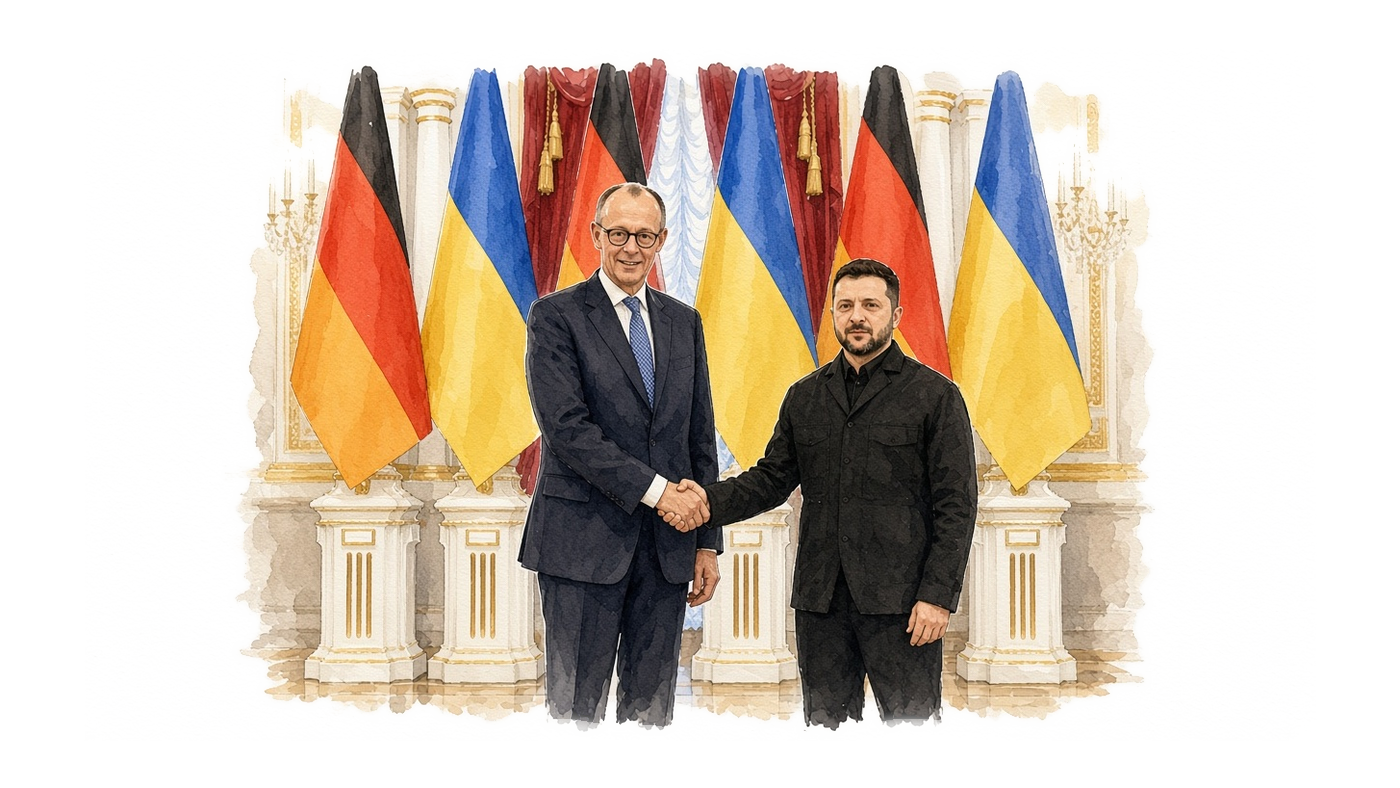
German Chancellor Friedrich Merz, left, with Ukrainian President Volodymyr Zelenskyy in Kyiv, October 2026.Illustration by The Good Times, based on a photo by the Vinnytsia Oblast State Administration / Wikimedia Commons (CC BY 4.0)
German Chancellor Friedrich Merz has written to European Council President António Costa and European Commission President Ursula von der Leyen saying that a commitment by all 27 member states to help close Ukraine's funding gap is "an essential prerequisite" for discussing other financial matters. The letter, dated November 6, also asks that the bloc's next long-term budget, for 2028 to 2034, include a multiyear financing plan for Ukraine backed by every member state. Ukraine faces a gap of about €70 billion for 2027, of which the EU is preparing to cover about €45 billion. Rapporteur called it "a two-part ultimatum," and the Financial Times reported that Merz threatened to block agreement on the budget; the Kyiv Independent wrote that it "does not issue any kind of ultimatum." Merz wants leaders to take up the issue at an informal summit in Dublin on November 13.
German Chancellor Friedrich Merz has told EU leaders that Germany wants a shared commitment on financing Ukraine settled before other spending questions, in a letter that several European outlets have obtained.
"A collective commitment that all of us, without exception, will contribute fairly to closing this gap is an essential prerequisite for resolving this issue and for discussing any further matters, particularly those with financial implications," Merz wrote in the letter, dated November 6, addressed to European Council President António Costa and also sent to Commission President Ursula von der Leyen.
He also asked that the EU's next seven-year budget, known as the Multiannual Financial Framework and covering 2028 to 2034, include "a solution supported by all member states that ensures a sound and multiannual financing perspective for Ukraine from 2028 onwards, including the interest liabilities that have already accrued." Support for Ukraine, he wrote, is "distributed unevenly and carried mostly by only a few member states."
The money at stake
Ukraine has a financing gap of about €70 billion for 2027, of which the EU is preparing to cover about €45 billion through an instrument that has not yet been defined, according to Euronews. Joint borrowing is considered the frontrunner, and the Commission is expected to present options before a special summit on November 26 and 27, where the 2028–2034 budget is also on the agenda.
The bloc is already paying out a €90 billion loan to Ukraine backed by 24 countries. Hungary, Slovakia and the Czech Republic secured opt-outs, and the remaining members share the interest payments in proportion to the size of their economies; Brussels initially estimated them at about €3 billion a year, though Euronews reported that rising borrowing costs have changed the calculation. Rapporteur reported that Bulgaria has also ruled out contributing to new financing.
Germany has provided close to €31 billion to Ukraine since the start of the war, more than any other EU country, but ranks ninth as a share of GDP, according to Kiel Institute figures cited by Rapporteur. Denmark, Finland, the Netherlands and Sweden share Germany's concern about the burden falling on a few countries, Euronews reported.
An ultimatum or not
Coverage of the letter has divided on how to describe it. The Financial Times, which first reported it, and Rapporteur characterized it as a warning that Berlin was ready to block negotiations on the EU budget, with Rapporteur calling it "a two-part ultimatum." Euronews's headline framed Merz's position as no deal on Ukraine aid, then no deal on the EU budget. The Kyiv Independent, which also reviewed the letter, wrote that it "does not issue any kind of ultimatum" and instead calls on the EU to prioritize a new loan.
Reactions in other capitals were mixed. Ignacy Niemczycki, Poland's deputy minister for European affairs, said last week that linking the two issues could backfire, and Slovak Prime Minister Robert Fico called the approach "very dangerous," according to Euronews. A spokesperson for Costa said he would make time for interventions on Ukraine at the informal European Council in Dublin this week and that Ukraine financing is on the agenda of the November 26–27 summit.