Trump Says Sanctions Pause Keeps Russia at the Table
President Trump said he put the new Russia sanctions law on hold so as not to drive Moscow away from peace talks, and said "great progress" includes hostage negotiations. Volodymyr Zelenskyy said the United States had restored warnings of incoming Russian ballistic missiles after a three-day gap, and Treasury Secretary Scott Bessent called his charge over Starlink "very reckless."
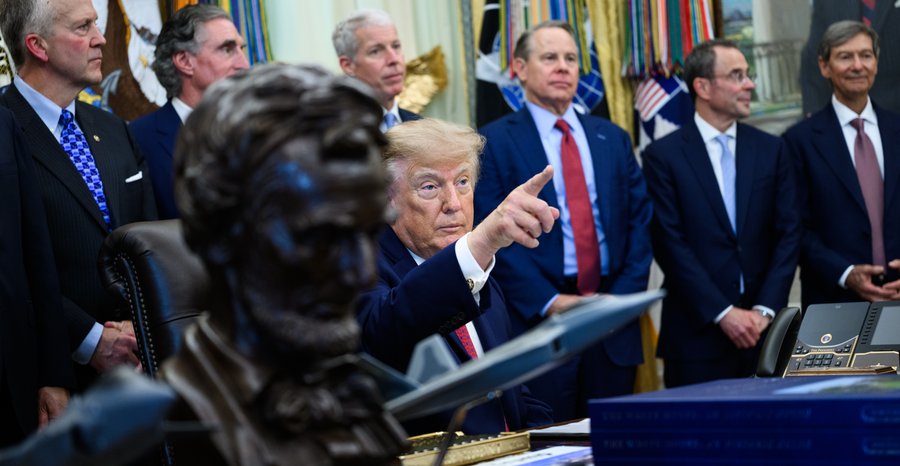
President Trump said he put the new Russia sanctions law on hold because he does not want to drive Russia away from peace talks. "Great progress is being made, and that includes current hostage negotiations!" he wrote on Truth Social. He added that he can sign "that document" later, "or any time that I want." He did not say which document he meant or who the hostages are.
Trump also wrote that Russia is doing "very little, if anything" to help Iran and that he wants "to keep it that way." The same day, Russia said its foreign minister would travel to Tehran this week.
Ukrainian President Volodymyr Zelenskyy told NBC's "Meet the Press" that a formal U.S. move to Putin's side would be a "historic mistake," but that the United States had restored intelligence warning Ukraine of incoming Russian ballistic missiles. "Now it works," he said. He said a speed limit on Ukraine's military Starlink service was "a message from American government." Treasury Secretary Scott Bessent said no one in the administration did that and called the charge "very reckless."
Washington — President Trump said he put the new sanctions on Russia on hold so as not to push Moscow away from negotiations to end the war in Ukraine, and he said those talks now include negotiations over hostages.
"My decision on Russia is a very simple one. I am in the process of negotiating Peace in the war between Russia and Ukraine, and don't want to do anything that will drive, foolishly, Russia away from the bargaining table," Trump wrote on Truth Social. "Great progress is being made, and that includes current hostage negotiations! Signing that document at this time will do that, and I can sign it later, or any time that I want!" Trump did not say which document he meant or give details of the hostage talks.
What the pause does
Trump signed an executive order on October 16 waiving the broad new sanctions required by a law that passed both houses of Congress with bipartisan support and that he signed in September. The order says the move "is in the national interests of the United States." The sanctions, due to take effect two days later, were meant to cut into Russia's oil and gas income by punishing buyers of Russian oil and gas around the world. China takes about half of Russia's crude exports and India about 37%, according to the Centre for Research on Energy and Clean Air, a research group.
Secretary of State Marco Rubio has described the step as a 60-day pause, during which the sanctions' possible effect on the American and world economies would be studied. The law itself stays on the books. Asked about it at a fundraising dinner at his Florida estate on October 17, Trump said: "We'll figure it out, and you'll figure it out. But it's a very good decision, and it's going to be a decision that's good for the country, and I think good for the world."
Kirill Dmitriev, a Russian envoy, called the order "an important and truly historic moment" and said the sanctions would have done "serious damage" to the American and global markets. Sen. James Lankford, an Oklahoma Republican on the Intelligence Committee, defended it on "Meet the Press" as "choosing the American people first," citing high gas prices, and said Trump was "siding with the free people of Ukraine."
Russia and Iran
Trump also wrote that "Russia is doing very little, if anything, to help the Islamic Republic of Iran, compared to what they could be doing, and I want to keep it that way, and will, unless stupid people get in the way." The same day, Russia's foreign ministry announced that Foreign Minister Sergey Lavrov would travel to Tehran this week. In the same post, Trump wrote that Zelenskyy "doesn't want to end this war, and probably never did."
Zelenskyy's answer
Zelenskyy said a formal U.S. move to Putin's side would be a "historic mistake," but that he still sees Trump as an ally. "We want to trust him," he said. "I hope that he will change his decisions, because I think that it's all mistakes, and it will not help us, and it will not help United States." He called it a "pity" that the sanctions were waived in a bill named for the late Sen. Lindsey Graham, a South Carolina Republican he called "a great supporter of peace and of Ukraine."
Asked about Trump's remark last week that he was "more difficult to deal with than Putin," Zelenskyy said he was "very honest" with Trump. "Maybe it's not very polite," he said, but it is "better to have partners who are very open and clear than to have those who are killers, even with a smile on their face."
Missile warnings and Starlink
Zelenskyy said U.S. intelligence on incoming Russian ballistic missiles, which Ukraine did not receive during three days of attacks, had been restored. "Only United States has this unique intelligence to tell our side when Russia uses ballistic missiles," he said. "It was blocked for some period of time. And then it was deblocked by the American side. We are very thankful for this. Now it works." European and Ukrainian officials had told NBC News they believed the pause was most likely meant to press Kyiv to make concessions in the talks.
He said a speed limit on Starshield, the military version of SpaceX's Starlink satellite internet service, was still in place and was hampering Ukraine's drone and air defense work. "It was a message from American government to limit the speed," he said. "And technically, SpaceX did it." He said he did not know whether Trump or Elon Musk made the decision, but thought "both" were involved, and that if Trump lifted it, "it will immediately work as it was before."
In a separate interview on the same program, Bessent said Trump and Rubio "have categorically said that no one in the Trump administration did that." He added: "I think it is very reckless for President Zelenskyy to make such a charge."
The next talks
Zelenskyy said he had spoken with Trump's envoys Steve Witkoff and Jared Kushner, that their teams were in constant contact and preparing the next diplomatic steps, and that he hoped to meet U.S. negotiators in the coming days. "I'm very open for this, even with all the difficult circumstances," he said. No date has been set.