Netanyahu Vows to Bring Down Iran's Regime
Nine days before Israel votes, Prime Minister Benjamin Netanyahu laid out a new national security doctrine built on striking first, with about $145 billion for defense, and said Israel will act without the United States if it must. He warned that a president "very hostile to Israel" could take office in Washington in two years. The same day, President Trump endorsed him for reelection.
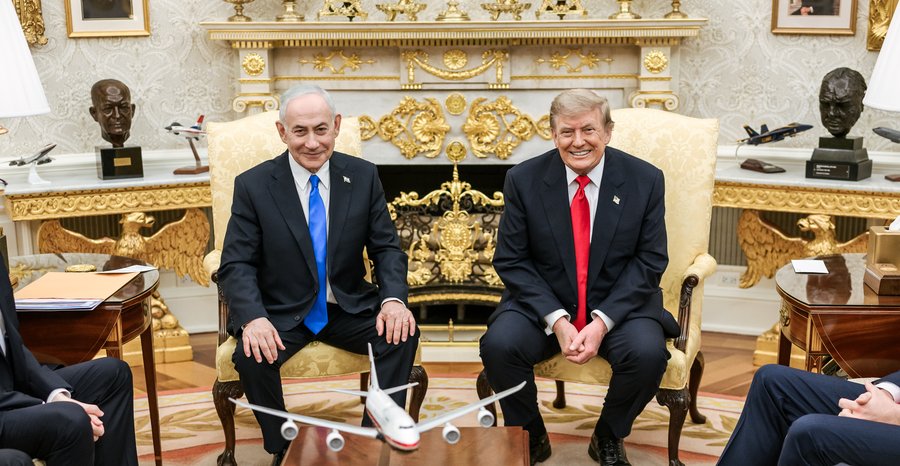
Israeli Prime Minister Benjamin Netanyahu presented a new national security doctrine that puts striking first ahead of containing threats, and he vowed to bring down Iran's government. "The regime must fall, and I will bring it down," he told Israeli reporters in Jerusalem, adding that he had given that directive to all of Israel's security agencies.
Netanyahu said Israel would act on its own if it had to, without U.S. backing. He called for about 450 billion shekels, roughly $145 billion, in security spending, including more weapons made in Israel, some in underground plants.
He also warned that "in two years, a president — male or female — could come to power in Washington who is very hostile to Israel," and said Israel should use the time to build alliances, naming India and countries in Latin America.
The same day, President Trump endorsed Netanyahu for reelection, calling him "a Great Warrior Prime Minister." Netanyahu answered, "Together we will complete the mission!" Israelis vote on October 27 in their first national election since the Hamas-led attack of October 7, 2023.
Jerusalem — Prime Minister Benjamin Netanyahu laid out a new Israeli national security doctrine built on preemptive offensive action, vowed to bring down Iran's government and said Israel would act without the United States if necessary, nine days before an election he has called existential.
Netanyahu spoke to Israeli reporters at his Jerusalem office for about two hours, in his first in-person security briefing for the media since the Hamas-led attack of October 7, 2023. He spent nearly an hour presenting the doctrine, which he said had changed in important ways since the one he outlined in 2018. Its central idea, he said, is to put offensive initiative and preemptive action ahead of containing threats. "We changed the Middle East because we changed ourselves," he said.
What the doctrine calls for
The doctrine calls for stronger border defenses, military and intelligence superiority, technological innovation and less dependence on foreign arms suppliers. Netanyahu said Israel would expand its own weapons production, including in underground facilities, as part of a security investment of about 450 billion shekels, roughly $145 billion. He listed the threats it is meant to meet: precision-guided missiles, drones, unmanned vessels at sea, cyberattacks, artificial intelligence and quantum technology. He named two regional blocs as the main challenges, one led by Iran and one led by Turkey.
"We are going to live by our sword for many years — and it's important that the sword be sharp," he said.
Iran and acting alone
Netanyahu said toppling Iran's government remains Israel's key strategic objective, after Israeli campaigns against Iran in 2025 and 2026 did not achieve it. "The regime must fall, and I will bring it down," he said. "Our plan is a very comprehensive and very determined plan to bring about the fall of the regime. That is my plan. That is the directive I have given all the security agencies, and that is what will happen."
Asked by The Times of Israel what he would do differently, given that past operations neither brought down the government nor led Iranians to overthrow it, he said repression was keeping people at home. "The Iranians are not taking to the streets because they are being killed," he said, adding that Iran's worsening economy was building public pressure. He said 90% of the work of defeating Israel's enemies was done, and tied finishing it to his own reelection: "The test of these elections is who will finish the job."
Asked whether Israel could pursue its aims against Tehran without Washington's backing, he said: "And insofar as it is necessary, we will also act independently. We have already done so, and if necessary, we will do so again."
Gaza, Lebanon and a Palestinian state
Netanyahu said "a Palestinian state will not be established here," and that Israel would not allow Gaza to be rebuilt before Hamas is disarmed and the territory demilitarized, though the Trump administration is pushing its 20-point plan for Gaza. On Lebanon, ahead of another round of security talks this week, he said the Lebanese army had so far "not demonstrated sufficient capabilities" to clear out Hezbollah, and that Israel would do it if Lebanon could not.
A warning about Washington
Netanyahu said Israel has a limited window under President Trump. "In two years, a president — male or female — could come to power in Washington who is very hostile to Israel. We must do everything in our power during these two years and work to establish many alliances in our region and beyond," he said. He named India and Latin American countries as possible partners. He acknowledged differences with Trump over Turkey's President Recep Tayyip Erdogan and said Israel was working to keep Turkey from expanding its military presence in Syria. "I hope we don't reach a direct confrontation," he said.
Trump's endorsement
The same day, Trump endorsed Netanyahu on Truth Social, writing that he "has been a Great Warrior Prime Minister, and an even greater Partner for Peace in combatting the Islamic Republic of Iran." Trump had held back an endorsement for months as the two leaders' Middle East strategies diverged. Netanyahu thanked him on X: "Together we will complete the mission!" In a video released by his Likud party, Netanyahu said "Israel has never had a greater friend in the White House" and that their partnership "will continue in order to eliminate the Iranian threat over the next two years, or even sooner."
The vote
Israelis vote on October 27. Netanyahu ruled out a unity government with his opponents and said he would not exclude National Security Minister Itamar Ben Gvir's party from a future coalition. Several prominent Israeli news outlets boycotted the briefing over Netanyahu's limited dealings with the press.