Alberta Votes on Whether to Start Toward Leaving Canada
Albertans choose between staying a province of Canada and having their government start the constitutional process for a binding vote on separation. Before polls opened, 1,356,873 of the province's 3.1 million eligible voters, 43.1%, had already voted early or by mail; in the 2023 provincial election, 27.5% voted early.
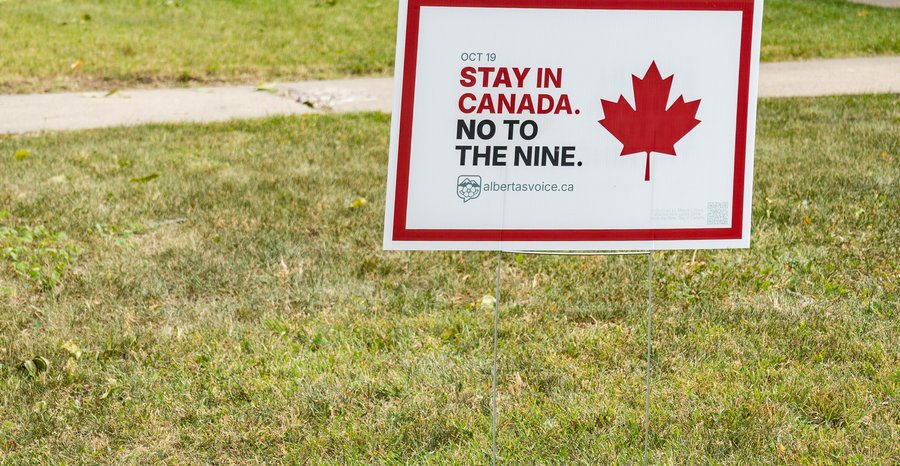
Voters in Alberta, Canada's largest oil-producing province, which borders Montana, decide whether the province should remain part of Canada or begin the legal process toward a binding referendum on separating from it.
It is the last of 10 questions on the ballot, and voters pick one of two options: that Alberta should remain a province of Canada, or that the provincial government should "commence the legal process required under the Canadian Constitution" to hold a binding referendum on separation. A win for the second option would not by itself take Alberta out of Canada. Five other questions deal with immigration and voting rules, and four propose constitutional changes.
Elections Alberta says 1,356,873 people voted early or by mail, 43.1% of the 3,148,343 eligible voters, compared with 27.5% in early voting for the 2023 provincial election. Elections Alberta says the 2023 mail-ballot totals are not directly comparable, because mail voting was not open to every voter then.
Prime Minister Mark Carney rallied thousands in Calgary and Edmonton for the remain side and joined Premier Danielle Smith, who also backs staying, at a brewery in Red Deer.
Polls close at 8 p.m. local time, 10 p.m. Eastern, and the separation question is counted first.
Edmonton, Alberta — Albertans vote on whether their province should stay in Canada or start down the constitutional road toward a binding referendum on leaving it.
The question is the last of 10 on the ballot, and it is not a yes-or-no question. Voters pick one of two options. The first is "Alberta should remain a province of Canada." The second is that "the government of Alberta should commence the legal process required under the Canadian Constitution to hold a binding provincial referendum on whether or not Alberta should separate from Canada."
Alberta, which produces 84% of Canada's crude oil, according to the Canada Energy Regulator, shares a border with Montana and has about 3.1 million eligible voters. Prime Minister Mark Carney, Premier Danielle Smith and the federal Conservative leader, Pierre Poilievre, all urged voters to stay.
What the vote does and does not do
A win for the second option would not take Alberta out of Canada. It would open the way to a second, binding referendum on leaving. Smith called this vote earlier this year, saying discontent with past federal policies had reached a boiling point, with hundreds of thousands of people signing petitions for and against staying in Canada. She said a referendum was needed to settle the question once and for all. Critics say she has inflamed separatist sentiment to appease hard-liners in her United Conservative Party.
The other nine questions
The other nine questions are yes-or-no. Four concern immigrants' access to public services. They ask whether Alberta should take more control over immigration to lower it to "more sustainable levels"; limit provincially funded programs such as health care and education to citizens, permanent residents and people with an Alberta-approved status; make people with temporary status wait 12 months for social support programs; and charge them a fee for health care and schooling. Smith has floated a $1,900 health care fee for temporary residents. A fifth question asks whether voters should have to show proof of citizenship, such as a passport, to vote in provincial elections.
Four questions propose changes to Canada's Constitution, to be pursued with other willing provinces: letting provinces, not Ottawa, pick judges for their superior courts; abolishing the unelected federal Senate; letting provinces opt out of federal programs in areas such as health care without losing the federal money; and giving provincial laws priority over federal ones where the two conflict. Smith wants voters to endorse all nine and says she needs the mandate to negotiate a better deal with Ottawa; Carney urges them to reject them.
A heavy early vote
Elections Alberta, the province's independent election office, said 837,791 people voted at advance polls from October 13 to 17 and 519,082 voted by special ballot, mostly by mail, for a total of 1,356,873. That is 43.1% of the 3,148,343 eligible voters. In the 2023 provincial election, 27.5% voted early; Elections Alberta says those special-ballot totals are not directly comparable, because special ballots were not available to every voter then. Polls have suggested a strong majority will vote to stay, though leaders on the remain side warn that low turnout could open the door to a vote for separation.
The campaign's last days
Carney, who grew up in Edmonton, spent two days in the province, rallying thousands of people in Calgary and then at Edmonton's Expo Centre. "A vote against Canada is a dangerous bluff that will lead to years of deep uncertainty and lost opportunities for Albertans and Canadians," he told the Edmonton crowd. "There are some outside our borders who are working to break us so they can own us. Never."
Earlier that day, Carney and Smith tapped a keg at a brewery in Red Deer, halfway between Edmonton and Calgary, sang "O Canada" and made a joint pitch to stay. "For the first time in a long time, Alberta and Canada are walking together," Smith said. The two said they were making progress on other matters, including a proposed fast-tracked oil pipeline from Alberta to the British Columbia coast. Poilievre, speaking in Calgary, said he understood separatists' frustration but that leaving was not the answer. "Quitting is the easy way out — and Albertans are not quitters," he said.
How results come in
Polls are open from 9 a.m. to 8 p.m. local time, 11 a.m. to 10 p.m. Eastern. Elections Alberta says Question 10, the separation question, will be counted first, followed by Questions 1 to 9, with unofficial results posted on its website as counts are completed. The count must be finished within 48 hours of the close of voting, and the official results will be announced on October 29.