U.S. Military Says 400 Ships Crossed Hormuz in a Week
Adm. Brad Cooper, head of U.S. Central Command, said about 400 merchant ships crossed the Strait of Hormuz in seven days, that U.S. forces helped Gulf partners ship more than 100 million barrels of crude in that time, and that the United States and its partners, not Iran, control the waterway. A British shipping monitor counted 254 crossings that week and at least 12 ships attacked.
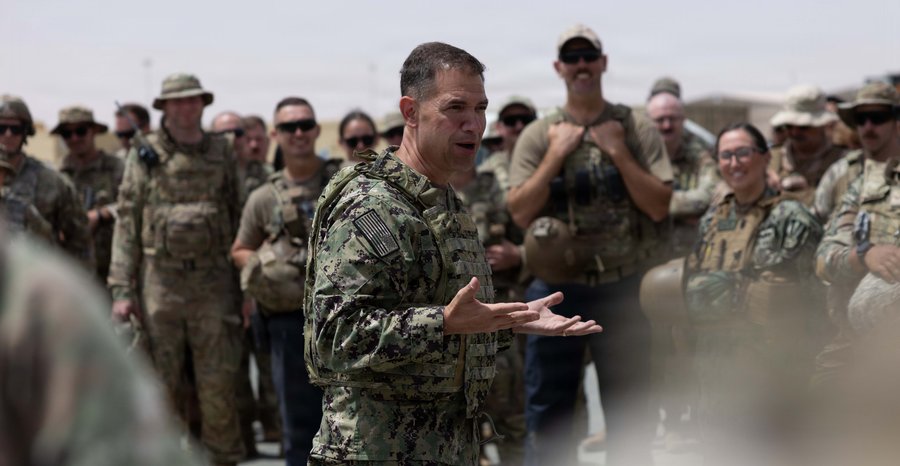
About 400 merchant ships sailed through the Strait of Hormuz over seven days, and U.S. forces helped Persian Gulf countries ship more than 100 million barrels of crude oil in that time, said Adm. Brad Cooper, commander of U.S. Central Command, the military headquarters for the Middle East.
"Let me be clear: the Strait of Hormuz is controlled by the United States and our regional partners, not Iran, and it remains open for business," Cooper said in a video statement.
Other counts are lower. The United Kingdom Maritime Trade Operations center, a British naval office that tracks shipping security, counted 254 crossings in and out over the same week and at least 12 ships attacked, one of which sank. It said most attacked ships do not report to it. Al Jazeera reported that October has seen more attacks on ships than any month since the war with Iran began on February 28. Iran says Washington is inflating its figures. Brent crude, the world benchmark oil price, touched $110 a barrel, its highest since May.
The commander of U.S. forces in the Middle East said about 400 merchant ships crossed the Strait of Hormuz in a week and that the United States and its partners, not Iran, control the waterway.
"Over the last seven days alone, about 400 merchant ships have sailed through the Strait," Adm. Brad Cooper, commander of U.S. Central Command, said in a video update. "U.S. forces have also assisted Gulf partners in shipping over 100 million barrels of crude oil during the same period, adding to the more than 1.3 billion barrels of crude we have helped regional allies ship through the Strait in recent months."
Cooper said the Islamic Revolutionary Guard Corps, the branch of Iran's military that patrols the strait, has "continually" attacked merchant ships and in many cases killed civilian sailors. "The International Maritime Organization reports that more than 20 civilian mariners have been killed by Iran's attacks against commercial shipping since February," he said. He put the rise in attacks down to "desperation" by the Revolutionary Guard.
What the U.S. says it is doing
The U.S. military is doing two things in and around the strait at once. It escorts and coordinates tankers and cargo ships for Arab governments, and it blockades Iran's own ports, turning back ships headed to or from them. Cooper said the blockade has kept Iran from exporting at least $25 billion worth of crude oil and that U.S. forces helped partner agencies seize nearly $350 million in Iranian cryptocurrency.
Capt. Tim Hawkins, a Central Command spokesman, told Fox News that about 97% of ships that tried to cross the strait did so "without being hit by an Iranian projectile." He called the blockade a "steel wall" and said no goods have gone into or out of Iran by sea without U.S. permission, apart from humanitarian ships. More than 50,000 U.S. troops are stationed across the Middle East, he said.
What other counts show
Independent counts give a different picture. The United Kingdom Maritime Trade Operations center counted 125 ships leaving and 129 entering the strait over the same week, a total of 254, most of them carrying dry bulk cargo such as grain or ore. It said at least 12 ships were attacked in the week ending October 16; half continued to their destination, one sank, two were disabled and three were damaged or had an unknown outcome. The center said it is "struggling to accurately report true number of attacks with majority of vessels attacked refusing to report." It also reported a new kind of attack: a tanker hit by a rocket-propelled grenade fired from a small boat 78 nautical miles northeast of the Saudi city of Jubail.
The ship-tracking firm Kpler put oil flows through the strait at 11.6 million barrels a day in the seven days to October 13, about 68% of the prewar level of 17.1 million barrels a day.
Mines or missiles
The two militaries also disagree about what is hitting ships. The Revolutionary Guard says vessels are striking mines on routes it has not approved, and that the strait is unsafe for ships that do not coordinate with the Persian Gulf Strait Authority, an Iranian body set up during the war to control passage. It said a supertanker carrying more than two million barrels of crude caught fire after hitting a mine. Central Command says it has cleared the strait of mines and that ships are being hit by projectiles. It said the GFS Pride, a Singapore-flagged container ship, was struck by a Revolutionary Guard projectile, not a mine, on October 14, and sank while being towed to shore.
Iran has not published its own count of crossings or attacks. It says Washington is exaggerating the numbers to make its naval campaign look successful.
Oil prices
Before the war, roughly a fifth of the world's oil and natural gas passed through the strait, the narrow channel between Iran and Oman. Brent crude touched $110 a barrel on the day of Cooper's statement, the first time since May, as attacks continued and Yemen's Iran-aligned Houthi movement hit Saudi oil sites. Talks between Washington and Tehran continue only through go-betweens such as Qatar and Pakistan.