France Arrests 1,200 After a Day of Looting and Arson
Prime Minister Sébastien Lecornu said 1,200 people were arrested and 150 police officers and gendarmes were injured, both provisional counts, as nationwide marches against the cost of living gave way to looting and fires, including one that gutted Limoges's 19th-century city hall. The interior minister blamed far-left militants and opportunistic looters.
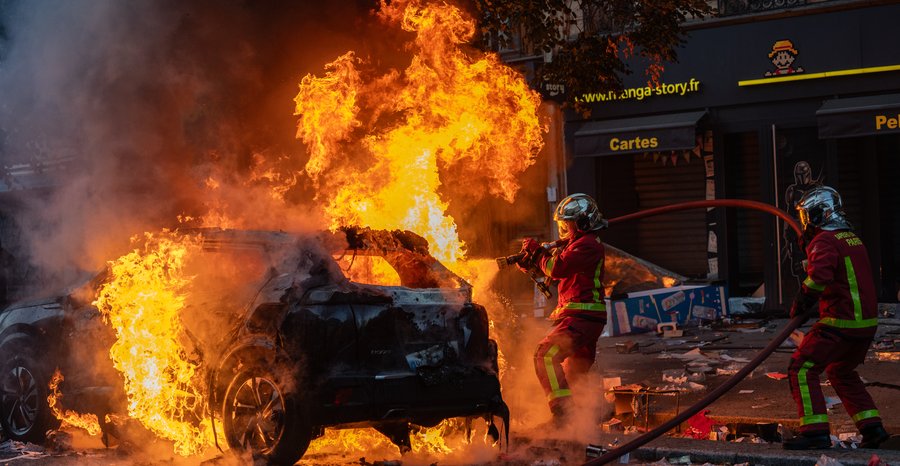
Police across France arrested 1,200 people after a nationwide day of marches against the cost of living gave way to looting, arson and attacks on police and public buildings, Prime Minister Sébastien Lecornu said. He put the number of injured police officers and gendarmes at 150 and called both figures provisional.
The Interior Ministry counted 550,000 marchers; organizers claimed 800,000. Hundreds of thousands marched peacefully. Fire gutted the 19th-century city hall in Limoges, crowds broke into the city halls of Lille and Marseille, and shops were looted in Paris, Marseille, Bordeaux, Nice and other cities. In a separate local count, the prefect for the Marseille area said 107 police officers were injured in that city.
Interior Minister Laurent Nuñez blamed far-left militants who formed black blocs and "opportunistic delinquents" who looted shops, and said most of those arrested were adults. Marseille Mayor Benoît Payan said the vandals and looters "have rotted the demands of the lycéens," the high-school students who have protested for weeks over teacher absences and run-down schools. Justice Minister Gérald Darmanin told prosecutors to seek pretrial detention for anyone who attacked police, firefighters, public buildings or shops.
Paris — Police across France arrested 1,200 people, and 150 police officers and gendarmes were injured, after a nationwide day of marches against the cost of living gave way to looting, arson and attacks on public buildings, Prime Minister Sébastien Lecornu said. He called both counts provisional and said it was "a miracle" the toll was not heavier.
The Interior Ministry counted 550,000 people in 110 marches, 110,000 of them in Paris. Organizers put the figure at 800,000. The marches against high prices answered calls to revive the 2018–19 yellow vest movement and were backed by the CGT, one of France's largest unions. Hundreds of thousands of people marched peacefully.
The student protests
High-school students, or lycéens, have protested for several weeks over teacher absences and run-down school buildings. Officials and mayors separated them from the violence. Nuñez said that, of the roughly 400 people arrested by the time he spoke, the majority were adults. In Marseille, Mayor Benoît Payan said "the casseurs and the looters," meaning the vandals and looters, "have rotted the demands of the lycéens." Paris Mayor Emmanuel Grégoire said he drew "the difference between the social movement" and the vandals, for whom he has "no indulgence."
What happened in the cities
Fire destroyed much of the 19th-century city hall in Limoges. "The roof has collapsed onto the lower floors, except in the west wing, and two-thirds of the facade is already gone," Maurice Barate, the state's prefect for the Haute-Vienne department, told AFP. He called it "a deliberate act by rioters, not by protesters."
In Marseille, a crowd rammed the doors of city hall with security barriers and briefly got inside before police removed them. In a separate local count, Jacques Witkowski, the prefect of the Bouches-du-Rhône department, which includes Marseille, said 107 police officers were injured in the city, three of them seriously. The government's national count of 150 is provisional. In Lille, people forced several entrances to city hall and damaged the inside, and shops in the city center were looted. In Bordeaux, the official residence of the Gironde prefect was ransacked, and the police tactical unit RAID was called in. In Lyon, a tourist office building was set on fire.
In Paris, groups dressed in black and masked threw fireworks and paving stones at police around the Place de la République, set a truck and cars on fire, and looted a sports shop and dozens of stores along Boulevard Magenta. Police answered with tear gas and water cannon. Paris Mayor Emmanuel Grégoire said "entire streets were methodically ravaged."
The violence reached well beyond the biggest cities. In Nice, the prefecture counted 15 shops damaged, about 60 people arrested for looting, damage and attacks on police, and about 10 injured. In Bordeaux, the prefecture reported 55 arrests and 23 injured, 15 of them police and gendarmes, and blamed "several hundred violent individuals." In Rouen and Le Havre, the prefecture reported 40 arrests and 17 injured.
In Saint-Étienne, a 17-year-old protester's right hand was torn off by a police grenade. Medical volunteers at the march who treated him said he had picked up the grenade before it exploded. The Saint-Étienne prosecutor opened an inquiry into the cause of his injuries and gave it to the IGPN, the national police's internal affairs inspectorate.
Who the government says did it
Nuñez said police had spotted "a great many far-left militants" across the country "who formed black blocs, who drew in a number of radicalized young people and who attack the police." He said "opportunistic delinquents" took advantage to loot shops. Lecornu blamed the "ultra-left" and criminals.
By early evening, the Paris prosecutor's office said 195 people had been arrested in the capital, 13 of them minors. Most were held for joining a group to commit violence or damage, carrying weapons including knives, possessing explosives, covering their faces, or assault.
Jean-Luc Mélenchon, leader of the left-wing party La France Insoumise, who joined a march, blamed the police. He wrote that in Paris "aberrant command opened the door to chaos," and he told supporters that those who share his cause "have no business" looting. Lecornu answered that blaming police chiefs was "a dangerous and cynical reversal of responsibility" and said it was now time to "choose your side." Marine Le Pen, leader of the National Rally, said the protesters' "legitimate demands" had been "held hostage by the far left."
What the government is doing
Nuñez said the government would not declare a state of emergency. Darmanin, the justice minister, said he had instructed all prosecutors to give "an extremely firm judicial response" and that pretrial detention "must be requested against those who attacked police, firefighters, public buildings and shops." Macron wrote that those who "broke, attacked the prefectures as well as the shops, looted even our city halls, will be prosecuted and punished."
Serge Papin, the minister for commerce, told shopkeepers whose stores were hit that the ministry was "mobilized" to help them. The mayors of Paris, Marseille and Lyon asked to meet him early in the week and demanded "a precise diagnosis" of how the day unfolded.
France votes for a new president in April. Macron cannot run again, and Lecornu said some groups were using the violence as "a warm-up" for the election.