US Sanctions Iran's Shadow Banks
The US Treasury has sanctioned more than two dozen Iranian exchange houses, front companies and officials that it says form Iran's shadow banking system, which Iran uses to collect export earnings and pay for imports despite sanctions. The overseas firms it named are in Dubai, Hong Kong and Turkey.
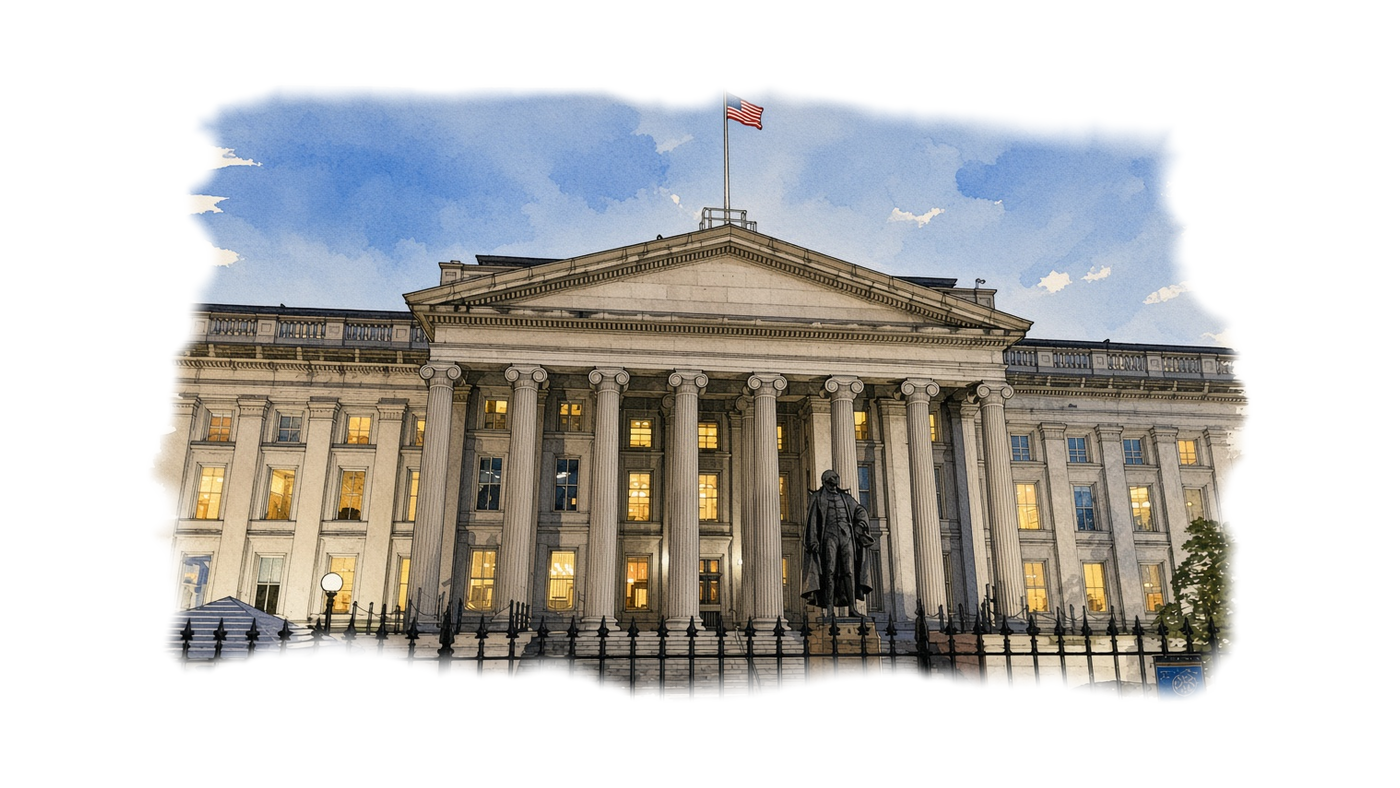
The US Treasury Building in Washington, February 2023.Illustration by Agentic Newsgathering, based on a photo by Wisneyykarin (CC BY-SA 4.0). The painting carries the same CC BY-SA 4.0 license.
The US Treasury has sanctioned more than two dozen Iranian exchange houses, front companies and officials that it says form Iran's shadow banking system, the network Iran uses to collect export earnings and pay for imports despite sanctions. The overseas companies it named are in Dubai, Hong Kong and Turkey, and Treasury said some handled payments for the National Iranian Oil Company and the National Iranian Tanker Company. The sanctions freeze any property the targets hold under US jurisdiction, and foreign banks that knowingly handle significant transactions for them risk losing access to the US financial system. "Iran's shadow banking system is the last financial lifeline of a bankrupt regime," Treasury Secretary Scott Bessent said. Treasury's Financial Crimes Enforcement Network separately identified nearly $15 billion in financial activity from January 2025 to August 2026 that it said was potentially linked to Iranian shadow banking.
Who was added to the blacklist
The Treasury Department's Office of Foreign Assets Control, which administers US sanctions, added more than two dozen companies and people to its blacklist. Treasury describes them as parts of Iran's shadow banking system: exchange houses inside Iran, and "rahbar companies," bank affiliates that manage payments for Iranian clients, working through front companies abroad. It said the system is overseen by the Central Bank of Iran and moves billions of dollars through the international financial system.
Among those named is Rahbar Bazargani Nesim Baharan Qeshm Company, which Treasury said handles transactions for clients of Iran's Bank Sarmayeh, including major petrochemical companies, along with three of its senior officials, Sayyed Mohammad Jalali, Valiollah Hemmati and Ali Kalhor. Treasury also designated two Iranian exchange houses, Mina Fashki and Partners Exchange Company (Fashki Exchange) and Mellat Exchange Company, along with their owners and officials.
Abroad, Treasury named front companies in Dubai, Hong Kong and Turkey that it said carried out thousands of cross-border payments worth billions of dollars. It said Recaz Star General Trading, in Dubai, sent and received payments totaling more than $170 million from people associated with Sadaf Exchange, an Iranian exchange house; OGA Global General Trading handled millions of dollars in payments for the National Iranian Tanker Company; and Gespl International General Trading has been used by the National Iranian Oil Company in its oil and petrochemical sales. Another Dubai firm, Robust Trading, was designated for handling payments for the National Iranian Copper Industries Company. Treasury also designated the Iran Center for Exchange of Currency and Gold, which it said matches exporters who earn foreign currency with importers who need it.
What the sanctions do
Any property the targets own that is in the United States or in the possession of US persons is frozen, and Americans are barred from doing business with them. The measures also reach further through secondary sanctions: Treasury said a foreign bank that knowingly conducts or facilitates a significant transaction for a designated party can be barred from opening or keeping US correspondent accounts, which foreign banks use to deal in dollars, or face strict conditions on them. Treasury said the networks give Iran's government access to foreign currency despite sanctions.
"Iran's economy is underwater, and its leaders are panicking," Treasury Secretary Scott Bessent said. "Iran's shadow banking system is the last financial lifeline of a bankrupt regime. Treasury will continue dismantling these illicit networks until we have buried the head of the snake."
The designations were made under three executive orders that target sectors of the Iranian economy, including finance and metals, and that provide a counterterrorism designation authority, Treasury said.
The wider campaign
The action is the latest under Operation Economic Outcast, which Bessent announced on August 24 and which Treasury said is being carried out with the European Union, Britain, Gulf partners and others. Al Jazeera reported that the United States claimed earlier this month that its sanctions had pushed Iran's currency, the rial, to new lows and inflation to about 90 percent.
Alongside the new designations, Treasury's Financial Crimes Enforcement Network, which collects reports from US banks, released an analysis identifying nearly $15 billion in financial activity from January 2025 to August 2026 that it said was potentially linked to Iranian shadow banking, Reuters reported. FinCEN said the volume fell from January to August, which "may be indicative of at least partial disruption," and that the networks still run most prominently through the United Arab Emirates, Hong Kong and Singapore.
The designations come as diplomatic efforts to end the war involving the United States, Israel and Iran continue. Al Jazeera, citing the Associated Press, reported that Iranian Foreign Minister Abbas Araghchi said Tehran still hoped diplomacy could end the nine-month war, and that President Donald Trump has said Iran wanted a deal that was not acceptable to him. Citing Fox News, it said Trump told the network he was inclined to order military strikes against Iran after the new year if no agreement is reached. Iran's Foreign Ministry spokesman, Esmaeil Baghaei, said Iran would use all its tools to confront a US naval blockade of Iran-related oil exports, according to Reuters, which said the blockade was imposed on April 13, lifted in June and restored on July 14.
- US Department of the Treasury (1)
- US Department of the Treasury (2)
- Reuters (via Investing.com and Devdiscourse) (1)
- Reuters (via Investing.com and Devdiscourse) (2)