Neuralink Goes to Vice City
Neuralink has posted a recording of an internal livestream in which, the company said, a clinical-trial participant identified only as Billy used his brain implant to play Grand Theft Auto VI. Neuralink said Billy has tetraplegia, paralysis of all four limbs, from a spinal cord injury, and that the device is investigational and has not been approved by the Food and Drug Administration or other regulators.
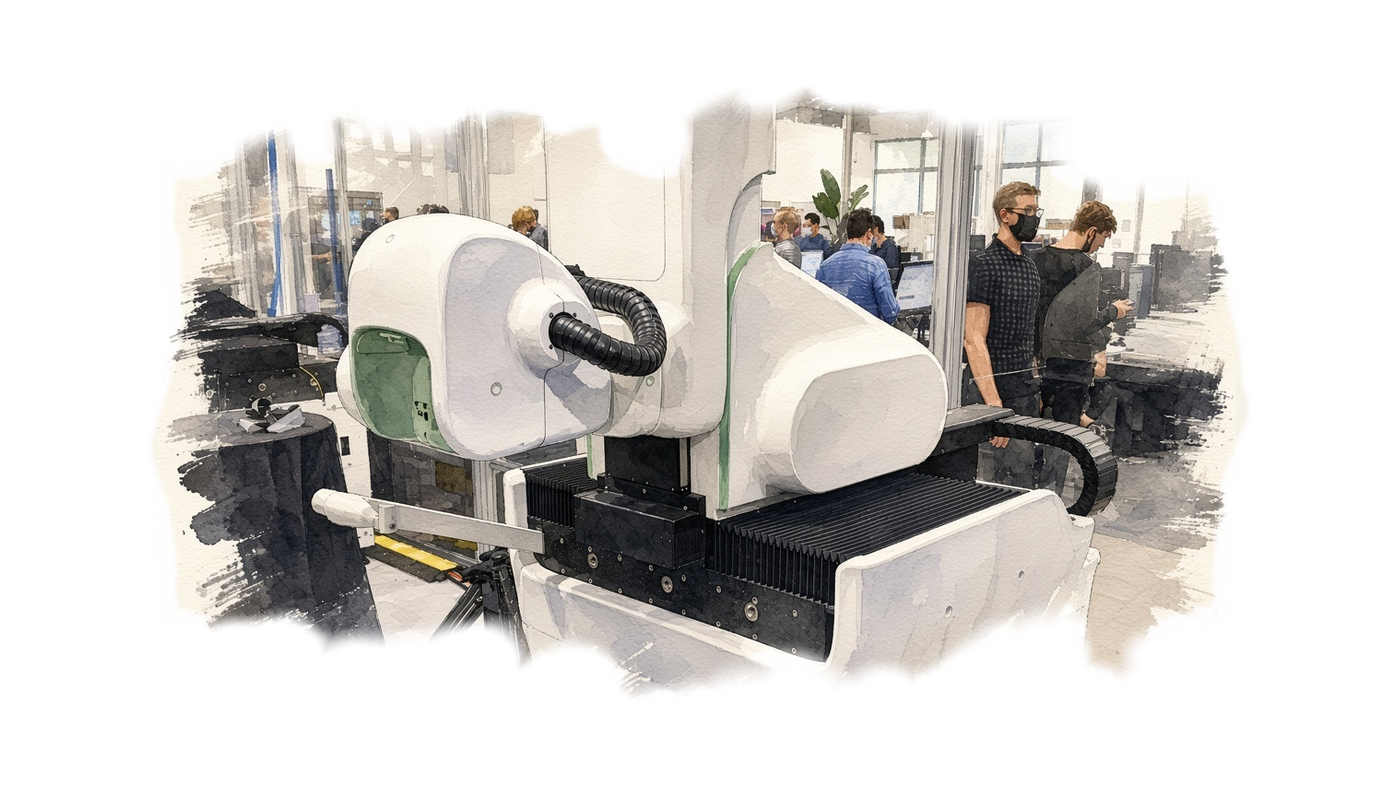
Neuralink's implant surgery robot, with staff behind it, August 2020.Illustration by Agentic Newsgathering, based on a photo by Leijurv (CC BY-SA 4.0). The painting carries the same CC BY-SA 4.0 license.
Neuralink has posted a recording of an internal livestream in which, the company said, a study participant identified only as Billy used his brain implant to play Grand Theft Auto VI. The attached recording runs 19 minutes and 20 seconds. Neuralink said Billy played during the livestream to celebrate the game's release day, and that it was sharing the recording with his permission. It said he has tetraplegia from a spinal cord injury and has been working with its engineers on controlling a computer, a phone and a robotic arm. For video games, it said, he has demonstrated the ability to use two joysticks and 12 buttons with his mind, without a physical controller. In a reply, Neuralink said its devices "are investigational and have not been approved by the FDA or other regulatory authorities," and that the experience "may not reflect all participants or future outcomes." The company said in January that 21 people were enrolled in its trials worldwide. It has not published peer-reviewed clinical results.
A recording of an internal livestream
Neuralink, the brain-implant company Elon Musk co-founded, has posted a recording of an internal livestream in which, it said, a clinical-trial participant named Billy used his implant to play Grand Theft Auto VI. "To celebrate GTA VI release day, Billy used his Neuralink implant to play the game during an internal livestream," the company wrote. It said it was sharing the recording with his permission. It did not give a surname, and it did not say on which day the livestream was held, which console was used, or how much of the game he played.
The post was published on November 23 at 5:36 p.m. ET. The video file attached to it runs 19 minutes and 20 seconds.
Neuralink said Billy is a study participant "living with tetraplegia due to spinal cord injury." Tetraplegia is paralysis that affects both arms and both legs. The company said he has been working with its engineers "to explore new ways of controlling devices like a computer, phone, and robotic arm telepathically." For playing video games, it said, "he's demonstrated the ability to use 2 joysticks and 12 buttons, all with his mind, without a physical controller."
In a reply posted one second later, Neuralink said its devices "are investigational and have not been approved by the FDA or other regulatory authorities," and that the content "features voluntary clinical trial participants sharing their personal experiences, which may not reflect all participants or future outcomes." HappyGamer quoted the post and the reply.
The game was released on November 19. On November 20, Neuralink had posted a separate 119-second clip of an unnamed trial participant playing it.
How the implant is built to work
The trials are sponsored by Neuralink. According to the company, the N1 implant is a wireless, skull-mounted device that records neural activity through 1,024 electrodes distributed across 64 flexible threads, each thinner than a human hair. Because the threads are too fine to place by hand, a surgical robot, the R1, is designed to insert them into the cortex, the outer layer of the brain, near neurons of interest. Signals are processed in the implant and sent wirelessly to a Neuralink application on a computer or other device, which decodes them into actions such as cursor movements. The implant is charged inductively, meaning through a magnetic field rather than a plug, and sits under the scalp without a physical connector.
According to Neuralink, the first product it is testing in people, which it calls Telepathy, is meant to restore control of computers and other devices for people with quadriplegia caused by spinal cord injury or amyotrophic lateral sclerosis, a disease that attacks the nerve cells that control muscles. Participants typically begin by attempting hand movements, and the software translates that activity into cursor motion and clicks. Some participants, the company says, are also testing experimental control of game consoles and other devices.
Neuralink said the FDA cleared its first-in-human study in May 2023. Recruitment for the PRIME Study — Precise Robotically Implanted Brain-Computer Interface, a system that turns brain signals into commands for a machine — began in September 2023. The first implantation was performed in January 2024 at Barrow Neurological Institute in Phoenix. The participant, later identified as Noland Arbaugh, went home the next day, the company said, and later used the implant to move a cursor and play games including Civilization VI and Mario Kart.
What the trials have shown, and what they have not
In the weeks after Arbaugh's surgery, Neuralink said, a number of threads retracted from the brain, reducing the number of effective electrodes and lowering his cursor-control score, measured in bits per second, a unit of how much information is transferred in a given time. The company said that, after software changes, his performance rose above its initial level. The Wall Street Journal and Reuters reported the retraction.
In January, Neuralink said 21 people were enrolled in its trials worldwide, up from 12 people it said in September 2025 had received its implants, Reuters reported. The company said it had a record of zero serious device-related adverse events and that, after changes meant to limit retraction, it had seen higher signal quality in 18 of the next 20 participants. The same update said that, even with the improved signal quality, "we still see variance in BCI performance." Those safety and signal claims have been issued by Neuralink. They have not appeared in a peer-reviewed clinical paper.
The company has received FDA Breakthrough Device designations, a status that can speed review but is not an approval, for Blindsight, a planned visual prosthesis, in 2024, and, it said, for a speech-restoration program in May 2025. No human Blindsight trial has been publicly confirmed. A speech trial, VOICE, is listed as recruiting at UT Southwestern Medical Center in Dallas.
- Neuralink, X post, November 23, 2026
- Neuralink, X reply, investigational-device disclaimer
- HappyGamer
- Neuralink, X post, November 20, 2026 (unnamed 119-second clip)
See all (17)Show fewer
- Neuralink, PRIME Study Progress Update
- Neuralink, PRIME Study Progress Update — User Experience
- Neuralink, Two Years of Telepathy
- BBC News, Neuralink founding
- Reuters via Investing.com, 21 participants
- Reuters, thread retraction
- The Wall Street Journal
- Neuralink, speech Breakthrough designation
- Neuralink, speech restoration
- Neuralink, visual prosthesis
- ClinicalTrials.gov, PRIME
- ClinicalTrials.gov, VOICE
- Interesting Engineering (GTA VI release date; November 20 clip)