Congo Halts Cobalt Exports
The Democratic Republic of Congo, the world's largest producer of cobalt, will suspend all exports of the battery metal until its regulator formally lifts the ban. The halt covers shipments from industrial mines and from artisanal sites and is meant to address what the regulator called a persistent imbalance of weak demand, rising inventories and excess supply.
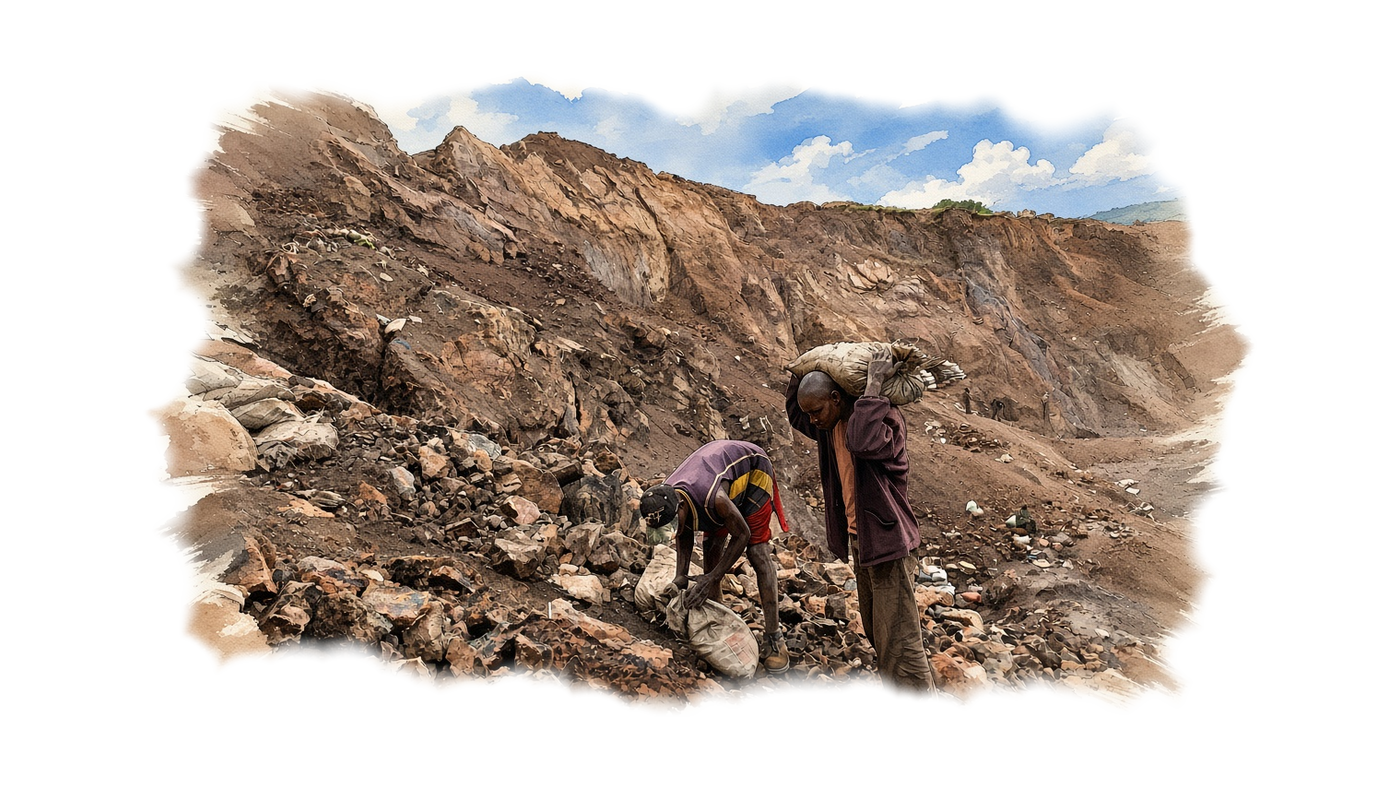
Artisanal cobalt miners at work in the Democratic Republic of Congo, December 2020.Illustration by Agentic Newsgathering, based on a photo by the International Institute for Environment and Development (CC BY 2.5). The painting carries the same CC BY 2.5 license.
The Democratic Republic of Congo, the world's largest producer of cobalt, will suspend all exports of the battery metal until its regulator formally lifts the ban. The strategic minerals agency ARECOMS said the halt would begin on November 30 and cover all cobalt produced in the country, from industrial mines to artisanal sites. It said the measure was meant to address "a persistent imbalance in the cobalt market caused by weak demand, rising inventories and excess supply." The agency will review the ban after four months, but that review will not automatically reopen exports. It is Congo's second full cobalt export ban; the first, imposed in February 2025, was later replaced with quotas. Benchmark Mineral Intelligence estimates the halt caps Congo's 2027 exports at 65,250 metric tons and removes 29,000 metric tons from the market.
A ban until the regulator lifts it
The Democratic Republic of Congo will suspend all exports of cobalt, the battery metal used in electric vehicles, smartphones and other electronics, until the agency that regulates its strategic minerals formally lifts the measure. The halt covers everything produced in the country, from large industrial mines to artisanal sites where miners work by hand.
ARECOMS, as the regulator is known by its French acronym, said the suspension would begin on November 30 and remain in place until further notice. "The measure is intended to address a persistent imbalance in the cobalt market caused by weak demand, rising inventories and excess supply," it said. In the same statement, it said prices had fallen significantly and persistently since the middle of the year because of slowing global consumption, rising inventories and speculative trading.
The agency said it would use the suspension to review and adjust its quota-allocation system, the rules that set how much each company may export, so that shipments better match world demand. It will review the ban four months after the measure takes effect, taking account of market conditions, inventories and the balance of supply and demand, but said that evaluation would not by itself restart exports. Any reopening would require a separate decision setting export volumes, quota allocations and conditions.
Bloomberg, in a report carried by Mining Weekly, said ARECOMS approved the temporary halt at a meeting on November 9 and that the statement was signed by the regulator's president, Patrick Luabeya.
The metal in the world's batteries
Most cobalt is used in rechargeable batteries, in electric vehicles and in consumer electronics. Congo is the world's largest source of the metal. Bloomberg said the country supplied about three-quarters of the world's mined cobalt before it imposed export restrictions. Business Insider Africa said China refines approximately 75 percent of global cobalt supplies and that Chinese companies are among the biggest exporters of Congolese cobalt.
Bloomberg said cobalt is extracted in Congo as a byproduct of copper mining, and that CMOC Group, Glencore and Eurasian Resources Group hold the largest export quotas, which already limited shipments to less than half of the country's output in 2024. Indonesia, the second-largest producer, obtains most of its cobalt as a byproduct of processing nickel ore and could pick up buyers looking for other sources, Bloomberg and Business Insider Africa reported. Bloomberg, citing analysts, said demand from consumer electronics is particularly weak at the moment. Business Insider Africa said mining companies with large Congolese operations, including Glencore, face new uncertainty over shipments from their mines there, and that Glencore had already reduced cobalt production after the earlier restrictions.
Benchmark Mineral Intelligence, a firm that tracks battery-metal prices, estimates that the ban caps Congo's 2027 exports at 65,250 metric tons and removes 29,000 metric tons of cobalt from the market. It projected a deeper supply shortfall in 2027 as a result. "This is likely to have a significant impact on prices," said Roman Aubry, a cobalt analyst at the firm. He said Congolese miners have had trouble selling hydroxide this year, with stocks growing in warehouses outside the country, and that the announcement could let miners and traders sell material already exported and sitting in warehouses around China at higher prices.
What happened after the last ban
Congo halted cobalt exports once before. Bloomberg and Benchmark said the first full ban was introduced in February 2025 and was later replaced, in October, with export quotas that have remained in place. Reuters, in a report carried by CNBC Africa, said prices came under fresh pressure this year after a brief recovery from record lows, as shipments under the quota system added supply to a market already dealing with weak battery demand.
Benchmark reported that cobalt hydroxide, the semi-processed form Congo mainly ships, more than doubled in price in the three months after the 2025 ban, from $5.70 a pound to $11.75. Refiners then turned to other supplies, including recycled battery material and Indonesian output, and, Benchmark said, prices fell again from $23.75 a pound at the end of July to $12.50 by mid-November. Bloomberg, citing Fastmarkets data, said hydroxide prices initially more than quadrupled after the earlier interventions, then almost halved from an April peak. Benchmark said most of the market had expected tighter quotas this time rather than an outright ban.