Probe Enters Mercury Orbit
BepiColombo, a joint mission of the European Space Agency (ESA) and the Japan Aerospace Exploration Agency (JAXA), entered orbit around Mercury after an eight-year flight, Nature and Eos reported. ESA had not yet published its own confirmation on its website at the time of writing.
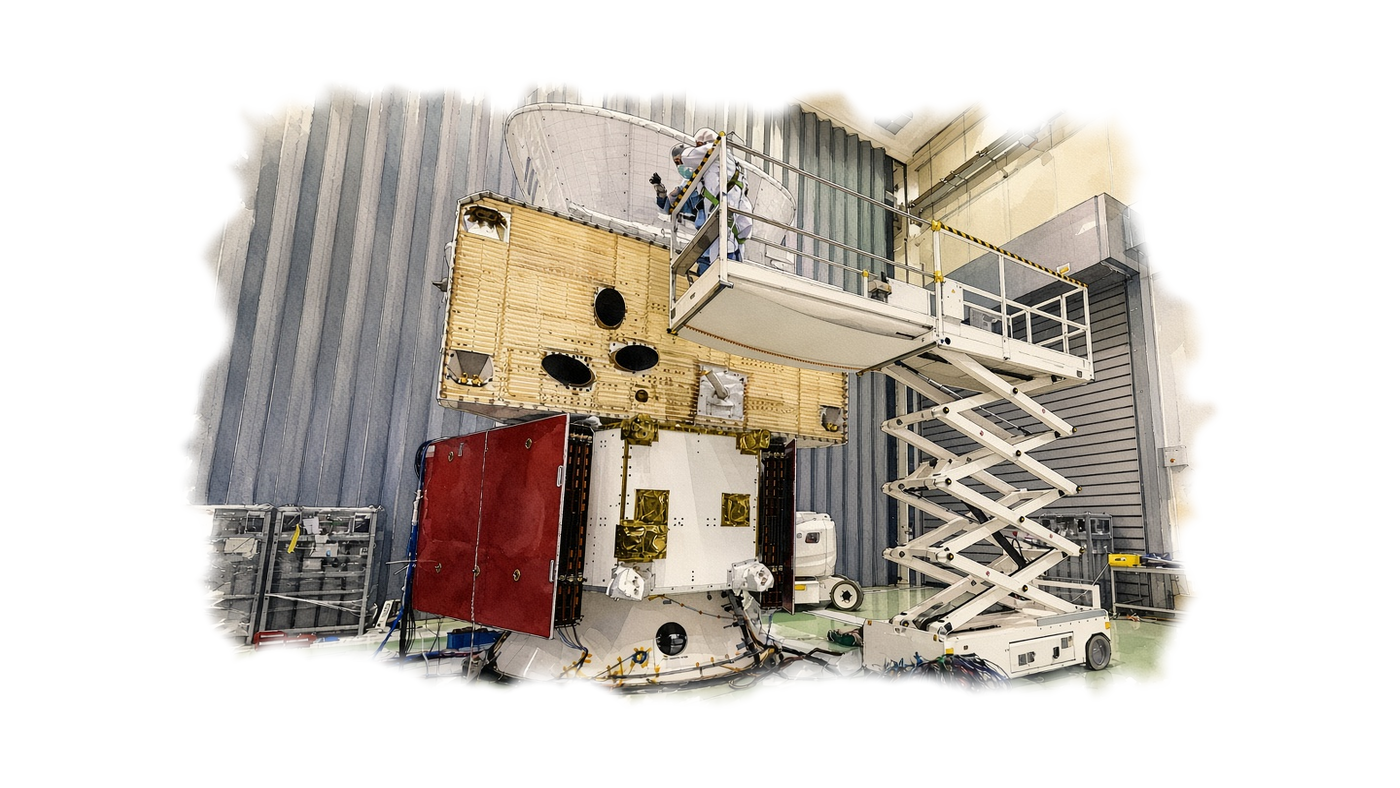
Archive photo: Engineers examine the BepiColombo spacecraft stack at the European Space Agency's test center in Noordwijk, the Netherlands, July 2017.Illustration by Agentic Newsgathering, based on a European Space Agency photo (ESA, CC BY-SA 3.0 IGO). The painting carries the same CC BY-SA 3.0 IGO license.
Nature and Eos reported that BepiColombo, a joint mission of the European Space Agency (ESA) and the Japan Aerospace Exploration Agency (JAXA), entered orbit around Mercury after an eight-year flight. It is only the second mission to do so, after NASA's MESSENGER. ESA had not yet published its own confirmation on its website at the time of writing.
Space.com, in an article published the same day, said an orbit-insertion burn was scheduled to begin at 1:24 p.m. Eastern and last 37 minutes. Nature reported that ESA announced a European-built module had inserted itself into orbit, beginning months of maneuvers. Eos wrote that the still-connected Mercury Planetary Orbiter and Mio entered orbit after the Mercury Transfer Module separated on September 3.
The two orbiters are due to separate in December and move into different polar orbits. Science operations are planned for April 2027. Officials quoted in the coverage were speaking at earlier events, including an August news conference and a September livestream, not at a post-insertion briefing. ESA has invited journalists to a briefing on November 27.
Reports of insertion, but no ESA web confirmation yet
Nature and Eos reported that BepiColombo had entered orbit around Mercury, completing an eight-year journey from Earth and becoming only the second spacecraft to circle the Solar System's innermost planet, after NASA's MESSENGER, which orbited from 2011 to 2015. The European Space Agency had not yet published its own confirmation on its website at the time of writing.
Nature, in a report by Davide Castelvecchi, said that ESA announced a European-built module had inserted itself into Mercury's orbit, beginning a months-long series of maneuvers. Eos, in a report by Kimberly M. S. Cartier, wrote that the still-connected stack of ESA's Mercury Planetary Orbiter and JAXA's Mercury Magnetospheric Orbiter, known as Mio, "entered Mercury's orbit today." A Space.com article by Mike Wall, published the same day, still described the arrival in the future tense. It said the insertion would come after an orbit-insertion burn scheduled to begin at 1:24 p.m. Eastern and last 37 minutes.
ESA's own "latest updates" page on the arrival, last dated October 29, still said the composite spacecraft "will enter orbit around Mercury on 21 November 2026." A media invitation posted on November 18 likewise treated the insertion as ahead, and invited journalists to a briefing on November 27 in London. The two science orbiters flew stacked together and were carried for most of the trip by the Mercury Transfer Module, which separated on September 3, Eos and Space.com reported.
A long approach, then a delayed arrival
Mercury is difficult to reach because it lies close to the sun. Spacecraft falling inward are sped up by the sun's gravity and must shed a great deal of energy to be captured by the planet's weaker pull, Space.com reported. Emma Bunce, a plasma physicist at the University of Leicester, told Nature that "it takes more energy to go to Mercury than to go to the outer Solar System."
Azul Pinochet-Barros, editor for operations activities at ESA's European Space Operations Centre, said during a September 3 livestream of the transfer module's separation, "Reaching Mercury is actually harder than reaching Pluto," Eos reported.
BepiColombo launched in October 2018 on an Ariane 5 rocket from French Guiana and took a looping path that included one flyby of Earth, two of Venus and six of Mercury, Space.com reported. Eos said each of nine planetary flybys was used to shed momentum.
The arrival was later than first planned, and the sources differ on the cause. Eos and New Scientist attributed the delay to a 2024 problem with the thrusters; Eos said the thrusters could not operate at full power, forcing a change in trajectory and pushing arrival from December 2025 to November 2026. Space.com attributed it to an issue with the solar panels that reduced the power available for the transfer module's electric thrusters and added a year to the flight.
Eos reported that BepiColombo is only the third mission to visit Mercury, after NASA's Mariner 10, which flew by in 1974, and MESSENGER. Santa Martinez Sanmartin, ESA's BepiColombo mission manager, speaking at a news conference on August 31, said the mission would be the first to put two spacecraft in orbit around the planet at the same time, Eos reported.
Two orbiters, and months before the science starts
The two probes remain joined. Nature said they will stay together until they reach the orbit intended for Mio on December 9. Eos and an ESA media invitation put the separation on December 9-10. After that, each is to take a different polar path.
Nature said Mio is to trace ellipses between 500 and 11,000 kilometers, sampling Mercury's magnetic field and its interaction with the solar wind, and that the Mercury Planetary Orbiter is to descend gradually until March 2027, into an orbit between 400 and 1,500 kilometers, from which it will study the surface. An ESA animation released before the insertion described the first capture orbit, with the stack still joined, as an ellipse of 590 by 11,640 kilometers.
New Scientist said the planetary orbiter is to follow a near-circular path taking 2.3 hours and Mio a more distant ellipse taking 9.3 hours, and that the European orbiter carries 11 instruments. Eos said the planetary orbiter is to map the surface, its composition, gravity and the size of the core, and that Mio is to help explain why Mercury has a magnetic field offset from the planet's center.
Space.com said the planetary orbiter is due in its final orbit on March 10, 2027, and that science operations are not due to begin until April 6, 2027. Eos also said science operations will begin in April 2027, that the nominal mission will last a year, and that an extended mission is planned through 2029. Nature reported that, en route, scientists pointed the Mercury Imaging X-ray Spectrometer at the Crab Nebula, and Bunce said MIXS is the first X-ray imaging device sent on an interplanetary mission.