Nations Extend Talks on Robot Weapons
Governments at a United Nations arms conference in Geneva agreed to work toward possible rules on lethal autonomous weapons by 2028, stopping short of a legally binding treaty, after talks ran through the night.
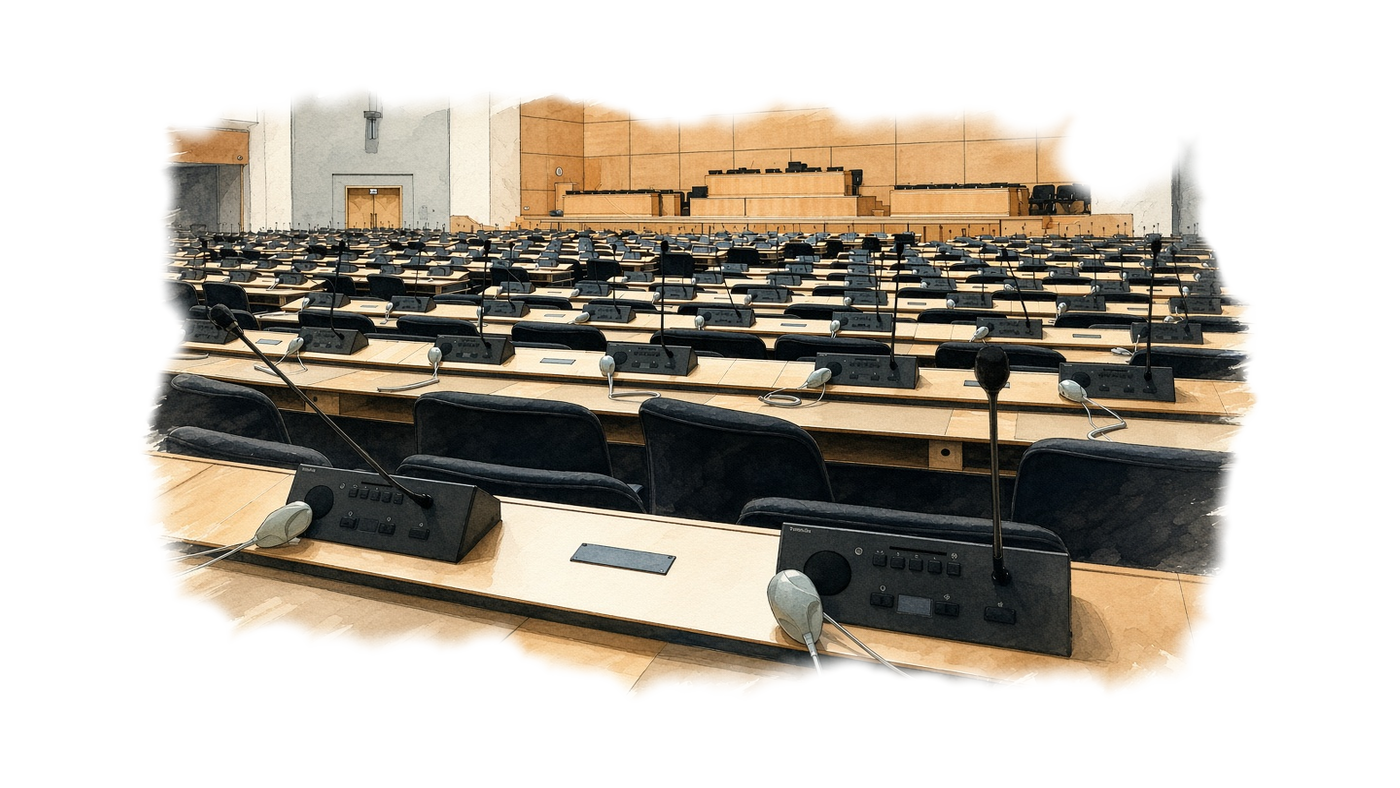
Archive photo: Delegates' desks and microphones in the Assembly Hall of the Palais des Nations in Geneva, June 2016.Illustration by Agentic Newsgathering, based on a photo by Nick-D (CC BY-SA 4.0). The painting carries the same CC BY-SA 4.0 license.
The 128 parties to the United Nations Convention on Certain Conventional Weapons agreed in Geneva to elaborate a possible instrument on lethal autonomous weapons by 2028. The mandate falls short of the legally binding treaty sought by nearly 100 countries and by UN Secretary-General António Guterres.
The weapons can identify and engage targets with little or no human oversight and can kill without a person making the final decision to fire. Decisions in the forum require the agreement of all member states. The United States, Russia and Israel opposed a binding instrument.
Diplomats said Russia's objections over procedure led to some formal sessions being called off, and talks on the final wording ran through the night. The Swiss chair, Julien Thoeni, said some countries had rejected the word "negotiate" and that the agreed text refers instead to the "elaboration" of an instrument.
Stop Killer Robots called the mandate "watered down." Its executive director, Nicole van Rooijen, said delaying a legally binding instrument "puts civilians and humanity at risk." Verity Coyle, deputy director for arms at Human Rights Watch, said the outcome "does not provide the urgent action needed to agree new rules — but the technology is racing ahead."
A two-year mandate, not a treaty
The member states of the Convention on Certain Conventional Weapons closed a weeklong conference in Geneva with an agreement to spend the next two years elaborating a possible instrument on lethal autonomous weapons systems, sometimes called "killer robots." Scores of governments had come to the meeting seeking a negotiating mandate for a legally binding treaty. What they adopted instead was a weaker formulation that leaves open whether any future measure would carry legal force.
The convention has 128 parties, and its decisions are taken by consensus, so a single state can block a text. Nearly 100 countries had pushed for swift adoption of legally binding rules on weapons capable of killing without a human making the final decision to fire. Proponents, including Guterres, had called for a legally binding treaty on a short timetable.
The agreed language is to "elaborate" an instrument by 2028. Thoeni, the Swiss diplomat who chaired the conference, told reporters that some countries had rejected the word "negotiate." He said more than 10 years of talks had produced a significant step for humanitarian disarmament. "It shows that even in today's deeply divided world, multilateral diplomacy can still deliver concrete results," he said as the meeting wrapped up. He said the process should determine which weapons can be banned under international humanitarian law and which can be permitted but regulated.
The talks had been due to end on Friday and continued through the night. CNBC reported that they concluded after 4 a.m. local time. Diplomats said Russia's objections over procedure forced the cancellation of some formal meetings, and negotiators then spent hours wrangling over a handful of words. The conference had opened on Monday. A diplomat from a country that supports new laws said the outcome was "disappointing but could have been much worse," CNBC reported.
Military powers refuse a binding instrument
Key arms-producing nations, including the United States, Russia and Israel, opposed a legally binding instrument. CBC News reported that the United States and Russia resisted committing to binding rules that would limit them in developing such weapons.
Some governments have argued that existing international humanitarian law is already sufficient. Others have said autonomous weapons raise new challenges that current law does not cover. Van Rooijen said such systems are being deployed in combat, including systems that use artificial intelligence to choose targets. CNBC reported that alarm has grown over their use in conflicts, including in Ukraine, Sudan and the Middle East.
Izumi Nakamitsu, the UN high representative for disarmament affairs, called the outcome a "significant achievement" but acknowledged a "glass half full or half empty" reading, citing Guterres's hopes for a legally binding deal this year, CBC News reported. She called for countries to begin work toward an instrument as early as Monday and "start thinking about how to get as strong as possible [an] instrument to prohibit and regulate lethal autonomous weapon systems."
The convention has not adopted a new legally binding protocol on a weapons category in decades, and some governments have in the past taken negotiations on other munitions outside the forum when consensus could not be reached. CNBC reported that some observers and former military officials say states should be prepared to consider a new process outside the UN framework.
Campaigners say the text is watered down
Stop Killer Robots, which opposes the development and use of autonomous weapons, said the mandate offered no clear route to legally binding rules. "Delaying the creation of a legally binding instrument puts civilians and humanity at risk," van Rooijen said.
Coyle, of Human Rights Watch, said the outcome was disappointing. "It does not provide the urgent action needed to agree new rules — but the technology is racing ahead," she said.
Max Tegmark, a machine learning specialist at the Massachusetts Institute of Technology and founder of the Future of Life Institute, said world leaders had failed to meet the moment. "States have agreed it is sufficient to just talk about the issue, for the 14th year, while these weapons enable atrocities," he said.
The mandate now sends the parties into two further years of work under the same consensus rule that shaped this conference.