New York City Council Targets Delivery Subcontracting
A New York City Council bill would require operators of last-mile delivery facilities to hold a city license and to directly employ their core delivery and warehouse workers, ending contracted delivery models such as Amazon's Delivery Service Partners. Intro 518, sponsored by Council Member Tiffany L. Cabán, has 35 sponsors on the Council's legislative record, and Mayor Zohran Mamdani has said he will sign it if it reaches his desk.
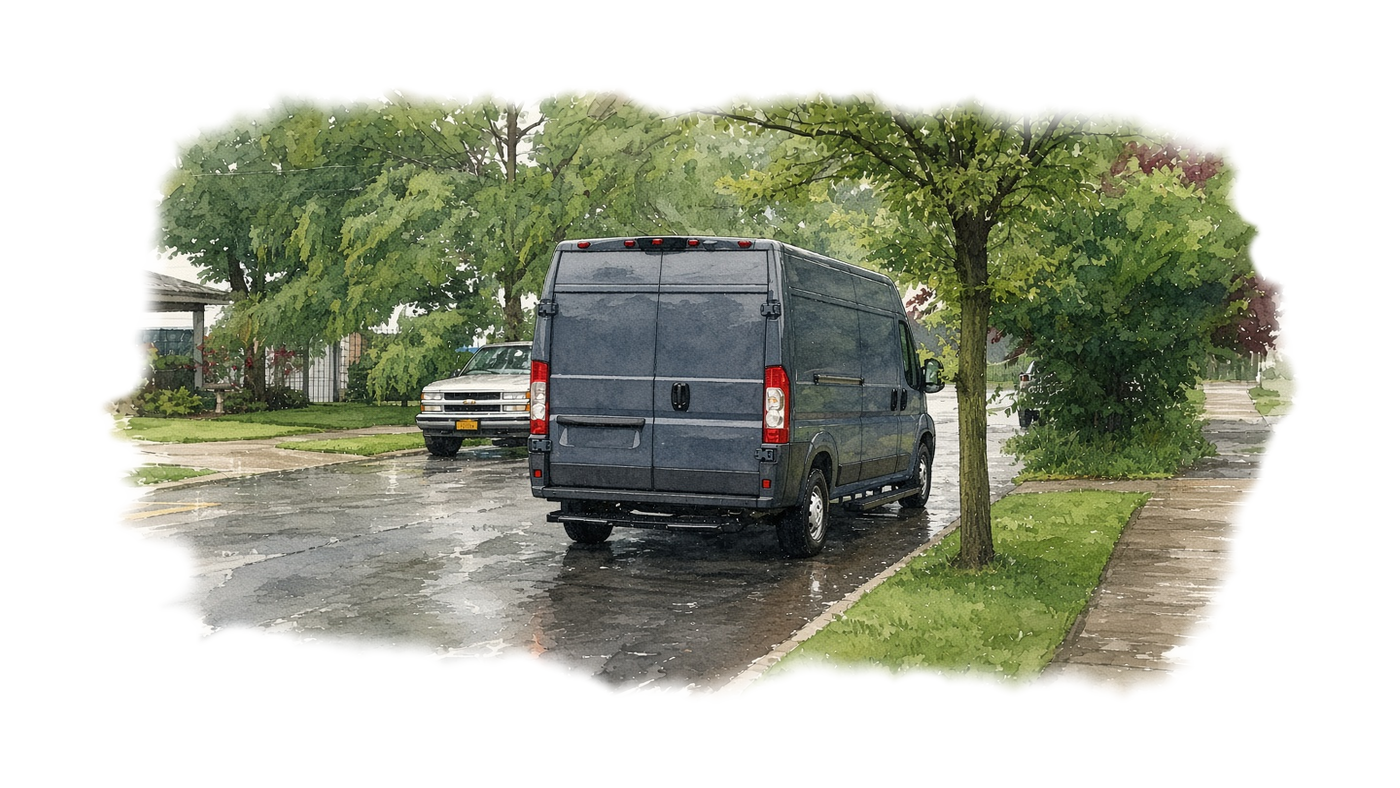
Archive photo: An Amazon delivery van parked on a rainy street in Hillcrest, Queens, June 2019.Illustration by Agentic Newsgathering, based on a photo by Tdorante10 (CC BY-SA 4.0). The painting carries the same CC BY-SA 4.0 license.
Intro 518, the Delivery Protection Act, would require operators of last-mile delivery facilities in New York City to obtain a license from the Department of Consumer and Worker Protection and to directly employ their core warehouse and delivery workers, ending contracted models such as Amazon's Delivery Service Partners. Council Member Tiffany L. Cabán is the prime sponsor. The Council's legislative record lists 35 sponsors, including Public Advocate Jumaane Williams. Mayor Zohran Mamdani has said he will sign the bill if it comes to his desk. The employment rule would take effect about a year after enactment, with extensions for existing contracts capped at two years after enactment. The International Brotherhood of Teamsters backs the measure and says the contractor model lets companies avoid liability. City Council Speaker Julie Menin has said the legislation needs changes to address legal concerns. A committee heard the bill on April 9 and laid it over, with no vote since. The remaining stated meetings, December 3 and December 17, have no vote on the agenda. Amazon has shown customers in-app notices warning that the bill "could add up to $5 per order." Menin said that claim "defies logic" and called the campaign deceptive.
What the bill would require
Intro 518, a New York City Council bill also known as the Delivery Protection Act, would require operators of last-mile delivery facilities to hold a license from the Department of Consumer and Worker Protection and to directly employ their core delivery and warehouse workers, ending contracted models such as Amazon's Delivery Service Partner program.
Cabán, the prime sponsor, introduced the bill on February 12. It would make it unlawful to operate a last-mile facility without a department license, which would carry safety, training and employment conditions.
The employment section, as filed, says workers who provide core warehouse and delivery services "shall be directly employed by the facility operator," and that contracting with third parties for that work "is prohibited." Operators would have to offer displaced contract workers jobs as employees before hiring others. Under the filed text, the rule would take effect about a year after the bill becomes law, and extensions for existing contracts could run no later than two years after that date.
Drivers who wear Amazon vests and drive Amazon-branded vans are employed by partner companies, known as DSPs, not by Amazon. Amazon has said it works with more than 40 such firms in New York City, which employ more than 5,000 people. The bill would apply to operators of last-mile facilities generally, not only to Amazon.
Who is behind it, and where it stands
The City Council's legislative record lists 35 sponsors, including Public Advocate Jumaane Williams. Mamdani, in an August statement endorsing the bill, said, "Corporations like Amazon build billion-dollar business models by insulating themselves from accountability through a system of exploitative subcontracting." He has said he will sign the bill if it comes across his desk.
The Committee on Consumer and Worker Protection held a hearing on the bill on April 9 and laid it over the same day. The Council's legislative record shows no committee or floor vote since then.
Menin has said the legislation needs changes to address legal concerns and that she wants to make sure consumer prices do not rise and that small businesses do not lose their business. A Cabán spokesperson told Gothamist the office expects a vote by the end of the year.
The Council's official calendar lists the remaining stated meetings this year on December 3 and December 17, with no vote set for either date.
Supporters and opponents
The Teamsters back the bill and have pressed Menin to bring it to a vote. Drivers and union officials say the contractor model lets Amazon and the partner companies each point to the other when a van is unsafe or a crash occurs.
José Huerta, a driver for Fast Track Delivery Inc. and a Teamsters organizer, told Gothamist, "Right now, if any accident happens to one of us drivers, Amazon claims the DSP is responsible. The DSP, on the other hand, says no, that it's Amazon that's responsible. In other words, they just blame each other." In October, Teamsters General President Sean M. O'Brien joined Mamdani, Cabán and Amazon drivers at City Hall and called on Menin to schedule an immediate vote.
Amazon says the bill would put partner jobs "at risk without improving safety." Amazon spokesperson Kelly Nantel said the company is "committed to the local small business partners who work with us every day to provide fast, reliable delivery for New Yorkers" and that the legislation as written would "undermine that commitment." Owners of some partner firms have said the bill could destroy their livelihoods. Amazon has spent millions of dollars on lobbying and advertising against the bill. The Amazon-backed New York Delivers Coalition has threatened legal action if the bill passes, City & State reported.
Amazon's warning to shoppers
Amazon is showing pop-up notices and a banner on its app and website to New York City customers. The notices warn that the City Council "could add up to $5 per order" if it passes the bill.
The company said that if the bill passes, it would no longer be able to work with a network of small delivery businesses and would be "forced to consider moving our operations outside of the city," which "would likely mean slower and more expensive delivery for millions of customers in New York City." The notices direct users to contact their Council member. Amazon said 20,000 customers sent emails to Council members in the first six hours. It published the message on November 19.
Nantel said the company wanted "to be transparent with our customers about what it would cost them if it passes as written," Gothamist reported.
Menin said Amazon's claim that it would need to raise prices "defies logic." "We are crafting legislation that regulates Amazon and protects workers, without impacting prices or jobs," she said. "If Amazon thinks this deceptive campaign will effectively threaten New Yorkers and intimidate this City Council, they are dead wrong."
Cabán told amNewYork it was "simply dishonest to claim that this bill would require them to charge consumers $5 for every delivery."