Xi Greets Trump on the Tarmac
Chinese President Xi Jinping walked out to meet President Donald Trump at the foot of Air Force One's stairs in Shenzhen, a welcome he did not give Russian President Vladimir Putin, who landed in the same city hours earlier. The three leaders are scheduled to hold their first three-way meeting at the summit.
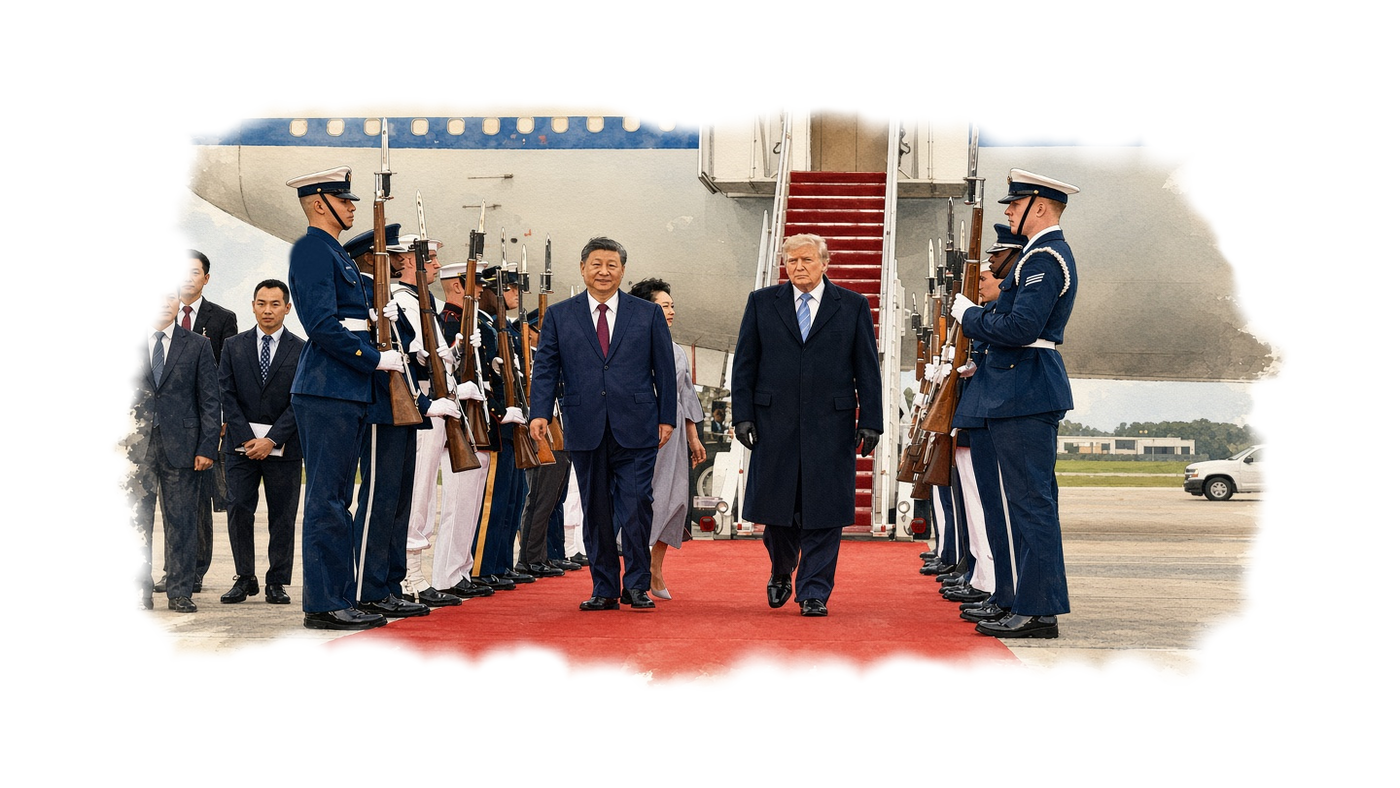
Archive photo: President Xi Jinping and President Donald Trump walk a red carpet at the foot of the stairs of the Chinese presidential aircraft during a welcome ceremony at Joint Base Andrews, Maryland, September 23, 2026.Illustration by Agentic Newsgathering, based on an official White House photograph by Andrea Hanks (public domain).
Chinese President Xi Jinping greeted President Donald Trump in person at the foot of Air Force One's stairs in Shenzhen, the southern Chinese city hosting this year's Asia-Pacific Economic Cooperation summit. The two leaders shook hands and then hugged on a red carpet, with an honor guard, a military band playing both national anthems and fighter jets flying overhead. Xi said he was returning the gesture Trump made in September, when Trump met Xi's plane at Joint Base Andrews outside Washington. Russian President Vladimir Putin, who arrived earlier the same day, was met by Cai Qi, a senior aide to Xi. Trump and Putin later shook hands before a welcome banquet, their first in-person meeting since talks in Alaska in August 2025. The three leaders are scheduled to meet as a group for the first time on Thursday afternoon in Shenzhen. Kremlin spokesman Dmitry Peskov said "no more than an hour" has been set aside. No full agenda has been released; Ukraine, Iran, nuclear weapons, trade and artificial intelligence are among the subjects expected to come up.
The welcome
Chinese President Xi Jinping was waiting at Shenzhen Bao'an International Airport when President Donald Trump landed from Manila, where he had attended a summit of Southeast Asian leaders. Xi met him at the bottom of the stairs from Air Force One. A handshake turned into a hug as rows of soldiers stood at attention and performers in bright outfits waved pompoms, flowers and the flags of both countries.
China's Foreign Ministry said an honor guard from the three branches of the Chinese military gave a salute, a military band played the national anthems of China and the United States, a young child presented Trump with flowers and fighter jets flew overhead.
Xi framed the greeting as a return of courtesy. In September, Trump went to Joint Base Andrews, the military airfield outside Washington, to meet Xi at his plane for a state visit, a step that is also rare for American presidents. According to the Chinese Foreign Ministry's account, Xi told Trump that "China is a nation of etiquette with a tradition of reciprocal courtesy" and said he looked forward to "in-depth exchanges" on relations between the two countries, cooperation in the Asia-Pacific and "the global landscape." The same account quoted Trump as thanking Xi for the personal welcome and calling him "a great leader."
When Trump visited Beijing in May, Xi did not meet him at the airport. NBC News reported that Vice President Han Zheng greeted him then, and that the Shenzhen welcome is believed to be the first time Xi, in power for more than a decade, has personally greeted any foreign leader arriving in China. Axios noted that Xi met President Barack Obama at an airport in 2009, when Xi was still China's vice president.
Russian President Vladimir Putin, who landed in Shenzhen earlier in the day, was met by Cai Qi, a member of the Communist Party's top leadership body and Xi's chief of staff. Putin then held talks with Xi.
William Yang, a senior analyst for Northeast Asia at the International Crisis Group, wrote on X that Xi's gesture most likely reflects a wish to "show respect to Trump." "It is likely also an attempt to uphold the positive rapport between Xi and Trump ahead of a potentially turbulent period in U.S.-China relations in the coming months," he wrote.
Trump and Putin
Trump and Putin shook hands in Xi's presence before the leaders' welcome banquet for the summit. It was their first in-person meeting since August 2025, when Putin flew to Alaska for talks on the war in Ukraine that ended without a deal.
Kremlin spokesman Dmitry Peskov said the two had only greeted each other and had not yet held a substantive conversation. A US official told the Associated Press that Trump plans a separate meeting with Putin on Thursday, and the Kremlin's announcement of Putin's trip lists one. DW reported that Russian officials told state media no "full-scale" talks between the two were planned.
Earlier, in a speech to the summit's business forum, Putin said he expected great potential benefit from the three-way meeting.
What comes Thursday
Trump, Xi and Putin are scheduled to meet at Kylin Villa in Shenzhen at 2:30 PM local time on Thursday, which is 1:30 AM Eastern, according to the White House schedule. It will be the first time the leaders of the United States, China and Russia have met together in person. Peskov said "no more than an hour" had been allocated. Trump and Xi are also scheduled to hold their own meeting earlier the same day.
No full agenda has been made public. The BBC reported that the wars in Ukraine and Iran, nuclear proliferation, trade tensions and artificial intelligence could come up, and Axios reported that the leaders are expected to discuss nuclear arms control, Iran, Ukraine, trade and AI chips. China's government has described the aim more broadly as "safeguarding world peace and promoting strategic stability," the BBC reported.
The meeting has drawn concern from governments that will not be in the room. Ukrainian President Volodymyr Zelensky has raised fears that a plan to end the war could be discussed without representatives from Kyiv or Europe, the BBC reported, and NBC News reported that officials in Ukraine, Iran and Taiwan worry the three leaders could make decisions about their futures without consulting them. In a briefing last week, a senior US official described the meeting as an "entry point" and "the first conversation" and said it was unlikely to produce an agreement, NBC News reported.
Alexander Gabuev, director of the Carnegie Russia Eurasia Center, told Bloomberg that Moscow "really wants this and is excited about the potential summit more than anybody else for a very clear reason – Moscow is the weakest power among the three."