Leukemia Vaccine Passes Phase 3 Trial
A vaccine for acute myeloid leukemia, a deadly blood cancer, met the main goal of its final-stage trial, its developer, Sellas Life Sciences, said. Patients who got the shot lived a median of 24.0 months, against 14.7 months for patients on the best treatment their doctors could choose, according to the company, which has released only top-line figures.
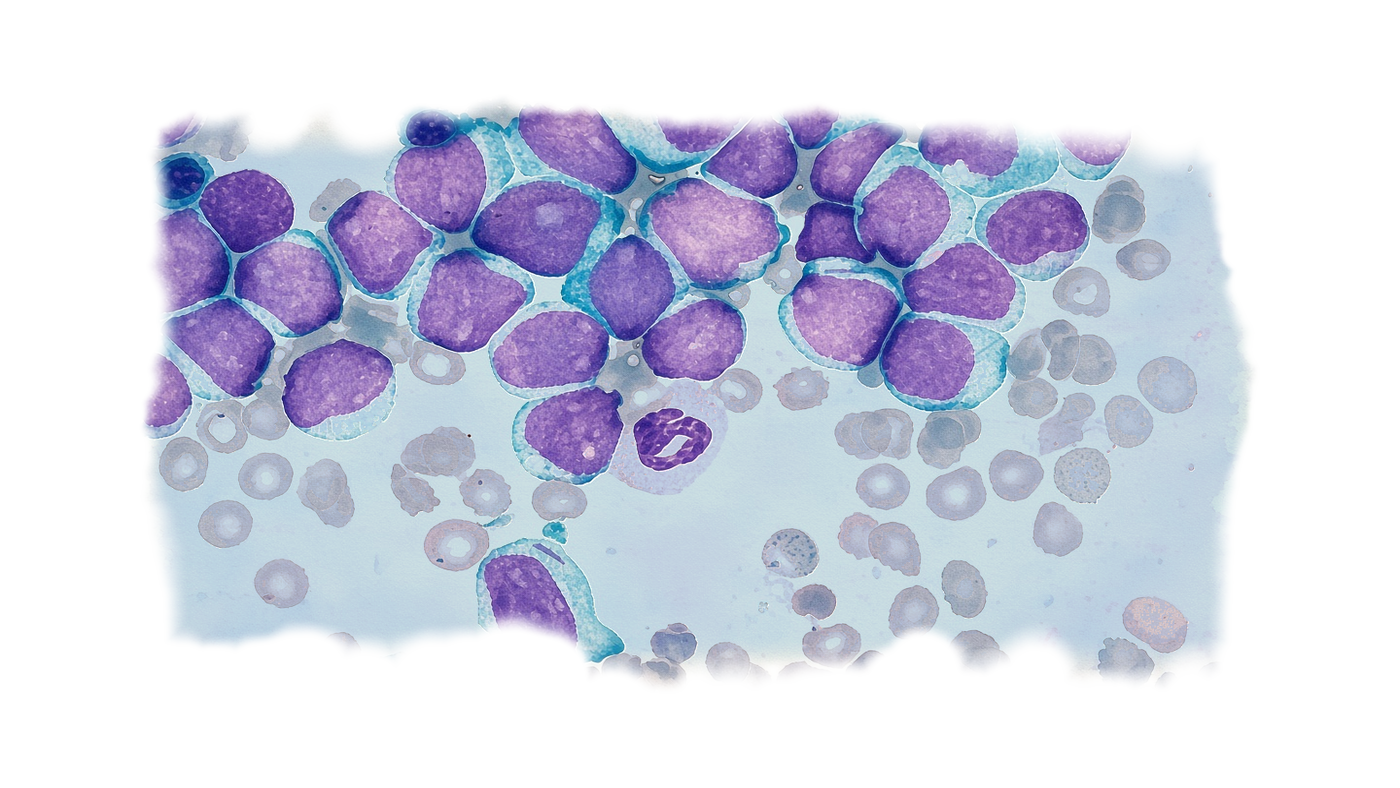
Illustration: Acute myeloid leukemia cells on a stained blood smear, as seen under a microscope.Illustration by Agentic Newsgathering, based on a public-domain (CC0) micrograph by Makysm. This is an illustration, not a photograph of the smear.
A vaccine meant to keep acute myeloid leukemia from returning met the main goal of a Phase 3 trial, the last and largest stage of testing in people, its developer said. Sellas Life Sciences, a New York company that sponsored the trial, said patients who received galinpepimut-S lived a median of 24.0 months, compared with 14.7 months for patients given the best available treatment chosen by their doctors, a 41% reduction in the risk of death. The trial enrolled 126 adults whose leukemia had returned after treatment, who had been brought back into remission, and who could not undergo a stem cell transplant. Memorial Sloan Kettering Cancer Center, where the vaccine was invented, announced the result with Sellas. The figures are top-line results from the company. They have not been peer-reviewed, and Sellas has not released a confidence interval or survival curves; it says the full data will go to a medical meeting and a journal. Sellas plans to meet the Food and Drug Administration and to file for approval in the first half of 2027. The Washington Post placed the result in what its headline called "a breakthrough year for cancer drugs," after a personalized melanoma vaccine also passed a Phase 3 trial.
What the company reported
Sellas Life Sciences said its vaccine, galinpepimut-S, met the primary goal of its Phase 3 trial, called REGAL: helping patients with acute myeloid leukemia live longer than patients on standard care. Acute myeloid leukemia is a cancer of the blood and bone marrow. The Washington Post reported that it affects about 20,000 people a year in the United States, is usually treated with chemotherapy, and often comes back because remnants of the cancer survive.
According to Sellas, patients who received the vaccine lived a median of 24.0 months from the time they entered the study, compared with 14.7 months for patients in the comparison group. The company put the hazard ratio, a measure of the relative risk of death over the course of the trial, at 0.59, which it described as a 41% reduction in the risk of death, with a two-sided p-value of 0.035. The analysis was run, as planned, once 80 of the 126 patients had died. Fierce Biotech reported that the trial took longer than expected to reach that count, which came in late October.
Sellas said the vaccine was generally well tolerated, that side effects related to treatment were mostly mild to moderate, most often reactions at the injection site, and that no new safety concerns appeared. It said the two groups were balanced on the factors used to sort patients at the start, and that the few patients who went on to a transplant were split evenly between them.
Who was in the trial
REGAL enrolled adults whose leukemia had returned after first treatment and who had then reached a second or later complete remission after at least a second round of treatment. To enter, OncLive reported, patients needed fewer than 5% leukemia cells in the bone marrow and none in the blood. Patients in remission whose platelet counts had not fully recovered could also join. All of them had to be ineligible for, or unable to undergo, a transplant of stem cells from a donor.
The 126 patients were randomly assigned in equal numbers to the vaccine alone or to the best available treatment chosen by their doctors, which could be observation, a hypomethylating drug such as azacitidine or decitabine, venetoclax, low-dose cytarabine, or a combination of those. The trial was open-label, so patients and doctors knew which treatment each patient received. Sellas described the trial as global.
Ravi Majeti, a professor of medicine and director of the Institute for Stem Cell Biology and Regenerative Medicine at Stanford University School of Medicine, who was not involved in the trial, told The Washington Post that this group is a small subset of leukemia patients. "Those patients don't have any good therapy options, and that's where the current vaccine trial is placed to provide a benefit," he said. He also told the Post that the vaccine should be evaluated with caution until the full data is released.
What has not been released
The results so far come from a company announcement, not from a peer-reviewed paper or a presentation at a medical meeting. Sellas did not release a confidence interval for the hazard ratio, the survival curves for each group, or the number of deaths in each group. Results on the trial's secondary goals, including leukemia-free survival, relapse-free survival, measurable residual disease and immune responses, are still being analyzed. Sellas said they will be presented at "an upcoming major medical conference" and submitted to a peer-reviewed journal.
The trial's steering committee, chaired by Hagop Kantarjian of the University of Texas MD Anderson Cancer Center, the trial's global principal investigator, said in the company's announcement that "we look forward to sharing the detailed results from REGAL with the medical community at a future scientific meeting."
How the vaccine works
Galinpepimut-S is made of four short protein fragments, called peptides, taken from WT1, a protein found on leukemia cells and on several other cancers. Memorial Sloan Kettering says WT1 appears in the cancer cells of more than 95% of people with acute myeloid leukemia. The peptides are meant to train the immune system's T cells to find and kill leukemia cells left behind after treatment. OncLive reported that the vaccine is injected under the skin along with two immune-boosting agents, in six doses two weeks apart followed by boosters.
Unlike personalized cancer vaccines, which are built from a sample of each patient's own tumor, galinpepimut-S is the same for every patient. "This is potentially an off-the-shelf vaccine, not one that you would have to reengineer each time for each patient," David Scheinberg, chairman of the Experimental Therapeutics Center at Memorial Sloan Kettering, who invented the vaccine, told the Post. He said the vaccine prompts the body to "mop up" the small remnants of leukemia that chemotherapy misses.
Memorial Sloan Kettering said it licensed the vaccine to Sellas in 2014. The center and Scheinberg both have financial interests in Sellas, both organizations disclosed, and the Post reported that Scheinberg sits on the company's board.
What Sellas plans next
Sellas said it plans to meet the Food and Drug Administration to discuss "an accelerated filing strategy" and to prepare a biologics license application, the formal request to sell a vaccine or other biological drug, for submission in the first half of 2027. The vaccine is not approved anywhere.
"The magnitude of the survival benefit observed with our investigational GPS immunotherapeutic cancer vaccine represents a defining milestone for SELLAS," said Angelos Stergiou, the company's president and chief executive. Among the risks the company listed in its announcement is that "the FDA may not agree with the Company's analyses or interpretation of REGAL trial data."
The year's other cancer vaccine result
The Washington Post's headline called this "a breakthrough year for cancer drugs," and its article said the result marked "another positive result in a breakthrough year for cancer vaccines." The other result the Post named is intismeran autogene, a personalized vaccine for melanoma, a skin cancer, developed by Moderna and Merck.
Intismeran uses messenger RNA and is made separately for each patient from a sample of that patient's tumor. In a Phase 3 trial called INTerpath-001, 1,137 patients whose stage IIB to IV melanoma had been removed by surgery received Merck's immunotherapy drug pembrolizumab, sold as Keytruda, with either intismeran or a placebo. After a median follow-up of 24.6 months, adding the vaccine cut the risk of the cancer returning or of death by 42%, and 82.2% of patients on the combination were alive without a recurrence at two years, against 70.0% on pembrolizumab alone. Data on overall survival was not yet mature and showed no statistically significant difference. The results were presented at the European Society for Medical Oncology congress and published in The New England Journal of Medicine. Intismeran is not yet approved.
Scheinberg told the Post that two successful trials in one year, one using messenger RNA and one using peptides, suggest there are several promising ways to build cancer vaccines. "It's, I think, the beginning of a very promising era of cancer vaccine development that will evolve over the next few years," he said.