Outages Hit Apple, the NSA and Chase
A software bug at JPMorgan Chase, a computer failure at United Airlines, a breakdown of the National Security Agency's classified network and a failed update at Apple disrupted banking, flights, intelligence work and Apple's online services across the United States within two days. Each company and agency says the cause was a technical fault, maintenance or an update, not hackers, and the administration's top security officials told Congress they have found no sign of an attack.
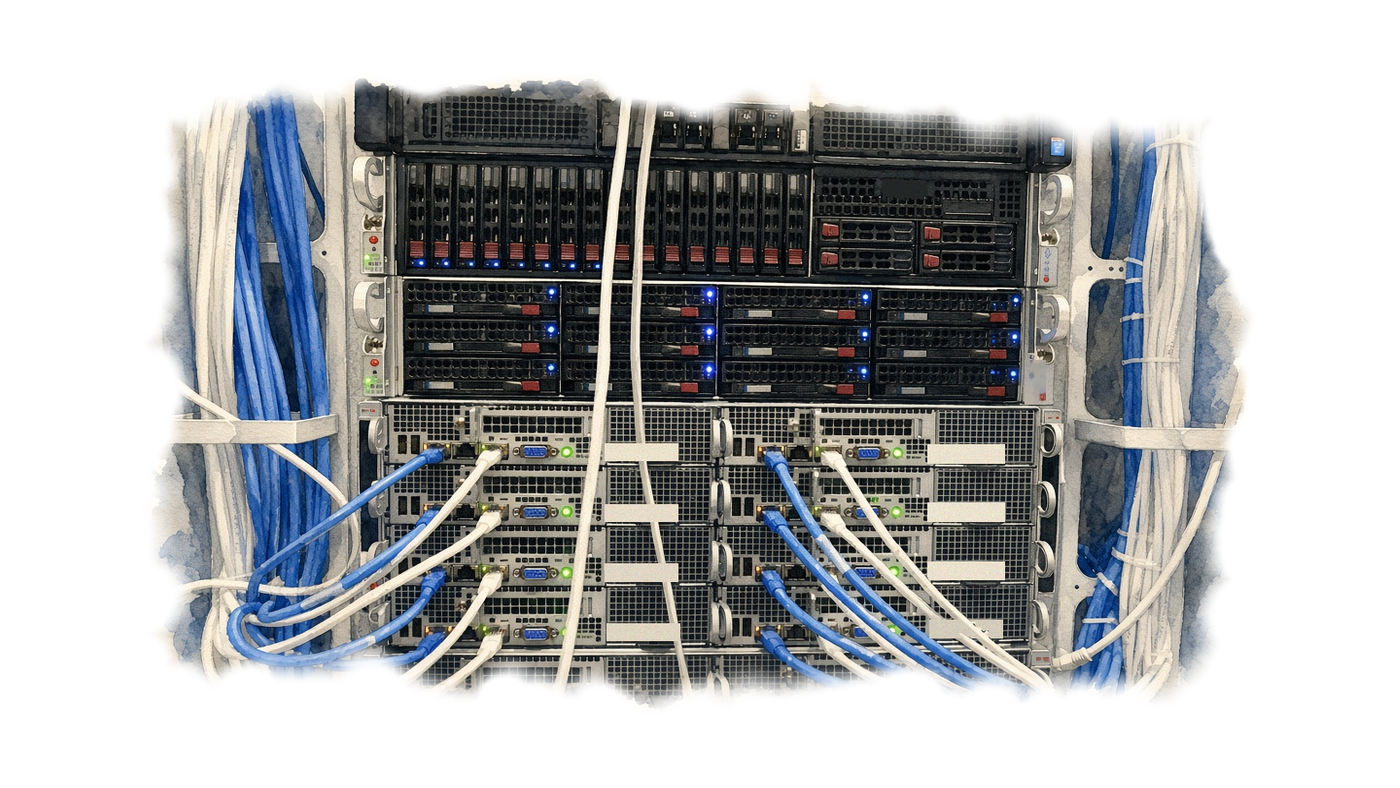
Archive photo: Server racks in the Chemicum building at the University of Tartu, Estonia, March 25, 2026.Illustration by Agentic Newsgathering, based on a photograph by Ivo Kruusamägi (CC BY-SA 4.0). The painting carries the same CC BY-SA 4.0 license.
A run of computer failures has hit American banks, an airline, the National Security Agency and Apple, and every company and agency involved says the cause was a technical fault, maintenance or an update, not an attack. On November 16, a software bug at JPMorgan Chase slowed transactions at several major banks and on the payment service Zelle, and a system outage at United Airlines delayed departing flights. On November 17, the NSA's classified internal network, NSANet, went down during what the agency called "scheduled routine maintenance," and Apple services including iCloud, the App Store and Apple Pay failed after what the company called "an internal update." Director of National Intelligence Jay Clayton told the House Homeland Security Committee the incidents "are not a coordinated or state-sponsored attack." President Donald Trump said, "It's fine." Senator Josh Hawley, a Missouri Republican, called the timing "the greatest coincidence in the history of the world," according to Reuters. The failures followed a nationwide ground stop on November 13 that the Federal Aviation Administration traced to a newly installed router. The FAA has paused installing those routers.
Banks and Zelle
On November 16, thousands of customers reported trouble reaching online accounts at several of the largest US banks after a technical problem at JPMorgan Chase. Customers of Bank of America, Wells Fargo, U.S. Bank and Capital One logged problems on the outage-tracking site Downdetector, and some described failed or delayed payments on Zelle, the person-to-person payment service owned by a group of large banks.
"JPMorgan Chase has experienced a temporary issue related to a software bug in an on-premise hardware system – it is not cyber-related," said Joe Evangelisti, a spokesman for the bank. The bank said customers kept access to their accounts and funds and that the problem was not systemic. "Other banks may have been impacted by slowness in transactions only to the extent that they were a party to a transaction with us," a spokesperson said.
Zelle said its own network was running normally and that problems at the banks people use to reach it can still hold up payments.
United Airlines
The same day, United Airlines held departing flights after an outage that affected several applications its pilots use. The Air Line Pilots Association told members that United could not "provide outbound flights with final weights." The Associated Press reported that the outage lasted more than 90 minutes. Flights already in the air and United Express regional flights were not affected, the airline said, and there was "no indication that this was a cybersecurity-related issue."
The NSA's classified network
On November 17, NSANet, the classified network NSA employees use to share secret information with one another, went down. The agency said in a statement that it "experienced temporary degradation during scheduled routine maintenance" and that "mission-critical capabilities remain fully operational."
The agency staggered employees' arrival times at its headquarters at Fort Meade, Maryland, to keep tens of thousands of people from logging in to the network at once. Director of National Intelligence Jay Clayton said in an interview with Fox Business that the failure came from a software patch, according to The Record from Recorded Future News, which reported that the patch fixed flaws in PHP, a programming language that runs much of the web. The Record reported that the network was working again on November 18 but that logins were still being staggered, and that a source expected full restoration to take another day or two.
Apple and Gmail
Apple users reported problems signing in to their accounts, using iCloud, downloading from the App Store, paying with Apple Pay and activating new iPhones, beginning before noon Eastern time on November 17. "Many of our systems are back up and running after an internal update caused some outages this morning," an Apple spokesperson said, adding that the company was working to get the remaining systems online "as soon as possible." Apple said the outage was not the result of a cyberattack.
The outage-tracking site Downdetector logged more than 2,800 reports of Gmail problems by noon Eastern time the same day, mostly about missing incoming mail. Google said it was not "currently seeing evidence of a broad Gmail service disruption."
The ground stop and the routers
On November 13, the Federal Aviation Administration stopped flights nationwide for nearly five hours after data flooded the network that carries air traffic control communications. The flood destabilized aircraft communications and radar feeds at 17 of the country's 22 regional air traffic control centers. Investigators traced it to a radio site in El Dorado, Arkansas, where L3Harris Technologies, the FAA's network contractor, had just installed a new router made by Juniper Networks as part of a switch from copper wire to fiber-optic lines. FAA Administrator Bryan Bedford called the work "ordinary course-of-business stuff."
The FAA said it addressed the initial cause by disabling the functionality of the originating Juniper routers, turned off the same functionality on more than 60 other Juniper routers in the system and paused installing them. Transportation Secretary Sean Duffy said the root cause has not been found. The router is being tested at an L3Harris laboratory in Melbourne, Florida, with FBI agents taking part.
What officials say
Clayton told Fox Business, according to Reuters, that "everybody recognizes it's time to upgrade their systems, and as they upgrade them, they're not coming back as expected in all cases." He added, "Looking very diligently across the landscape, we are not seeing this as a cyber attack incident."
Homeland Security Secretary Markwayne Mullin told CNBC, "I can tell you with complete certainty that we are not under attack."
President Donald Trump, speaking to reporters in Manila, said: "When you're big and powerful and you have all the money, things like that happen. It's fine."
Before the House Homeland Security Committee, Clayton repeated that "these are separate service outages associated with maintenance and technical changes. They are not a coordinated or state-sponsored attack." Mullin told the committee, "We have seen nothing that would indicate that they are related," and Christopher Raia, the deputy director of the FBI, said, "At this point, there is no indication whatsoever that there is any cyber malicious activity related to any of those incidents," CBS News reported.
"If this is all a coincidence, it's like the greatest coincidence in the history of the world," Senator Josh Hawley, a Missouri Republican, told reporters, according to Reuters.
- CP24 (CTV News, with Reuters and the Associated Press)
- Digital Trends
- Interesting Engineering
- CBS News (Apple)
See all (21)Show fewer
- MacRumors
- Anadolu Agency (Gmail)
- CNBC (JPMorgan Chase)
- Al Jazeera
- MarketWatch (via Morningstar)
- CNBC (United Airlines)
- National Security Agency
- Politico
- The Record from Recorded Future News (November 17)
- The Record from Recorded Future News (November 18)
- Federal Aviation Administration
- Reuters (via Investing.com)
- CRN
- NBC News
- The Times of India
- CBS News (hearing)
- Anadolu Agency (hearing)