What the Permitting Bill Would Change
The Senate voted 70 to 27 to end debate on a rewrite of federal permitting rules, moving the bill toward a final vote that has not yet been held. The text would speed reviews for power lines and pipelines, make large data centers pay for the grid upgrades they need, and make a finished federal permit hard to take back.
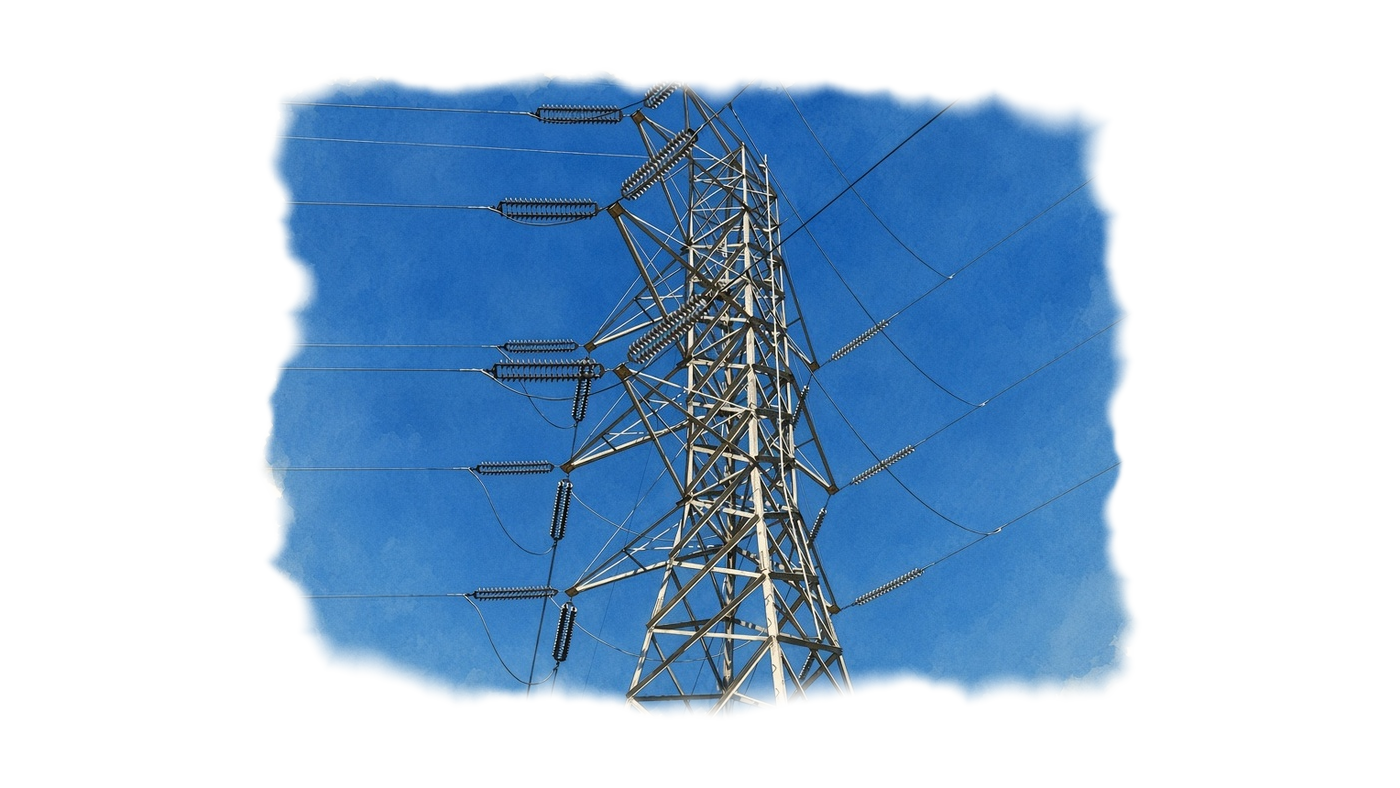
Archive photo: A high-voltage transmission tower along Denow Road in Lawrence Township, New Jersey, March 24, 2026.Illustration by The Good Times, based on a photograph by Famartin (CC BY-SA 4.0). The painting carries the same CC BY-SA 4.0 license.
The Senate voted 70 to 27 to end debate on the negotiated text of the Bipartisan American Affordability and Jobs Act, moving a rewrite of federal permitting rules toward a final Senate vote that has not yet been held. The bill would set deadlines for environmental reviews and agency decisions, narrow the window for lawsuits, and require data centers to pay for the grid upgrades they need instead of passing those costs to other customers. It would let federal regulators approve an interstate power line if a state refuses or fails to act within a year. Its most disputed part, Section 1401, would make a finished federal permit very hard to revoke, for wind farms and gas pipelines alike, Inside Climate News reported. Sen. Martin Heinrich, one of the bill's authors, says it would cut permitting for a major power line from about two decades to about five years. Earthjustice President Abigail Dillen argues that favored industries will rush to lock in approvals no successor can undo. The bill still needs a final Senate vote, House passage and the president's signature.
The vote
The roll call was the Senate's 264th of the second session of the 119th Congress. The official record on senate.gov shows the motion was agreed to, 70 to 27, with three senators not voting: Sen. Ashley Moody, a Florida Republican, Sen. Chris Murphy, a Connecticut Democrat, and Sen. Jim Risch, an Idaho Republican. Both California senators, Alex Padilla and Adam Schiff, voted no.
The question was cloture, a vote to end debate, on a substitute amendment, numbered 6883, offered by Sen. Shelley Moore Capito, a West Virginia Republican who chairs the Environment and Public Works Committee, to H.R. 2347, the vehicle for the bill. Cloture on an amendment of this kind requires 60 votes. The Hill reported the same 70-27 result and said the procedural vote sets up a final Senate passage vote before the Thanksgiving recess. According to the official record, the vote began at 6:27 PM ET on November 16.
The final vote has not been held. On November 17 the Senate resumed consideration of the bill after cloture, but the only roll call that day, vote 265, was the confirmation of a circuit judge. Senators can still act on the substitute before a final passage vote. The bill would then still need to pass the House and be signed by the president.
The Senate had earlier voted 73 to 25 on November 9 to end debate on a motion to take the bill up, and 62 to 21 on November 10 to proceed to it, according to the Senate's official roll call records. The negotiated substitute was the text at issue on November 16. Capito wrote the substitute with Sen. Mike Lee, a Utah Republican who chairs the Energy and Natural Resources Committee, and two Democrats, Sen. Sheldon Whitehouse of Rhode Island and Sen. Martin Heinrich of New Mexico, The Hill reported.
What the text would change
The bill would speed the construction of energy, mining and infrastructure projects while limiting environmental challenges under the National Environmental Policy Act, the basic law that requires agencies to study the environmental effects of their decisions, as well as the Clean Water Act, the Endangered Species Act and the National Historic Preservation Act, The Hill reported.
A central, and less disputed, piece concerns electric transmission, the high-voltage lines that move power across state lines. Today a single state can stall an interstate line for years. Inside Climate News reported that the main federal process for planning lines between regions has produced no miles of high-voltage line since it was created in 2011. The bill would let federal regulators approve a line if a state refuses or does not act within a year, and would require neighboring grid regions to plan lines together, Inside Climate News reported. The Hill said the measure seeks to boost transmission capacity and could reduce the time it takes to build new lines.
The bill would also require data centers, the large computing buildings that train and run artificial intelligence systems and that draw heavy amounts of electricity, to pay for the grid upgrades they need rather than leave those costs on other customers, Inside Climate News reported. The Hill said the substitute strengthened provisions addressing energy-hungry data centers.
The clause that is in dispute
Section 1401, as described by Inside Climate News, would allow an agency to revoke a finished permit only in narrow cases, such as fraud, a court order or an immediate threat to health or the environment. An agency that interferes in bad faith could owe the developer a quarter to half of what the developer has spent, that outlet reported. The protection would cover any permit in effect on or after November 6, so it would reach approvals already on the books, not only future ones, and it would apply to pipelines, liquefied natural gas terminals and mines as fully as to wind farms.
Heinrich, one of the four authors, argues that the bill would cut permitting for a major power line from about two decades to about five years, Inside Climate News reported. Abigail Dillen, the president of Earthjustice, an environmental law organization, argues the reverse: that favored industries of the current administration will rush to lock in approvals that no successor can undo. "They're making competing forecasts about what could get approved between now and January 2029," Inside Climate News wrote, summarizing the split. The same outlet reported that President Donald Trump said last week that he still will not approve wind turbines, bill or no bill.
The motivating example for the clause, Inside Climate News reported, is the Trump administration's 2025 halt of five offshore wind projects, one of them about 87 percent built. Democrats had wanted a durability provision after those cancellations; as written, the protection is not limited to wind.
What still has to happen
The sponsors are trying to finish the bill before Democrats take control of Congress in January, Inside Climate News reported. In the House, Minority Leader Hakeem Jeffries wants changes, that outlet said. The Hill reported that the bill also faces resistance from House Energy and Commerce Committee Chairman Brett Guthrie, a Kentucky Republican, who has called for changes to address grid reliability, and from several House Democrats, including Rep. Jared Huffman of California, who says the bill would constrain environmental reviews, change transmission approvals and let companies sue the government for damages if they can show they were discriminated against on the basis of fuel type.
Whitehouse, the other Democratic author, would rather not wait. "We'd be silly not to take this win," he told Reuters, according to Inside Climate News.