Waymo Barred From California Freeways
The California Department of Motor Vehicles has barred Waymo from running its driverless taxis on the state's freeways, saying those operations pose an imminent hazard to public safety because the vehicles have repeatedly entered active construction zones.
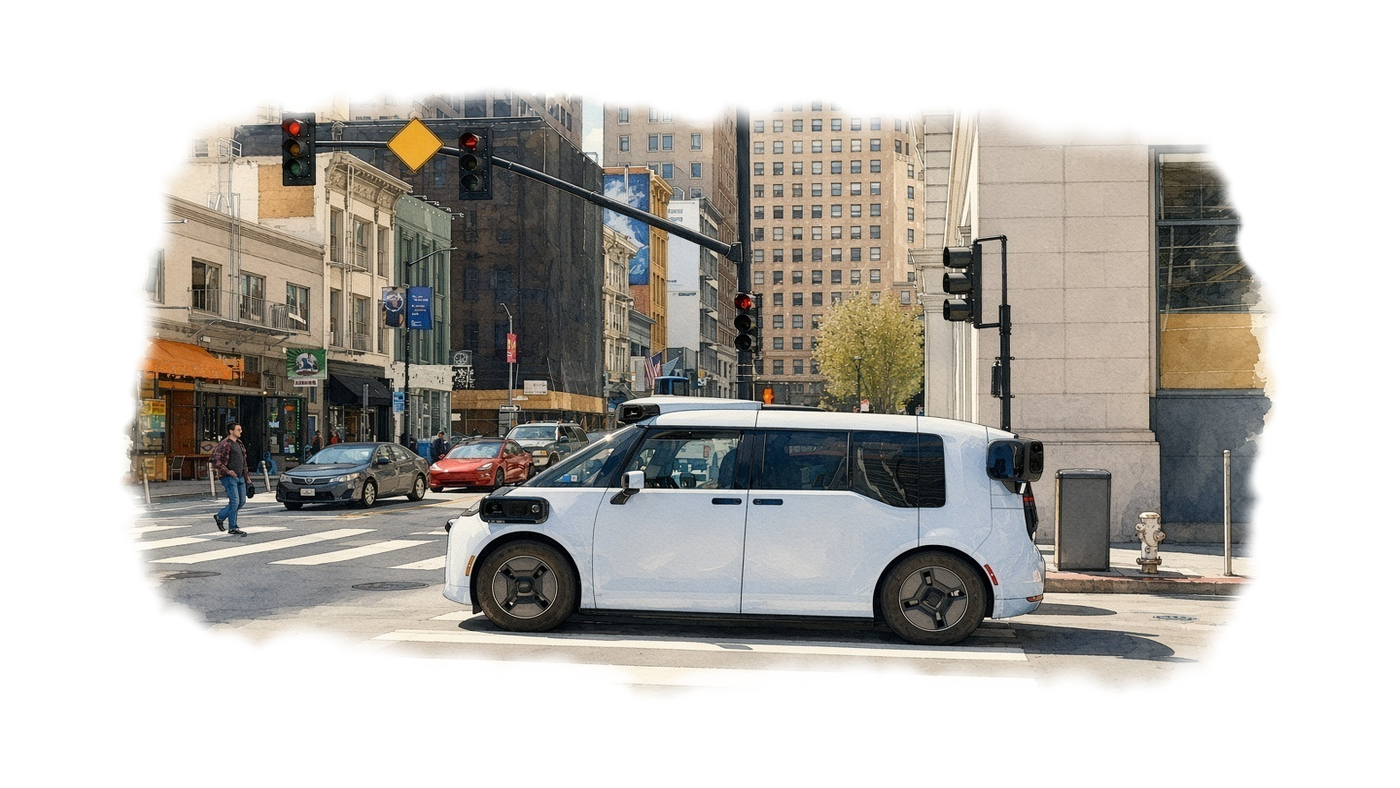
Archive photo: A Waymo Ojai robotaxi on Mission Street in San Francisco, July 23, 2026.Illustration by The Good Times, based on a photograph by Daniel Lu (User:dllu) (CC BY-SA 4.0). The painting carries the same CC BY-SA 4.0 license.
The California Department of Motor Vehicles has barred Waymo, the Alphabet-owned company that operates driverless taxis, from running or testing those vehicles on the state's freeways. In a statement, the department said Waymo's freeway operations "pose an imminent hazard to public safety due to recurring incursions by its vehicles into active construction zones where construction workers, vehicles and equipment are present," despite a prior restriction and corrective actions after similar incidents on May 18. It named two recent triggers: three Waymo vehicles that entered an active construction closure on US 101 near Burlingame, and one that tried to get past a California Highway Patrol traffic break on Interstate 280 in San Francisco. The order took effect November 11 and was made public November 17. Waymo then temporarily restricted freeway rides in all the markets where it offers that service. A company spokeswoman, Dana Gallagher, said the recent incidents caused no injuries and no collisions, and that rides on ordinary city streets continue. The restriction stays in place until Waymo shows the department that it has taken effective corrective actions.
The order
The California Department of Motor Vehicles, which regulates the testing and deployment of autonomous vehicles in California, has prohibited Waymo from operating or testing its driverless vehicles on all state freeways. Jonathan Groveman, a department spokesman, confirmed the action to KQED and other outlets.
TechCrunch reported that the order took effect on November 11, was not made public until November 17, and that the San Francisco Business Times was the first to report it.
The department's emailed statement, as published by TechCrunch, said: "The Department determined that Waymo's driverless freeway operations pose an imminent hazard to public safety due to recurring incursions by its vehicles into active construction zones where construction workers, vehicles and equipment are present, despite a prior restriction and corrective actions implemented following similar incidents that occurred on May 18, 2026."
The restriction, the DMV said, will remain in place until Waymo "demonstrates to the Department that it has taken effective corrective actions to address the deficiencies that precipitated the restrictions." KQED, citing Groveman, reported that this would include sufficient evidence that the vehicles can detect and respond to construction zones and emergency vehicles.
The incidents
The department cited two recent episodes in the Bay Area. In one, three Waymo vehicles entered an active construction closure on US Route 101 near Burlingame, south of San Francisco. In the other, a Waymo vehicle attempted to pass California Highway Patrol cars that were creating a traffic break on Interstate 280 in San Francisco. A traffic break is a police maneuver in which officers slow or stop traffic, often to clear a hazard or protect a work area.
Those episodes came after similar problems in May. Groveman told KQED that the new incidents followed "prior restrictions and corrective actions implemented following similar incidents on May 18, 2026," when Waymo vehicles drove into active construction zones. TechCrunch reported that Waymo abruptly stopped operating on highways in May, after social media posts showed its robotaxis driving through traffic cones and struggling in construction zones, and that the vehicles returned to freeways in July after the company said it had updated its self-driving software to improve performance around freeway construction. ABC News and ABC7 also reported that Waymo paused freeway operations in several cities in May, including San Francisco and Los Angeles, to improve how the cars respond in construction zones.
What Waymo said
Waymo spokeswoman Dana Gallagher, in a statement issued to TechCrunch, KQED and ABC News, said, "Safety is at the foundation of everything we do." After "recent freeway construction zone encounters on U.S. 101 in California that did not involve any injuries or collisions," she said, the DMV "has implemented an operating restriction on freeway operations in the state." She added: "In alignment with our safety-first principles, we have also temporarily restricted freeway operations across our other operating markets to evaluate our performance. Our ride-hailing service continues to operate safely on surface streets, serving over half a million trips each week. We are working with the California DMV and other state officials diligently and responsibly to resume freeway operations."
KQED reported that Waymo said it will continue freeway testing with "trained autonomous specialists" while the restriction is in place, meaning a human specialist would be in the vehicle during those tests.
The service
Waymo is a subsidiary of Alphabet, the parent company of Google. It operates robotaxis, cars that carry paying passengers without a driver at the wheel, in multiple US cities. The company began offering fully driverless freeway rides to the public in November 2025 in the San Francisco Bay Area, Phoenix and Los Angeles, CNBC, CBS News and KQED reported. CNBC reported that the cars would take those routes "when a freeway route is meaningfully faster," and that they would generally travel up to the posted speed limit. Freeway access let the cars use high-speed roads for trips that connect riders to airports and, in the Bay Area, that run between San Francisco and Silicon Valley. TechCrunch noted that this has mattered in particular on the Peninsula, where surface-street trips could take 45 minutes to more than an hour.
TechCrunch reported that Waymo now has commercial operations in 15 US cities. KQED reported that the company provides service in eight states, with further expansions planned.
The California order applies only to freeways in that state. The company's decision to pause freeway rides elsewhere is its own, and temporary, according to the statements it gave reporters. Service on surface streets, the ordinary roads of a city, is not affected by the DMV restriction.