New York Disbands a Police Unit
New York City Mayor Zohran Mamdani and Police Commissioner Jessica Tisch announced the disbanding of the New York Police Department's Strategic Response Group, the unit that has handled both counterterrorism work and protest crowd control, and said those two roles will now be kept apart.
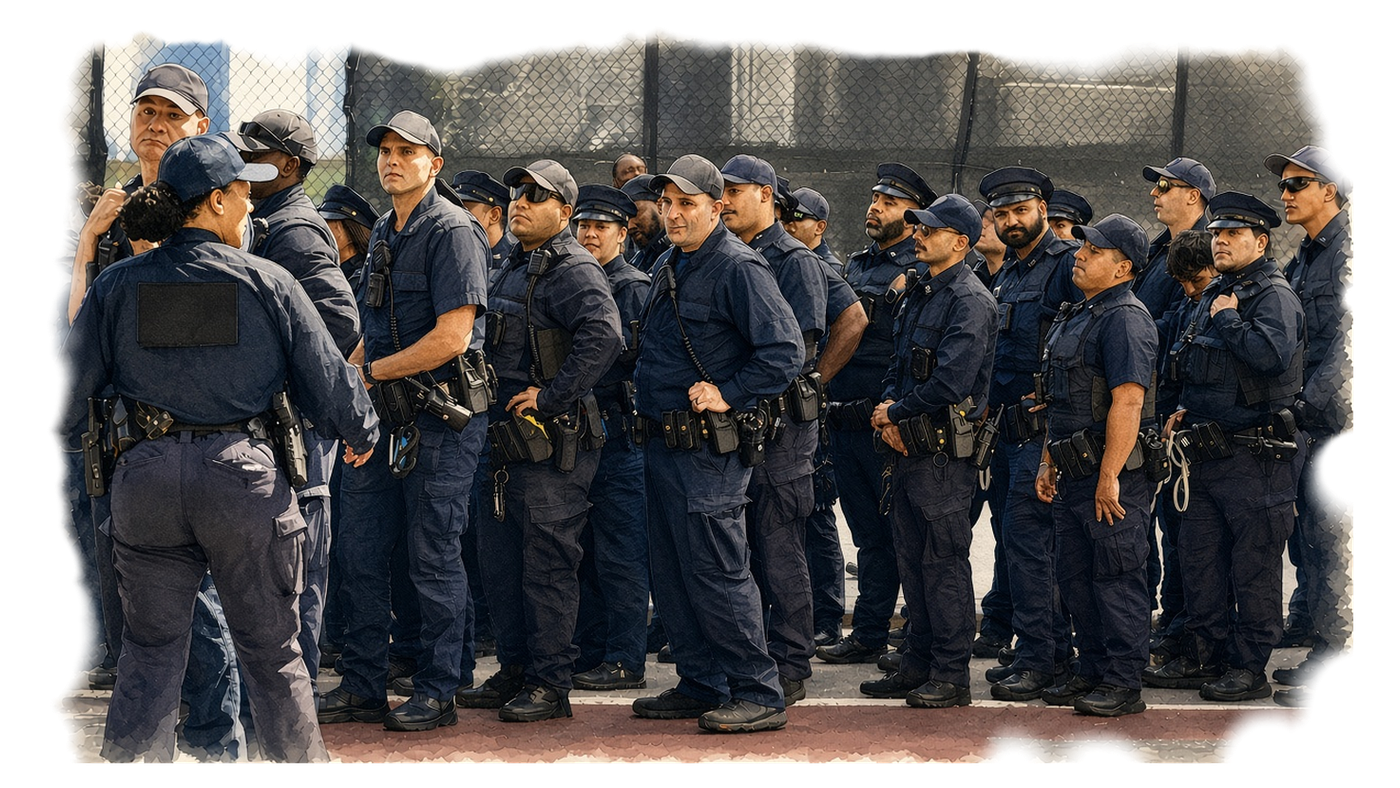
Archive photo: Officers of the NYPD's Strategic Response Group near a sit-in in Manhattan, September 24, 2026.Illustration by The Good Times, based on a photograph by Tessa Bury (CC BY 4.0).
New York City Mayor Zohran Mamdani and Police Commissioner Jessica Tisch announced the disbanding of the New York Police Department's Strategic Response Group, the unit that has handled both counterterrorism work and protest crowd control, and said those two roles will now be kept apart. Ending the group was a pledge of Mamdani's 2025 campaign for mayor. Its counterterrorism functions will move to the Intelligence and Counterterrorism Bureau. Protest response will be shared by a civilian division in the Mayor's Office of Community Safety, which will have no weapons or arrest powers; a 30-officer First Amendment Support Team; and a new Patrol Support Division of vetted officers who the city said will spend most of their time on patrol and may make arrests at demonstrations only in rare cases. The mayor's office said officers will be barred from using kettling, long guns and tear gas during First Amendment activities, and that pepper spray will not be used as a crowd-management tool. Reports put the unit at 500 to 600 officers and differ on whether it will be dissolved by mid-February or in the spring of 2027.
What City Hall announced
New York City's mayor and police commissioner said they will break up the Strategic Response Group, known as the SRG, and separate the work of answering a terrorist threat from the work of managing a demonstration.
The announcement was made on November 16 in a City Hall video and an interview with ABC's Eyewitness News. "During our campaign, I promised New Yorkers that we would disband the Strategic Response Group and separate counterterrorism from protest response, and today we are delivering on that promise," Mamdani said in a statement released by his office. "New Yorkers exercising their constitutional right to protest should not be met with the same police response as a terrorism threat."
Tisch, in the same release, said, "I would never support changes that diminish the NYPD's ability to protect New Yorkers, or that put our officers in a position where they lack the resources necessary to confront a serious threat." Asked in the ABC interview whether the move was a compromise, she said, "No, I would never compromise on security for New Yorkers."
The mayor's office said work on the plan began in January. In the ABC interview, Mamdani said the administration had taken 10 months "to ensure that we could do so in a way that fulfilled the promise."
What takes its place
The group's counterterrorism functions, including heavy-weapons deployments at critical infrastructure, will be consolidated in the Intelligence and Counterterrorism Bureau.
A Community Dialogue and De-escalation Division will be created in the Mayor's Office of Community Safety to plan for and respond to protests. It will not have weapons or arrest powers. The Police Department will also create a First Amendment Support Team of 30 uniformed officers in the Community Affairs Bureau, trained in communication and de-escalation, which the mayor's office said will handle dialogue work while the civilian division is being built. ABC7 reported that, over the next year, the city plans to hire and train civilians to work with protest organizers. City & State New York reported that the civilian force would not be operational until at least 2028, and that the 30-officer team would take the lead in the interim.
A Patrol Support Division will be established in the Patrol Services Bureau, made up of vetted officers who, the mayor's office said, will receive specialized crowd-management training, spend most of their time on patrol and "conduct arrests at protests in rare instances, if necessary." The office said the unit builds on reforms agreed to in what City Hall called the Payne protest settlement.
The reforms also set what the mayor's office called a formal prohibition on kettling, long guns and tear gas during First Amendment activities. Pepper spray will not be used as a crowd-management tool, long-range acoustic devices will be limited to 90 decibels, and officers will be prohibited from using bicycles as weapons except when necessary to prevent death or physical injury, the office said. CBS New York reported that the department said tear gas and kettling are not currently used.
In the ABC interview, Tisch said the change would not affect how the department responds to civil disorder. "Nothing would change about the way that the NYPD responds to crowd control conditions, like, for example, the celebrations following the Knicks' epic championship," she said.
Reports differ on size and timing
The mayor's office statement did not give a size for the group or a date for its dissolution. Tisch told ABC's Eyewitness News that the group's 500 officers will be reassigned, with many moving to the Counterterrorism Bureau. The Independent, citing that interview, reported a figure of roughly 500, and the New York Post also described the unit as 500 strong. NBC New York put the number at approximately 600 and said that, according to the mayor's order, the group will be dissolved by mid-February. ABC7 reported that the unit is scheduled to be dissolved in the spring of 2027, and NY1 reported that the transition will not be complete until then.
The New York Post wrote that the group can be deployed only with the mayor's sign-off, has been used fewer than 20 times this year and has made around a dozen arrests.
A unit built for two jobs
The Strategic Response Group was formed in 2015, when William Bratton was police commissioner, as a force of 350 officers, according to a 2021 Gothamist account and 2023 testimony from the New York Civil Liberties Union. Gothamist reported that Bratton described a force trained in "advanced disorder control" and tasked with counterterrorism and large-scale events, including protests, and that after objections, James O'Neill, then the chief of department, told reporters the unit would not handle protests and would do "counterterror work." The civil liberties union, citing a January 2015 Daily News report, gave a similar account of that walk-back. Both said the unit was later sent to demonstrations. Gothamist, citing the Independent Budget Office, reported that the unit's personnel budget rose from $13 million to more than $90 million a year by 2016, and that the number of officers had grown to about 700. The civil liberties union gave the same figures.
The group drew lawsuits after the demonstrations of the summer of 2020. On September 5, 2023, Attorney General Letitia James, the Legal Aid Society and the New York Civil Liberties Union announced an agreement with the Police Department resolving those suits. The attorney general's office said the agreement required a four-tiered response meant to minimize the police presence at demonstrations and to use de-escalation first, and required the department to stop kettling. NBC New York reported that the unit was accused of unlawfully detaining more than 100 demonstrators in 2020.
Police unions object, and advocates approve
Patrick Hendry, president of the Police Benevolent Association, criticized the move in a statement quoted by Gothamist, CBS New York and NY1. "Today is not a good day for New Yorkers who just want a safe and orderly city," he said. "Mayor Mamdani is showing his true colors: he's willing to put your safety and police officers' safety at risk to appease his radical base."
Scott Munro, president of the Detectives' Endowment Association, said in a statement reported by ABC7 and Fox News that disbanding the unit "proves just how disconnected City Hall is from the realities of policing New York City."
Donna Lieberman, executive director of the New York Civil Liberties Union, said, "The demise of the SRG is a victory for our First Amendment rights and the advocates who worked tirelessly for this day." She told CBS New York that the group "has really chilled the right to protest."
The Legal Aid Society commended the mayor for disbanding "one of the NYPD's most notorious units" and for endorsing a City Council bill, the Communities United to Reject Brutality Act, known as the CURB Act. It said the restructuring "will require vigilant oversight to ensure that the SRG's tactics are not repeated."
Mamdani made the announcement in a video alongside Council Member Chi Ossé, the sponsor of the CURB Act, a bill the mayor said he is proud to support. "We will be doing all of this while keeping NYPD headcount the same," Ossé said, according to the New York Post. A spokesman for City Council Speaker Julie Menin told City & State New York and CBS New York that the administration can make the changes "without legislative action."
- NYC Mayor's Office (November 16)
- NBC New York (November 16)
- ABC7 Eyewitness News (November 16, exclusive interview)
- ABC7 Eyewitness News (November 16, reactions)
See all (15)Show fewer
- CBS New York (November 16)
- Gothamist (November 16)
- The New York Post (November 16)
- NY1 (November 16)
- The Independent (November 16)
- City & State New York (November 16)
- The Legal Aid Society (November 16)
- Fox News (November 16, union statements)
- Office of the New York Attorney General (September 5, 2023, protest-policing agreement)
- Gothamist (February 19, 2021, unit history)
- New York Civil Liberties Union (March 1, 2023, City Council testimony)