A Caravan Walks Through Chiapas
A migrant caravan walking north through southern Mexico has reached the town of Mapastepec in Chiapas, and President Donald Trump has threatened to double tariffs on Mexico if the group is not stopped before it reaches the United States border.
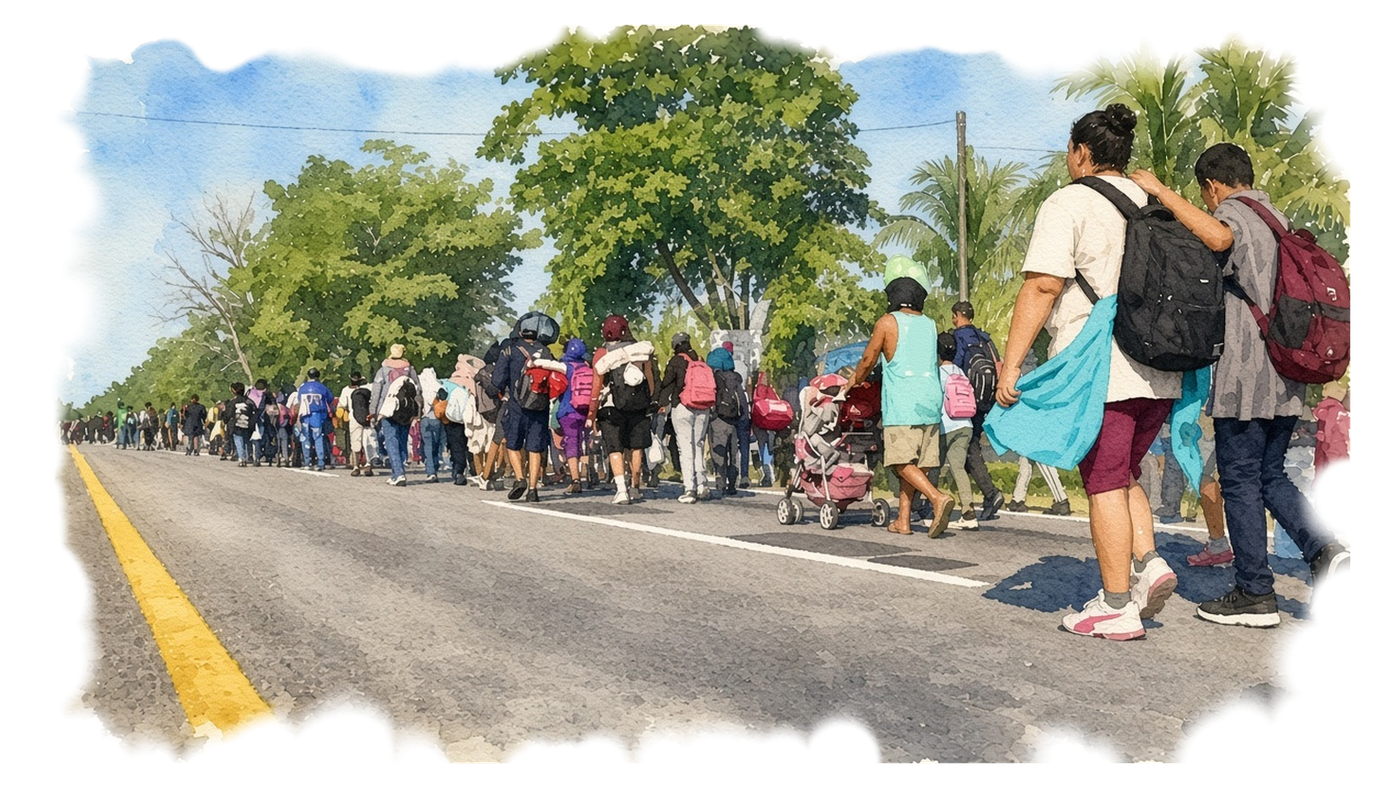
Archive photo: A migrant caravan walks a highway north from Tapachula, Chiapas, in December 2023.Illustration by The Good Times, based on a Voice of America video still by Juan Gallegos (public domain).
A migrant caravan walking north through southern Mexico has reached the town of Mapastepec in Chiapas, and President Donald Trump has threatened to double tariffs on Mexico if the group is not stopped before it reaches the United States border. The group, which its members call Dios con nosotros, arrived in the early hours of November 16 and is made up mostly of Hondurans. Counts of its size do not agree. Mexico's National Migration Institute told Reuters that about 870 people were in the town of Huixtla on November 13, while two local sources and a nongovernmental organization put the number at 1,500 to 2,000, which Reuters said would make it the largest caravan so far this year. Mexican newspapers described more than 1,000 people in Mapastepec. President Claudia Sheinbaum has said that "not a single migrant caravan has reached the north" since January 2025, and that the people walking are offered a safe return home or the option to stay in Mexico under certain conditions. The United States border lies some 2,900 kilometers, or about 1,800 miles, north of Huixtla.
A stop in Mapastepec
A migrant caravan walking the coastal highway in Chiapas has reached Mapastepec, where its members gathered at a covered court to rest before continuing toward the town of Pijijiapan.
La Jornada reported that the group, which its members call Dios con nosotros, arrived in the early hours of November 16 and is made up mostly of Hondurans. It put the distance walked at about 140 kilometers in the ten days since the group entered Mexico through the municipality of Suchiate. El Universal said the walkers reached the town around 3 a.m. after covering 34 kilometers from Escuintla, and that more than 1,000 people had walked about 110 kilometers since leaving Tapachula on November 10. Jessica López, a Salvadoran woman in the caravan, told La Jornada, "We are already very tired, our bodies hurt a lot, especially our feet, but here we are with one objective, to reach the United States." Reforma reported that the migrants planned to rest through November 16 and resume walking toward Pijijiapan late in the afternoon of November 17.
El Universal and El Financiero reported that the group also includes people from El Salvador, Guatemala, Nicaragua, Cuba and Haiti, and El Financiero and UnoTV also listed Venezuela. Beyond Pijijiapan, the highway leads to Arriaga, near the Chiapas border with Oaxaca.
Counts that do not agree
A Chiapas state government source told Reuters that about 1,500 people, including many families, set off from Tapachula on November 10. Mexico's National Migration Institute later told Reuters that about 870 people were gathered in Huixtla, some 60 kilometers west of the border with Guatemala, on November 13. Two local sources and a nongovernmental organization estimated 1,500 to 2,000, which Reuters said would make this the largest migrant caravan so far this year. UnoTV put the number at more than 2,000 as the group left Huixtla for Escuintla. TV Azteca reported on November 15 that operations by the migration institute had cut the group to around 800, from about 1,500. Milenio, reporting from Escuintla that evening, put the group at around 1,200 and said that, according to other walkers, about 300 people had turned themselves in to the institute. El Universal wrote on November 16 that the institute had not reported how many people had given themselves up because of fatigue or illness.
Accounts of when the caravan crossed into Mexico range from November 6, in La Jornada, to the evening of November 8, when Agence France-Presse said a group of about 1,000 crossed the border without resistance. Reforma and Irineo Mujica, the director of the advocacy group Pueblos Sin Fronteras, quoted by El Financiero, said the group left Honduras on November 3.
El Financiero and Agence France-Presse said this is the third Central American caravan since September, and that the two earlier groups were broken up in Chiapas after their members received temporary permits to stay. El Financiero reported that neither got past Arriaga. On November 10, Agence France-Presse reported, Mexico's National Guard, immigration authorities and Chiapas state police blocked a separate group of about 100 Central American migrants who had crossed the Suchiate River from Guatemala. About 40 people were detained, according to reports from Tapachula; the migration institute did not confirm the detentions to the agency.
The tariff threat
On November 12, President Donald Trump wrote on Truth Social that "huge caravans are forming and beginning their illegal march through Mexico." "They will not be accepted! MEXICO MUST STOP THEM, NOW, and if they do not do so, the Tariffs on Mexico will be IMMEDIATELY DOUBLED," he wrote, according to Reuters, the Associated Press and Courthouse News Service. He added that Mexico, "the very liberal new governor of Texas," the Border Patrol and Immigration and Customs Enforcement had "been so informed," and that "there will be no leniency." Reuters identified the incoming Texas governor as Gina Hinojosa, a Democrat elected in the November 3 midterm elections.
"We will utilize all assets to make sure our borders are secure," Homeland Security Secretary Markwayne Mullin wrote on social media after the threat, Reuters and Courthouse News Service reported. "This illegal migrant caravan will NOT be allowed to enter our country. Full stop."
The United States and Mexico traded about $779 billion worth of goods in the first nine months of this year, according to U.S. Census Bureau figures. Reuters described the two countries as each other's top trading partners and said they are negotiating a trade agreement after Trump chose in July not to extend the United States-Mexico-Canada Agreement. Marcelo Ebrard, Mexico's economy minister, told reporters he was in contact with his American counterparts and that, as of November 13, the caravan was not affecting the talks, Reuters reported.
What Mexico says
President Claudia Sheinbaum said at her regular news briefing on November 12 that "not a single migrant caravan has reached the north" since January 2025, the Associated Press reported. She said a caravan of about 600 people in Chiapas had largely dispersed after its members were told that reaching the United States would be "very difficult," and that Mexican authorities were talking with another group of several hundred Honduran migrants and encouraging them to return home. She ruled out the use of force, saying authorities have "extensive experience" accompanying migrants. "There will be no acts of repression," she said, according to Reuters.
The next day she said, "There is no caravan currently in transit through our country on its way to the border." An earlier caravan, she said, had "dissolved while en route, and most of its members have already returned to their countries of origin, and another caravan is only just forming."
Sheinbaum said that, according to the Interior Ministry, 24 caravans had been broken up since Trump took office in 2025 and that none had gone beyond Oaxaca, El Universal and Agence France-Presse reported. El Financiero gave the same count of 24 but dated it from Sheinbaum's own inauguration in October 2024, saying all had been dispersed in Chiapas or Oaxaca.
Sheinbaum said people in the caravan have been told that if their goal is to reach the United States, "they will not be able to achieve it because that possibility does not exist," and that they are being offered a safe return or the option to stay in Mexico "under certain conditions." "But the vast majority return to their countries of origin once they learn they will not be able to cross into the United States," she said, according to El País and Courthouse News Service. BBC News Mundo reported that she also said some people "deceive migrants" by telling them the United States election had changed immigration policy, "which is false."
Mexico City first
The migrants have said they aim first to reach Mexico City, more than 1,000 kilometers, or about 620 miles, from Tapachula, to seek help from the federal government and protection from detention on the way to the United States border, Reuters reported. The trip is likely to take at least several weeks.
César Sandoval, a 47-year-old Nicaraguan who was deported from the United States a few months ago, told Reuters, "There might be a light at the end of the tunnel, a way for us to get in." "We believe the Democrats will help us," he said. Reuters reported that Democrats won control of Congress in the midterm elections, with the new Congress taking office in January, and that migrants hope the result could open ways to live and work in the United States. Iván Porraz, a researcher at El Colegio de la Frontera Sur, told Reuters, "As long as Trump remains president, the deportations will not stop." He also warned that human smugglers could exploit migrants, the agency said.
El Universal reported that a separate group of Honduran migrants left San Pedro Sula on November 15 and began entering Guatemala on the morning of November 16, and that Guatemalan Migration Institute officials were asking them for documents.
- La Jornada (November 16)
- El Universal (November 16, Mapastepec and Guatemala)
- Reforma (November 16)
- UnoTV (November 16)
See all (25)Show fewer
- TV Azteca (November 15, updated November 16)
- Milenio (November 15)
- El Financiero (November 12)
- Reuters (November 11, via ThePrint)
- El Economista (Reuters, November 11)
- Reuters (November 12, tariff threat)
- Reuters (November 13, via Yahoo News)
- Reuters (November 13, via Internazionale)
- Associated Press (November 12, via ABC News)
- Associated Press (November 12, via Los Angeles Times)
- Associated Press
- Courthouse News Service (November 12)
- El Universal (November 13, Sheinbaum briefing)
- Agence France-Presse (November 11)
- Agence France-Presse via France 24 (November 11)
- Agence France-Presse via France 24 (November 14, Sheinbaum remarks)
- BBC News Mundo (November 12)
- El País (November 14)
- Al Jazeera (Reuters and AFP, November 12)
- U.S. Census Bureau, trade in goods with Mexico
- El Economista (Colectivo de Monitoreo de la Frontera Sur, November 13)