New York City Cuts Its Bus Payment to the MTA
Governor Kathy Hochul allowed New York City to reduce its payment for Metropolitan Transportation Authority bus operations by $200 million for one year, and the transit agency's financial plan says it will cover the shortfall with its own resources.
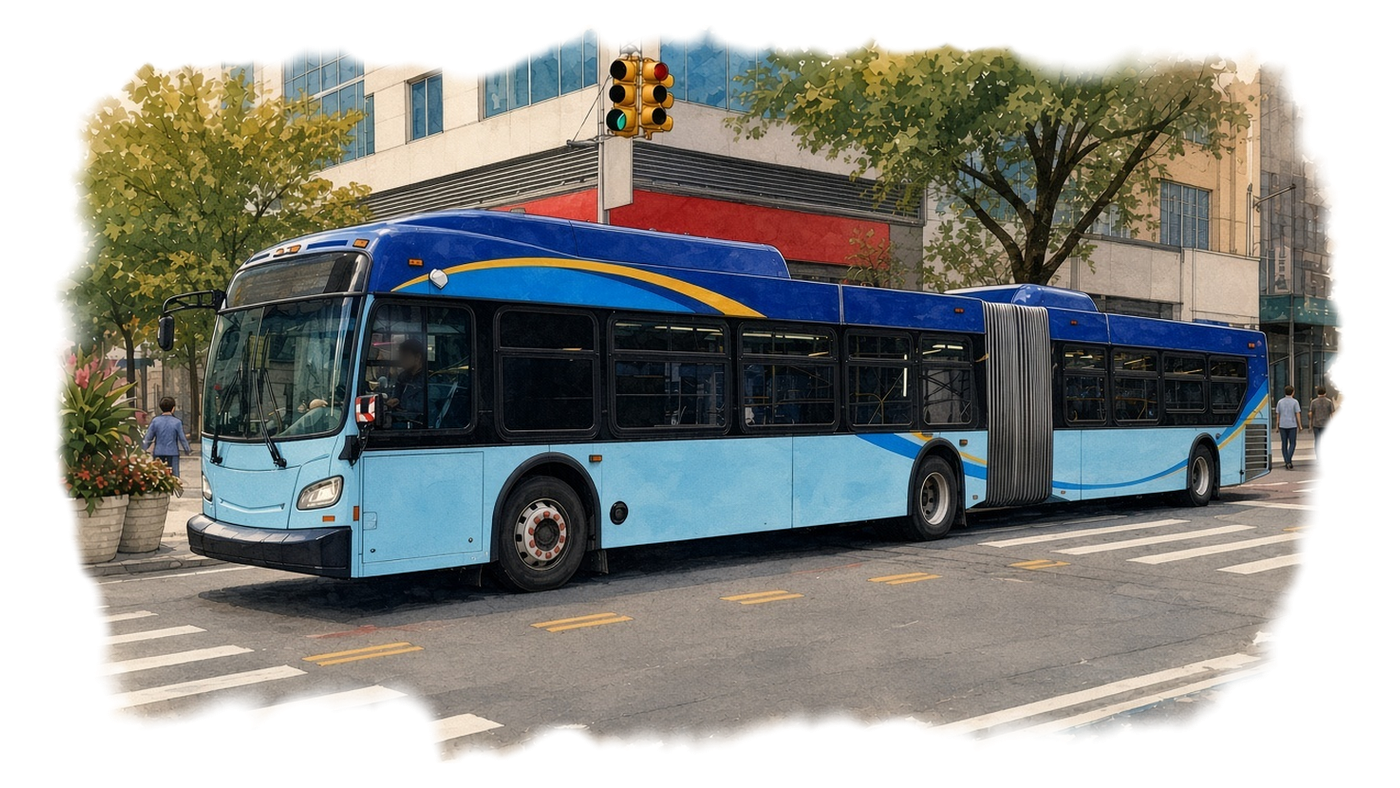
Archive photo: An MTA bus on 14th Street in Manhattan, October 5, 2026.Illustration by The Good Times, based on a photograph by VynedJ (CC BY 4.0).
New York Governor Kathy Hochul allowed New York City to reduce its payment for Metropolitan Transportation Authority bus operations by $200 million for one year, and the transit agency's financial plan says it will cover the shortfall with its own resources. The reduction was recorded in Mayor Zohran Mamdani's Fiscal Year 2027 city budget after a May package of state help for the city's finances. City Comptroller Mark Levine first described a "one-time shift to the State," then wrote in June that the change "was not included in the Enacted State Budget and must be made in the MTA financial plan." The MTA's July Financial Plan says the reduction "will be covered by MTA resources" and that current bus service levels will be maintained. It projects deficits rising to $897 million in 2030 and includes proposed 4 percent fare and toll increases in March 2027 and March 2029 that still require board approval. Reinvent Albany, a government watchdog group, called the move a "backdoor raid." Sean Butler, a spokesman for the governor, said it "has zero impact on bus service for New Yorkers."
A reduction in the city's payment
New York Governor Kathy Hochul allowed New York City to reduce its annual payment for Metropolitan Transportation Authority bus operations by $200 million for one year, and the transit agency has recorded the loss as a shortfall it will cover with its own resources.
The reduction was built into Mayor Zohran Mamdani's first city budget, for Fiscal Year 2027, after Hochul and Mamdani announced $4 billion in additional gap-closing support from the state on May 12. The city's Office of Management and Budget, in a May financial plan reconciliation reported by Reinvent Albany, a government watchdog group, and by Streetsblog, listed a $200 million cut in city spending as "State Aid for MTA." Sean Butler, a spokesman for the governor, later said that "allowing a reduction in New York City's FY27 subsidy of MTA bus service was part of a comprehensive package to address the city's deficit."
The payment is the city's subsidy to the MTA Bus Company, which runs bus routes the city once franchised to private operators. The MTA's July Financial Plan describes those payments as "subsidy payments made by the City of New York to cover the operating deficit of MTA Bus." The plan's tables list the city payment at $732.7 million in 2026, $674.5 million in 2027 and $824.9 million in 2028. Bloomberg also reported the 2026 and 2027 figures.
What the books recorded
Early official descriptions treated the $200 million as a cost the state would take on. In his May economic newsletter, City Comptroller Mark Levine listed a "one-time shift to the State for $200 million in contributions to the MTA in FY 2027." In a June review of the city's financial plan, State Comptroller Thomas P. DiNapoli included, among actions in the state's enacted budget, "funding $200 million in FY 2027 only for city-funded MTA-related costs."
Levine's office later described the item differently. In June 9 comments on the city's executive budget, the comptroller wrote that the May plan "included a one-time $200 million reduction in the City bus subsidies to the MTA for FY 2027." "This change was not included in the Enacted State Budget and must be made in the MTA financial plan and approved by the MTA Board," the comments said. Reinvent Albany reported that it had found no mention in the state budget bills or supporting documents of the city's MTA payments being forgiven or deferred. The group also cited a May 13 radio interview in which Hochul, according to the governor's official transcript, said part of the package was "support for some projects related to the MTA that the state had covered before but had been removed."
The agency covers the shortfall
The MTA recorded the reduction in the July Financial Plan presented to its board on July 29, writing: "The New York City FY 2027 Budget includes a one-time $200 million reduction in the City's subsidy for the MTA Bus Company. The July Financial Plan, consistent with the City's adopted budget, reflects a corresponding one-time reduction in the expected City subsidy reimbursement, which will be covered by MTA resources. Despite the reduction in City reimbursement, the MTA Plan continues to provide the resources necessary to maintain current bus service levels for customers." An August 5 disclosure update likewise said the July plan includes the reduction "in recognition of the City's current fiscal constraints."
Rachael Fauss, a senior policy adviser at Reinvent Albany who wrote the group's report, told City & State, "If the state made the MTA whole and the state paid for that, then it wouldn't have been a raid on the MTA funding. It would have been helping the city and holding the MTA harmless. But that's not what they did." The group called the episode a "backdoor raid," a phrase it said it uses "to describe the diversion of funds legally dedicated to the MTA." Fauss told Streetsblog, "The MTA is not the piggybank of the state and the city whenever they need to find money to pay for some other priority." Reinvent Albany, citing bond documents, said a December 2004 letter agreement requires the city to pay the difference between the cost of operating the MTA Bus system and the revenues and subsidies allocated to it.
Butler, in a statement to Streetsblog, City & State, Bloomberg and the New York Post, said, "No Governor has stepped up to support the MTA and its riders like Governor Hochul. She saved the agency from a fiscal cliff and has made historic investments to improve and expand service." He said the reduction "has zero impact on bus service for New Yorkers."
Hochul, speaking to amNewYork, said the group had "mischaracterized" the maneuver and that the state had filled the hole by deferring the MTA's Tier 6 pension costs. "We made some other structural changes in the longer-term pension benefits and that generated more money back into the MTA immediately," she said. "So they have the resources they need. There's not an expectation that the state was going to go cut a check for $200 million to make up for that. So the money's there, the work's continuing. Everybody can calm down." The MTA's July plan, in a separate passage, estimated that legislative changes to Tier 6 pension benefits would increase the agency's expenses by $120 million over the plan period. Fauss told amNewYork that a short-term deferral of those costs "is gonna come to roost in a few years." The MTA referred a New York Post request for comment to the governor's office. A spokesman for Mamdani's office did not respond to amNewYork.
Deficits and proposed fare increases
The July plan is balanced in 2026 and projects deficits of $295 million in 2027, $507 million in 2028, $707 million in 2029 and $897 million in 2030. For 2026 through 2029, the gaps are a combined $800 million wider than in the February plan. It includes proposed fare and toll changes for March 2027 and March 2029 that would generate annualized 4 percent increases in farebox and toll revenues. Until the MTA Board votes, the plan counts that revenue separately from its baseline. The March 2027 increase is projected to raise $281 million in 2027 and $332 million in 2028. Over the plan period, the two proposed increases are projected to generate $1.86 billion.
Reinvent Albany said the $200 million reduction is commensurate with what riders of New York City Transit buses and subways, MTA Bus and the Staten Island Railway are expected to pay in fare increases in 2027 and 2028, figures the group put at $142 million and $171 million. Fauss told the New York Post, "It's unfair for riders to have a higher burden for the transit system when the state and city are failing to provide funding as required." Betsy Plum, executive director of the Riders Alliance, said, "Raiding public transit funds or trying to balance the city budget on riders' backs makes New York less affordable and erodes trust in our government." The MTA Board is scheduled to meet on November 18, when the agency is expected to release an updated financial plan.
- Reinvent Albany (November 16)
- Streetsblog (November 16)
- City & State (November 16)
- New York Post (November 16)
See all (20)Show fewer
- amNewYork (November 16)
- Bloomberg, via 1010 WINS (November 16)
- The Center Square (November 16)
- MTA July Financial Plan 2027-2030, Volume 2 (July 2026)
- MTA July Financial Plan 2027-2030, Volume 1 (July 2026)
- MTA July 2026 Financial Plan presentation (July 29)
- MTA Annual Disclosure Statement Update (August 5)
- NYC Office of the Mayor, Hochul-Mamdani budget announcement (May 12)
- NYC Office of the Mayor, FY 2027 Executive Budget release (May 12)
- Governor Kathy Hochul, LI News Radio rush transcript (May 13)
- NYC Comptroller Mark Levine, Monthly Economic Newsletter No. 113 (May 2026)
- NYC Comptroller, Comments on the FY 2027 Executive Budget (June 9)
- NYC Comptroller, Comments on the FY 2027 Adopted Budget (August 12)
- Office of the State Comptroller, Review of the Financial Plan of the City of New York, Report 4-2027 (June 2026)
- Office of the State Comptroller, DiNapoli press release on the executive budget (June 17)
- MTA Board, November 2026 meeting page