Turkey and Qatar Sign a Defense Pact
Turkey and Qatar signed a mutual defense agreement pledging a unified stance against any external armed attack on either country, and called for the full resumption of safe passage through the Strait of Hormuz.
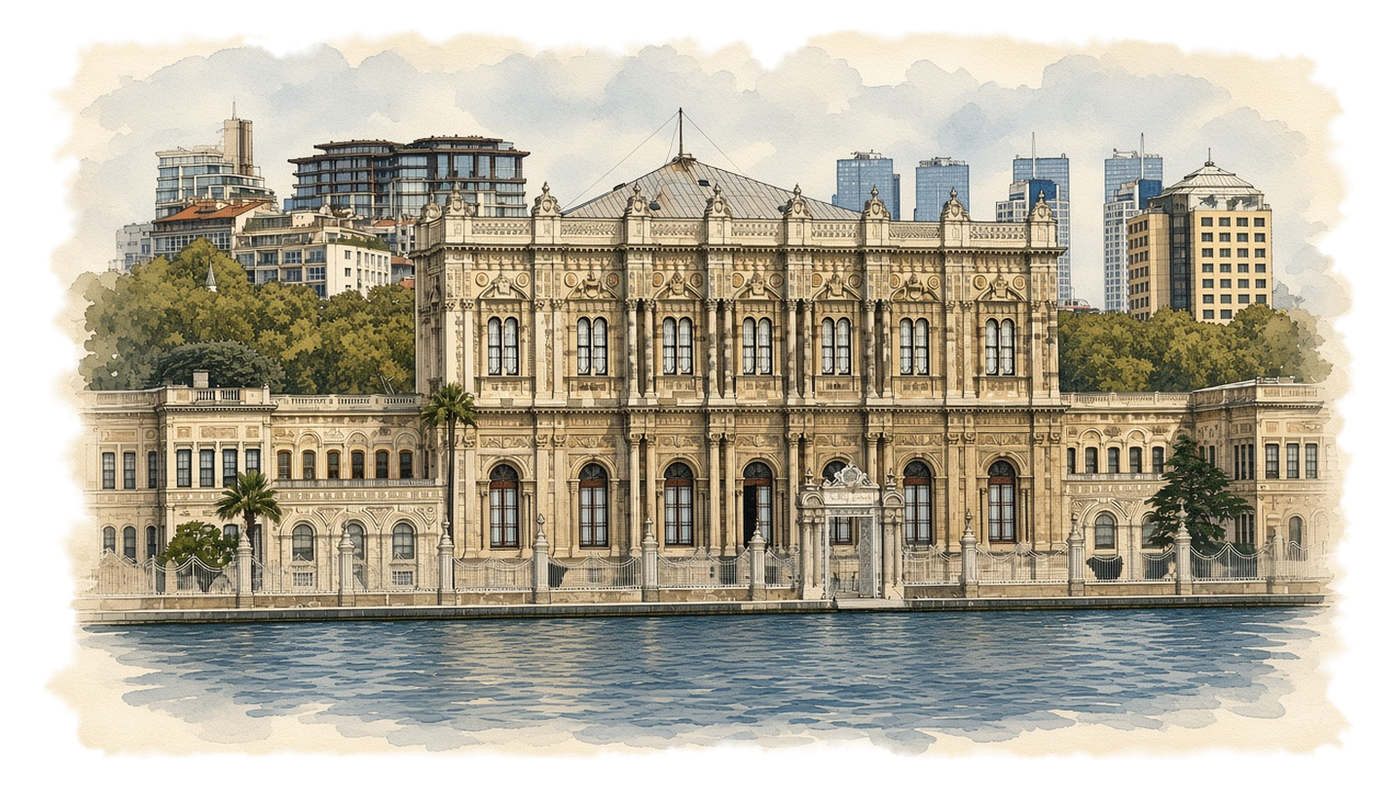
Dolmabahçe Palace on the Bosphorus in Istanbul, August 2026.Illustration by The Good Times, based on a photo by Joseolgon / Wikimedia Commons (CC BY 4.0)
Turkish President Recep Tayyip Erdogan and Qatar's emir, Sheikh Tamim bin Hamad Al Thani, signed a mutual defense agreement in Istanbul on November 13, committing the two countries to "a unified stance in confronting any external armed attack targeting either party or both of them," according to a joint statement issued after their talks. They agreed to consult on threats to their security and to expand joint military exercises, defense-industry cooperation and personnel training exchanges. The statement did not say what would trigger the pact or what form a joint response would take, and the full text of the agreement has not been released. Erdogan's office said the two countries would keep working "to prevent the resurgence of war in the Gulf region." The joint statement said the conflict involving the United States and Iran should be resolved through dialogue and diplomacy, and called for "the swift and full resumption of safe, secure and unimpeded passage through the Strait of Hormuz." The signing is Turkey's second mutual defense agreement this year: on November 5 its parliament approved an August pact with Saudi Arabia and Pakistan under which an attack on one counts as an attack on all.
What was signed
Erdogan and Sheikh Tamim signed the accord at Dolmabahce Palace, at the 12th meeting of the Turkey-Qatar Supreme Strategic Committee, a forum the two countries set up in 2014. The defense pact was one of several agreements signed there; the others cover education, consumer protection and cooperation on peace and conflict resolution. The two sides also issued the joint statement.
The statement said the pact was signed "with the aim of strengthening collective defense and promoting regional security and stability," and that it reflects the two countries' commitment to "safeguarding their sovereignty and territorial integrity" and a "shared vision of contributing to a more secure and stable regional order." It does not, in the published text, commit either side to go to war for the other. The full agreement has not been made public. Arab News, in a Reuters report, said details of the defense accord were not disclosed, and the Turkish presidency's statement on the signing did not provide them, France 24 reported.
Abdulla Banndar Al-Etaibi, an assistant professor of international affairs at Qatar University, told Al Jazeera the aim is not an alliance against any particular country but to raise the cost of any attack so that others are deterred from trying.
Hormuz and a second pact
The two leaders called for "the swift and full resumption of safe, secure and unimpeded passage through the Strait of Hormuz" and said the conflict involving the United States and Iran, and its wider regional repercussions, must be resolved through dialogue and diplomacy, the joint statement said. Erdogan's office, in a statement on X, said he had told his counterpart that the two countries would "continue working together to prevent the resurgence of war in the Gulf region and establish a basis for dialogue and achieve peace."
The statement also welcomed a memorandum, known as Badr, signed by Turkey, Qatar, Pakistan and Indonesia on joint defense production and technology. Turkey's parliament on November 5 approved, by 279 votes to 119, the August 7 defense agreement with Saudi Arabia and Pakistan, under which an attack on one party constitutes an attack on all. A law approving that ratification was published in Turkey's Official Gazette on November 14, Anadolu Agency reported. Arab News and France 24, both citing Reuters, reported that the ratification cleared the way for Ankara to send military support to Saudi Arabia, which has been fending off attacks by Yemen's Houthi militants.
Trade and energy
The two countries' ties also run through construction and energy. Turkish contractors have carried out 206 projects in Qatar worth $20.8 billion, according to the joint statement, and the two governments repeated a target of $5 billion in bilateral trade and said they were ready to pursue closer cooperation on liquefied natural gas.