Germany Hands Spies New Powers
The Bundestag voted to let Germany's foreign intelligence service conduct covert operations abroad, including sabotage and cyber counterattacks, and gave the domestic service new powers, including covert entry into homes.
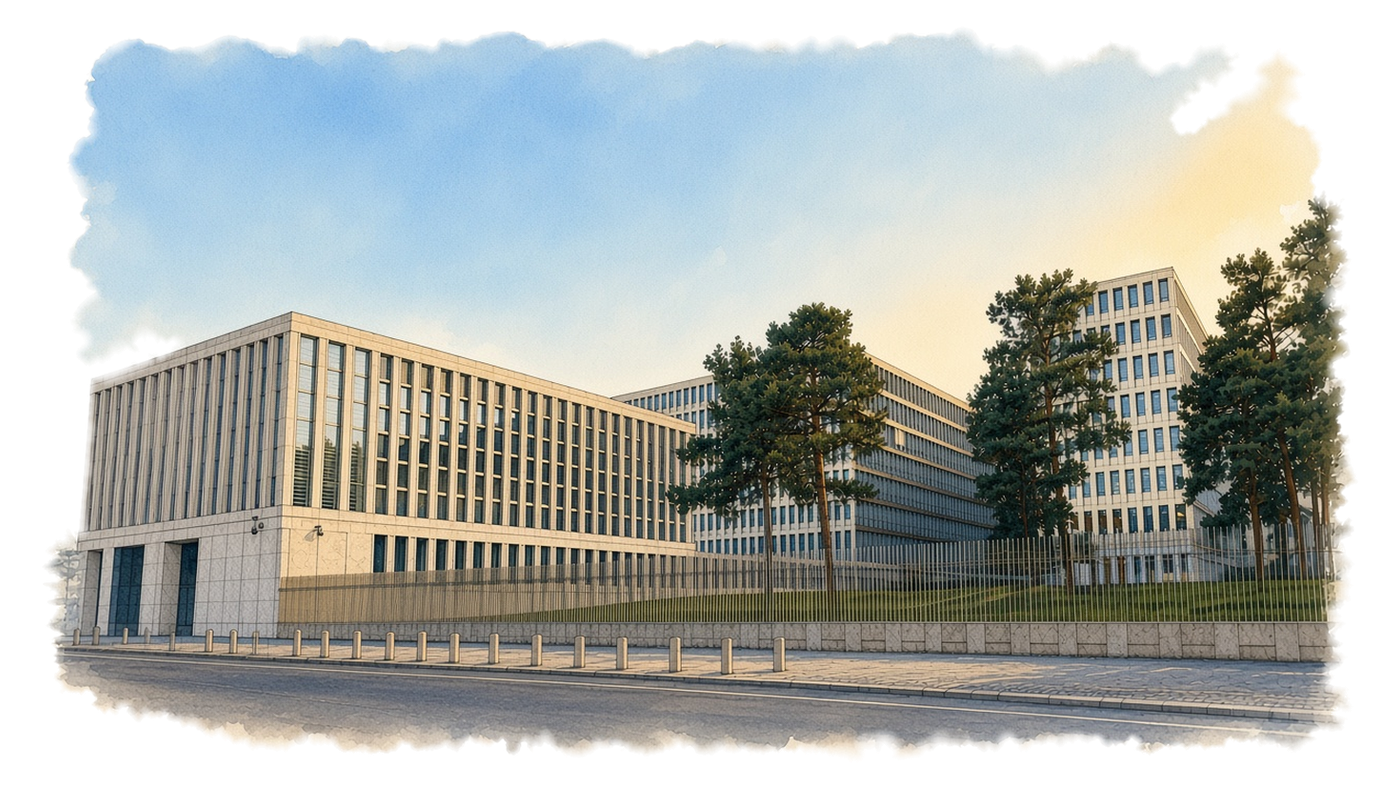
The headquarters of Germany's Federal Intelligence Service (BND) on Chausseestrasse in Berlin, March 2026.Illustration by The Good Times, based on a photo by NutzerAusBerlin / Wikimedia Commons (CC0 1.0)
The Bundestag on November 13 approved an overhaul of Germany's intelligence laws by 308 votes to 190, with 71 abstentions, The Record and Al Jazeera reported. Lawmakers from the governing Christian Democratic Union, the Christian Social Union and the Social Democratic Party backed the legislation, while Alternative for Germany and the Left Party voted against it, Al Jazeera, Tagesschau and Deutschlandfunk reported. The law gives the Federal Intelligence Service, the BND, which handles foreign intelligence, the power to conduct covert operations abroad, including sabotage and cyber counterattacks. The domestic service, the Federal Office for the Protection of the Constitution, may act against property and computer systems when a specific threat is identified, such as disabling explosives or diverting data during cyberattacks. Under certain conditions, agents of both services may enter homes and business premises covertly, with prior authorization. They may not use force against people, and arrests and open searches remain with the police. Interior Minister Alexander Dobrindt called the legislation a "reform of the century," needed because of hybrid threats, particularly from Russia, China and Iran. The main provisions are scheduled to take effect on December 31, Al Jazeera reported. Heise reported that the Bundesrat, the upper house, will consider the bill next.
What Parliament approved
The Record described the legislation as the biggest overhaul of Germany's postwar intelligence laws. Dobrindt, who championed the bill, said it would turn the country's agencies into "genuine intelligence services" operating "on equal footing with our European partners," The Record reported, language he and other officials also used in the debate, according to Tagesschau, Deutschlandfunk and ZDF. "We are the target of hybrid threats," Dobrindt said. "Germany is a theater of operations for terrorism, extremism and foreign powers," the BBC and Spiegel reported.
The government has pointed to an increase in foreign espionage and sabotage, particularly from Russia, China and Iran, the BBC, Tagesschau, Spiegel and Legal Tribune Online reported. In August, authorities found a drone carrying an explosive device at Leipzig Airport, near Ukrainian cargo planes; German officials have said Russia was behind the attempt, the BBC, Al Jazeera and Legal Tribune Online reported. Russia has denied involvement, Al Jazeera reported.
Covert operations and powers at home
Until now, German intelligence services have been limited mainly to gathering information rather than acting on it, the BBC, Deutsche Welle and ZDF reported. The BND may now intervene against threats abroad, including by disabling the servers of state-backed hacking groups, disrupting disinformation networks and interfering with weapons supply chains, the BBC reported. Deutsche Welle reported that the service may answer cyberattacks with counterattacks of its own, from deleting and manipulating data to disabling entire systems and, if necessary, destroying physical weapons such as drones that could be used against Germany. Nina Warken, the chief of the chancellery, who oversees the BND, had earlier said the powers could allow the agencies to use cyber operations to sabotage drone factories or chemical weapons laboratories, The Record reported.
The domestic service, for the first time, may take protective measures against property and computer systems if specific threats are identified, the BBC reported. Those measures include disabling explosives or weapons, blocking or diverting data flows during cyberattacks, deleting or falsifying data stored for malicious purposes, and planting false information, the BBC, Tagesschau and ZDF reported. Legal Tribune Online and n-tv reported that the domestic service may take such steps only if the police cannot avert the danger. Sonja Eichwede of the Social Democratic Party said the service may act only when the police cannot, Legal Tribune Online reported.
Under certain conditions, agents of both services may enter homes and business premises covertly, for example to prepare surveillance operations or to carry them out, Deutsche Welle, ZDF and Heise reported. The BBC reported that covert entry by the domestic service must always be authorized in advance. Heise and Legal Tribune Online reported that particularly intrusive measures, including covert entry into homes in Germany, require prior review by the Independent Control Council, a court-like oversight body. The agencies may not use force against people, Deutsche Welle, The Record, ZDF and Legal Tribune Online reported. Arrests and open searches remain with the police, Tagesschau, Deutschlandfunk, Spiegel and Legal Tribune Online reported.
Both services also gain a legal basis to analyze large data sets with artificial intelligence and to match images biometrically against material found online, the BBC, The Record, Tagesschau and ZDF reported. The BBC reported that the domestic service will have wider powers of digital surveillance, including monitoring encrypted telecommunications and carrying out online searches. The BND will be allowed to retain unsifted data collected abroad, with deletion periods of six months for content and 13 months for metadata, ZDF and The Record reported.
Oversight and opposition
A strengthened Independent Control Council, staffed in part by former judges, is to examine the legality of certain measures before they are carried out, including the new cyber operations, online searches and the bugging of a home, Tagesschau, Deutschlandfunk, Spiegel, The Record and n-tv reported. The Record reported that the council's court-like panel has been doubled, from six members to 12. In urgent cases, the agencies may act first and must then submit the measure promptly to the council; if the council does not confirm its legality in time, the order lapses, Heise and Legal Tribune Online reported. When the cabinet approved the draft in August, ZDF reported that the Bundesrat could send the bill to a mediation committee but that its consent was not required. The committee version of the bill passed by the Bundestag sets December 31 as the date the law takes effect.
Dobrindt dismissed claims that the law would create a new secret police as "madness," the BBC, Spiegel and Legal Tribune Online reported. Clara Bünger, the Left Party's spokeswoman on domestic policy, said he was creating "a new German secret police," the BBC and ZDF reported. Konstantin von Notz, deputy parliamentary leader of the Greens, said he supported the changes for the BND but opposed the law governing the domestic service, Tagesschau and Deutschlandfunk reported. He said the coalition would "have real problems" before the Federal Constitutional Court, Legal Tribune Online reported. The Gesellschaft für Freiheitsrechte, a civil-liberties group, said it was examining a constitutional complaint, arguing that parts of the reform are unconstitutional, n-tv reported.