The Jensen Story So Far
As more than 100,000 people sign a letter asking Nvidia to bring back Jensen Huang, the road behind him runs from a Kentucky dormitory and a San Jose Denny's to the first $5 trillion company.
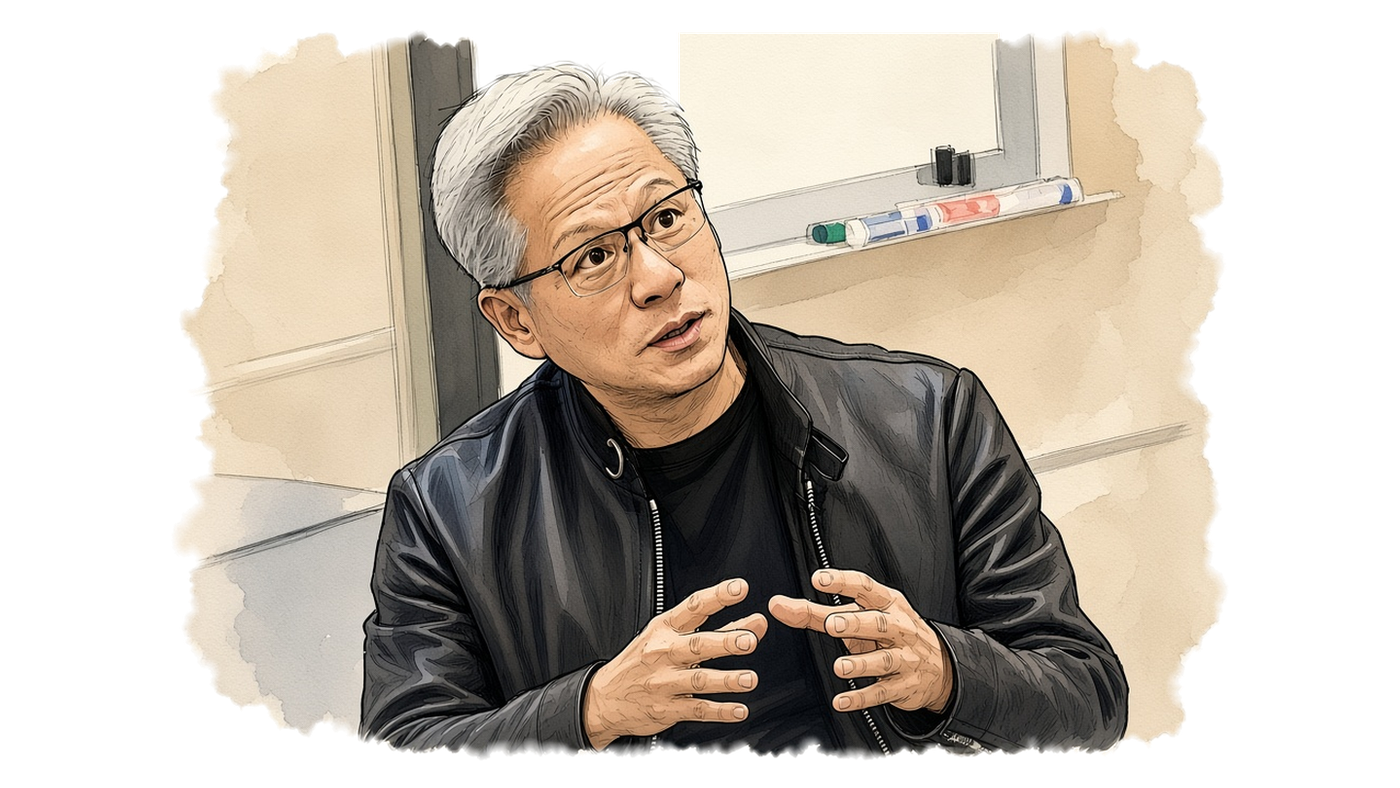
Jensen Huang speaking at Stanford University's CS 153 course, April 2026.Illustration by The Good Times, based on a photo by Anders Eidesvik / Wikimedia Commons (CC BY 4.0)
A volunteer campaign called Stand with Jensen has gathered more than 100,000 names on an open letter asking Nvidia's board to reinstate Jensen Huang as chief executive while an independent investigation runs. Business Insider counted more than 108,000, Elon Musk among them, though affiliations are self-reported and some entries are fake. Nvidia announced Huang's resignation on November 12 without giving a reason. The resignation followed news reports of extramarital relationships, one of them with a woman U.S. intelligence officials reportedly suspect of spying for China. Huang's story starts in Taiwan in 1963. At 9 he was sent to a Kentucky boarding school, where his job was cleaning the bathrooms. He bused tables at a Denny's in Oregon, and in 1993 he co-founded Nvidia at a Denny's in San Jose. The company nearly died in 1996 and survived on a chip called RIVA 128. It launched what it called the world's first GPU in 1999, bet on CUDA in 2006 and became the engine of the AI boom. In October 2025 it became the first company worth $5 trillion. Two large investors have asked the board to keep his return on the table. The board has given no sign either way, and Nvidia reports earnings on November 17.
The letter opens with a line that reads like a eulogy and a demand at once: "Thirty-three years deserve an answer." Posted by a volunteer campaign called Stand with Jensen, it asks Nvidia's board to "bring Jensen back while an independent investigation establishes the facts, unless and until you can provide compelling evidence that his removal is in NVIDIA's best interests." Business Insider's latest count put it at more than 108,000 names. The campaign's site said those included more than 58,000 shareholders, more than 5,600 current Nvidia employees and more than 1,000 former ones. Moneywise, writing on Yahoo Finance, noted that Nvidia had about 42,000 employees at the end of January, so the self-described staff signers would be roughly one in eight. The affiliations are self-reported and unverified. Business Insider found "Tim Cruise, Hollywood actor" and "Xi Jingping" on the list, and the organizers said they were removing fake signatures.
Elon Musk signed. "A petition is underway to reinstate Jensen and I'm signing it too," he posted on X, as Moneywise reported. On November 14 he added that "many of those deals were a handshake with Jensen, not a written contract," and that without him, "at least some of those critical deals will be lost." Separately, Brad Gerstner of Altimeter Capital and Gavin Baker of Atreides Management, whose funds held about $2.13 billion of Nvidia stock as of June 30, according to CNBC, wrote to the board. They asked for a "slow, measured, and deliberate process" that leaves "all options on the table, including the potential return of Jensen Huang." Their letter does not call for him to be reinstated now.
Nvidia announced on November 12 that Huang had resigned as president, chief executive and a member of the board, effective immediately. A securities filing shows the board accepted the resignation the night before. The company gave no reason. The resignation followed reports in The Financial Times, The New York Times and Reuters of extramarital relationships, including one with a woman U.S. intelligence officials reportedly suspect of spying for China, and Huang admitted to an affair, CNBC reported. Colette Kress, Nvidia's chief financial officer since 2013, is interim chief executive. In the company's statement, she said she was committed to "building on the extraordinary foundation Jensen created over the last 33 years." The board's own statement said, "Jensen's contributions to NVIDIA are profound."
That foundation has a beginning, and it is not in Silicon Valley.
Huang was born in Taiwan in 1963. When he was a child his parents were working in Thailand. "In 1973, there was social unrest and my parents decided that it was probably safer for the kids to go to the United States and then for them to follow," he told NPR in 2012. He was 9, and his brother was 10. They went first to an uncle in Tacoma, Washington, who sent them to the Oneida Baptist Institute in the mountains of eastern Kentucky, believing it was a prestigious boarding school, The New Yorker reported. It was a reform academy. "They all had pocket knives," Huang told NPR. Every child worked, and his job was cleaning the bathrooms. His 17-year-old roommate could not read, so Huang taught him, and in exchange, he told The New Yorker, "he taught me how to bench-press. I ended up doing a hundred pushups every night before bed."
He was too young for the academy's classes, so he walked to a nearby public school across a swinging footbridge with missing planks. Local boys sometimes grabbed the ropes and tried to shake him off. "Somehow it never seemed to affect him," a childhood friend, Ben Bays, told The New Yorker. "He just shook it off." By the end of the year, Bays said, Huang was leading those same boys into the woods. "The ending of the story is I loved the time I was there," Huang told NPR. In 2019 he donated a building to the school.
His parents reached the United States after a couple of years and settled in Oregon. There Huang skipped two grades, became a nationally ranked table-tennis player and finished high school at 16, The New Yorker reported. He also worked at a Denny's in Oregon, starting as a dishwasher and moving up to busboy and server. The work, he said in 2023, "teaches you humility, it teaches you hard work, it teaches you hospitality."
At Oregon State University he studied electrical engineering. His lab partner in the introductory classes was Lori Mills, one of perhaps three women among about 250 students. "I looked like I was about twelve," he told The New Yorker. He called her every weekend to do homework together. "I tried to impress her, not with my looks, of course, but with my strong capability to complete homework," he said. After six months he asked her out. They married, and both went to work designing microchips in Silicon Valley. "She actually made more than me," he said. He worked at LSI Logic and Advanced Micro Devices, and he earned a master's degree from Stanford at night.
In 1993, at 30, he sat down at a Denny's in San Jose with two veteran chip designers, Chris Malachowsky and Curtis Priem. He picked it because it was quieter than home and the coffee was cheap. Nvidia's own history dates the founding to April 5, 1993. The three wanted to bring 3D graphics to games and multimedia. Priem wanted rivals "green with envy," so they first called the company NVision, until they learned a toilet-paper maker had the name. Huang suggested Nvidia instead, from invidia, the Latin word for envy, The New Yorker reported. Malachowsky and Priem were older, but they wanted Huang as chief executive. "He was a fast learner," Malachowsky said.
The first product nearly killed the company. Nvidia had designed its graphics around four-sided shapes. Microsoft's new graphics software went with triangles. A contract with Sega to build a console chip was keeping the company alive. "After one year of development, we realized our architecture was the wrong strategy. It was technically poor," Huang recalled in a 2023 commencement speech at National Taiwan University, as CNBC reported. If Nvidia finished the job, it would ship inferior technology. If it stopped, it would run out of money. He told Sega to find another partner and asked to be paid in full anyway. "I was embarrassed to ask," he said. "The CEO of Sega, to his credit and my amazement, agreed. His understanding and generosity gave us six months to live." Business Insider, recounting his December 2025 interview with Joe Rogan, identified that executive as Shoichiro Irimajiri and the lifeline as $5 million.
In 1996 Huang laid off more than half of Nvidia's roughly 100 employees and bet what was left on a production run of an untested chip. "It was fifty-fifty," he told The New Yorker, "but we were going out of business anyway." When the RIVA 128 reached stores in 1997, Nvidia had enough money for one month of payroll. It sold a million units in four months. For years afterward Huang opened staff presentations with the words "Our company is thirty days from going out of business." "The phrase '30 days from going out of business' I've used for 33 years," he told Rogan. "The feeling doesn't change."
Nvidia went public on Nasdaq in 1999. On August 31 of that year it unveiled the GeForce 256 and called it "the world's first graphics processing unit." The chip had nearly 23 million transistors, more than twice as many as Intel's Pentium III, the company said. "The GPU is a major breakthrough for the industry and will fundamentally transform the 3D medium," Huang said in the announcement. He meant games. The GeForce line took off with players of shooters like Quake, who bought new cards with every upgrade.
The bigger bet came next. A Stanford graduate student named Ian Buck had chained 32 GeForce cards together and then found a way to use them as a cheap supercomputer, and Huang hired him. Buck went on to lead CUDA, software that let ordinary GeForce cards do general-purpose computing. "We were democratizing supercomputing," Huang told The New Yorker. When CUDA was released in late 2006, Wall Street balked at the cost. By the end of 2008 the stock had fallen 70%, and downloads of CUDA peaked in 2009 and then declined for three years, the magazine reported. Huang has a phrase for products like that: the "zero-billion-dollar market," a product with no rivals and no obvious customers yet.
The customers turned up in a bedroom. In 2012 Alex Krizhevsky, a student of the computer scientist Geoffrey Hinton, worked with Ilya Sutskever and trained a neural network on two Nvidia GTX 580 cards at his parents' house, The New Yorker reported. Their paper says the training took five to six days. The network, later called AlexNet, beat the field in the ImageNet image-recognition contest by such a margin that the organizers at first wondered whether he had cheated, the magazine reported. "To do machine learning without CUDA would have just been too much trouble," Hinton told the magazine. Huang moved fast. "He sent out an e-mail on Friday evening saying everything is going to deep learning, and that we were no longer a graphics company," Nvidia executive Greg Estes recalled. "By Monday morning, we were an A.I. company."
The bet compounded for a decade. When it became known that ChatGPT had been trained on an Nvidia supercomputer, Nvidia's value rose about $200 billion in a single session in May 2023, The New Yorker reported. That year it passed $1 trillion. In September 2023 Denny's put a plaque over the San Jose booth: "the booth that launched a $1 trillion company." That evening, Nvidia researcher Bryan Catanzaro wrote, Huang served food and drinks to about 100 employees and "balanced ten plates on his arms." On October 29, 2025, Nvidia became the first company in the world worth $5 trillion, the BBC reported.
He ran it his own way. Huang dressed in a black leather jacket, black T-shirt and black jeans. He had about 60 direct reports and held no one-on-one meetings, preferring to give feedback in front of the whole leadership team so everyone could learn from it, Fortune reported. Employees sent him weekly lists of their five most important projects, and he read them late into the night. He believed "failure must be shared." When an early-2000s graphics card shipped with a loud, overactive fan, he did not fire the managers. He had them walk a few hundred colleagues through every decision that led to it. He could be demanding, and he admitted his temper. "I've been afraid of Jensen sometimes," Catanzaro told The New Yorker, "but I also know that he loves me."
He was blunt about what it cost. "Greatness is not intelligence. Greatness comes from character. And character isn't formed out of smart people, it's formed out of people who suffered," he told Stanford students in March 2024. "For all of you Stanford students, I wish upon you ample doses of pain and suffering." Inside Nvidia, he said, he used the phrase "pain and suffering" "with great glee," because "you want to refine the character of your company." He was more modest about himself. "I don't really think I've done anything special here," he told The New Yorker. "It's mostly my team."
What happens next belongs to the board. An independent investigation by its directors was still underway when Huang resigned, CNBC reported, and no findings have been made public. On November 13 the board said it was still choosing a search firm and had not formally engaged any candidates, Moneywise reported. In Washington, the Senate Banking Committee has asked Huang to testify, CNBC and Moneywise reported.
By November 12 the plaque at the San Jose Denny's had come down, NBC Bay Area reported. On November 13 the company said it would put it back. "Jensen Huang started at Denny's as a dishwasher," the company said in a statement. "Years later, he and his co-founders gathered in one of our booths to discuss the idea that became NVIDIA. The plaque commemorates that shared history."
Nvidia reports its quarterly results on November 17, its first without Huang as chief executive. The letter asking for Huang's return is still collecting names. The board has not said whether it will answer.