Starship Reaches Orbit Again
SpaceX's Starship flew to orbit on its 15th test flight and deployed 26 Starlink satellites; the booster's tower catch was called off, and the upper stage was caught by the tower's arms, the first recovery of a Starship upper stage.
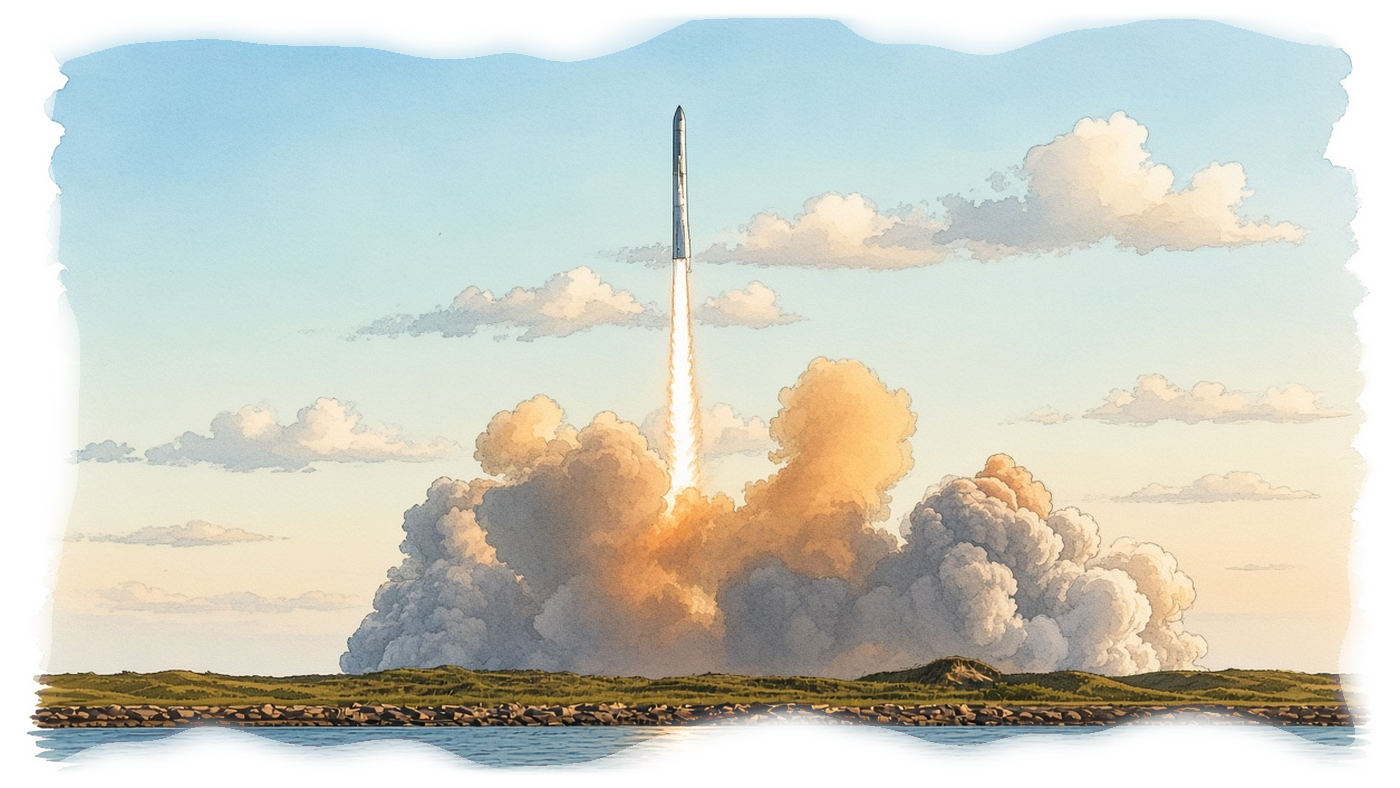
SpaceX's Starship lifts off from Starbase, Texas, on its 11th test flight, October 2025.Illustration by The Good Times, based on a photo by Shujianyang / Wikimedia Commons (CC BY-SA 4.0); the painting is CC BY-SA 4.0
SpaceX launched the 15th test flight of its giant Starship rocket from its Starbase site in South Texas, and the upper stage reached orbit for the second time, about 170 miles up. It then deployed all 26 of the newer Starlink V3 internet satellites it was carrying, Space.com reported. The plan had been to catch both stages with the giant mechanical arms on the launch tower. The Super Heavy booster's catch was called off minutes into the flight and the booster came down in a splashdown in the Gulf of Mexico; SpaceX did not immediately give a reason. The upper stage, Ship 42, completed 14 orbits and was caught by the tower's arms at Starbase around 4:20 p.m. Eastern, Space.com and The Verge reported. It was the first recovery of a Starship upper stage, the step SpaceX needs for a rocket that can be flown again and again. Dan Huot, commentating on the company's webcast, said the flight would be the longest Starship mission yet, lasting past the point at which Flight 14 had to come home.
The launch
Starship lifted off at 5:47 p.m. Eastern under more than 18 million pounds of thrust from the 33 Raptor 3 engines on its Super Heavy booster, Space.com reported. The stages separated about two and a half minutes later, and a second engine burn placed Ship in low Earth orbit at roughly 26 minutes. "We've got a nominal orbit insertion, so Starship now in orbit around Earth for the second time ever," Huot said on the webcast. "That's a really great moment." Ship first reached orbit on Flight 14 on September 28.
The FAA had licensed the flight earlier in the day. The agency told CNBC the license was not affected by the nationwide ground stop it ordered for airline traffic that afternoon. The rocket left the pad after that halt was already in effect.
The booster
SpaceX planned the first catch of a Version 3 Super Heavy booster, Booster 22, with the tower's "chopstick" arms. Instead, the booster was steered to a splashdown offshore about six and a half minutes after launch. "We'll dig in to what caused that abort during its flight back to the tower," Huot said. CNBC and the BBC reported that the booster burst into flames as it came down. The company has caught three earlier-version boosters and flown two of them again.
The satellites
Ship 42 deployed all 26 Starlink V3 satellites over a span of about 42 minutes, beginning 35 minutes after launch and finishing by the one-hour, 17-minute mark, Space.com reported, updating its account at 7:10 p.m. Eastern. Three of the satellites carry cameras pointed back at Ship to inspect its heat-shield tiles after the climb to orbit. SpaceX has said each V3 satellite is meant to add a terabit of capacity, and that one Starship can eventually carry up to 60 of them, about 20 times the capacity of earlier Falcon 9 launches, according to CNBC. This was the second batch of V3 satellites, after 26 flown on Flight 14.
The ship's return
SpaceX said Ship will attempt a return to the launch site only if the flight team confirms that the systems for reentry, the final landing burn and the tower approach are healthy, and it set three checkpoints for an early return to the Pacific Ocean instead. Controllers passed up the first of those, about 90 minutes after liftoff, which would have brought the ship down off Hawaii. "That means this is now going to be the longest Starship mission we've ever flown," Huot said. Ship passed the later checkpoints and, after a 10-second deorbit burn about 21 and a half hours into the flight, was caught by the tower's mechanical arms at Starbase around 4:20 p.m. Eastern, Space.com and The Verge reported. It was the first catch of a Starship upper stage.
A rocket that lands and flies again cuts the cost of each launch. NASA has picked Starship as a crewed lunar lander for its Artemis program, and Space.com reported a demonstration with the Orion spacecraft and Artemis III astronauts in Earth orbit is planned for summer 2027.